
Japanese zelkova
Zelkova serrata
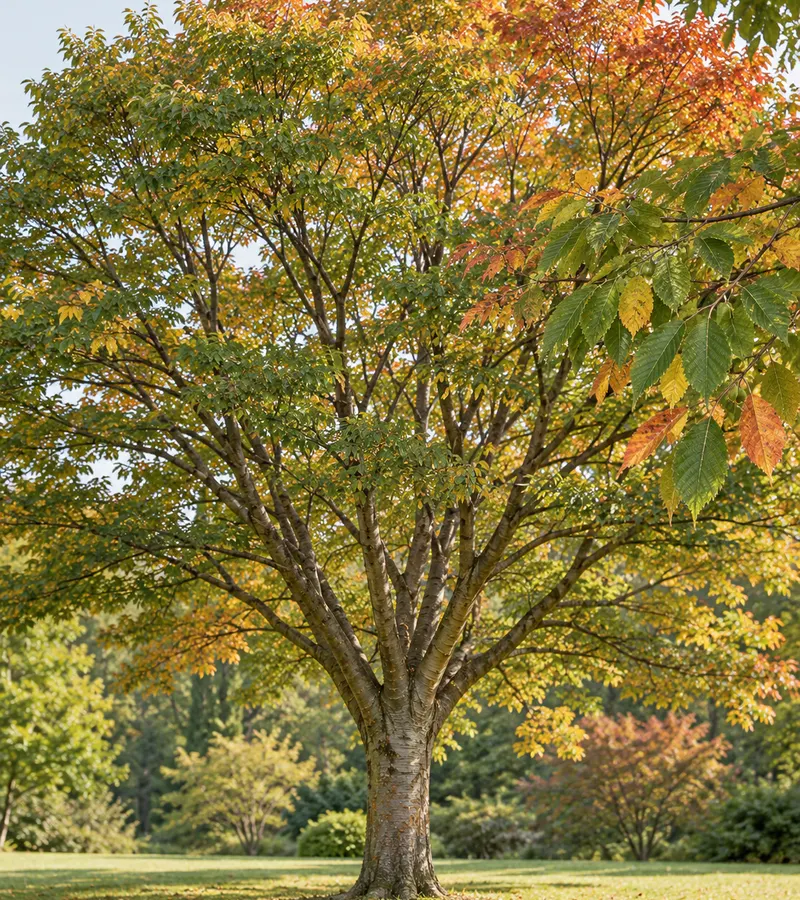
A deciduous elm-family shade tree with saw-toothed leaves and a broad spreading crown, widely planted along streets in temperate East Asia.
Care and placement
Needs full sun (6+ hours), well-drained soil (it takes both acid and alkaline pH) and moderate watering; drought tolerant once established; shape the crown while young. The sources record it only in temperate regions (USDA 5–8) and say nothing about growing it in Vietnam; one source saw it stressed on streets in central North Carolina (USA).
Draft mature dimensions
Maximum height (cm): 1800 cm · Maximum spread (cm): 1200 cm
Things to consider
The sources consulted mention neither toxicity nor allergenic pollen, so the tree is not claimed safe or toxic. Main city risks: it is a large tree with a crown 12 m or more wide, so it needs room; young trees tend to crowd their limbs, which is hard to correct later if the crown is not shaped early; one source records crown dieback and bark cracks on trees along streets and car parks in central North Carolina (USA); and dead leaves can stay on the tree for months.
How to grow and care for it
Planting and pot
Plant in full sun in well-drained soil; acid to alkaline soil is fine. A mature tree is about 18 m tall and 12 m wide, so keep it well away from houses, paving, pipes and overhead lines; the sources give no distances and say nothing about roots, so a site survey is needed before planting. NC State records street and car-park trees under stress in central North Carolina (USA), so compacted soil or a narrow planting pit is a risk. Planting on public land needs permission from the owner or the tree-management authority.
Light
Needs full sun, at least 6 hours of direct sun a day; Wikipedia says it also grows in partial sun. Three sources describe it as heat tolerant, but that is in temperate regions rather than year-round tropical heat.
Watering
Water needs are moderate, with soil moist to occasionally dry; once established the tree is drought tolerant. Young trees need regular watering at first, and the soil must drain well because a long wet season can waterlog the roots; the sources give no detailed amounts.
Feeding
Wikipedia says the tree tolerates nutrient-poor soil, so heavy feeding is not needed. If a tree is weak, apply well-rotted compost around the base and follow the product label; the sources consulted give no specific fertiliser or rate.
Pruning
Virginia Tech notes that young trees need pruning because their limbs tend to cluster; building good branch structure early avoids costly heavy pruning later. The trunk typically divides into several ascending limbs at roughly 2–3 m. For a street tree, keep clear headroom under the crown for people and vehicles.
Propagation
NC State recommends growing it from seed; Wikipedia says stem cuttings and grafting also work. Autumn colour and crown form differ between seed-grown trees, so for an even crown and colour choose a selected cultivar from a reliable nursery.
Pests and common problems
In the city: NC State records trees under stress along streets and in car parks in central North Carolina (USA), with crown dieback and bark cracks, and tags it as intolerant of tough urban conditions. It resists Dutch elm disease and has few pest problems (leafrollers and Japanese beetle are recorded in North America). On some trees dead leaves stay in the crown for months, and small hard fruit ripen from late summer into autumn. Hard cold can kill twig tips. The sources say nothing about roots, scent or pollen, or about growing it in Vietnam or surviving typhoons; NC State only tags it as wind tolerant.
For plentiful, healthy leaves
For a fine canopy: give enough sun, well-drained soil, early crown shaping and a good selection. Leaves are green through summer then turn yellow, orange, bronze-red or maroon in autumn, varying from tree to tree; the smooth grey-white bark flakes in patches to show orange with age. The sources do not say whether it colours well in hot humid regions.