
Small-leaved lime
Tilia cordata
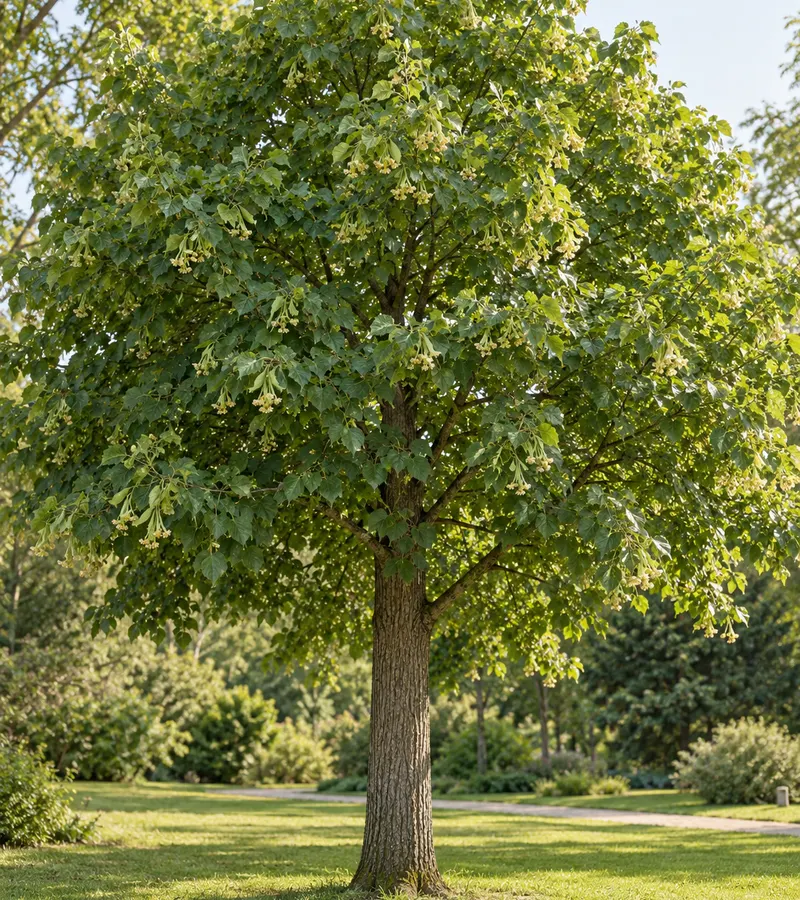
A deciduous tree with heart-shaped leaves and fragrant pale-yellow summer flowers, suited to cool climates with a cold winter.
Care and placement
Needs full sun to part shade, moist well-drained nutrient-rich soil, and room for a crown 15–25 m tall. It is a cold-climate tree (USDA zones 3–7, hardy to −34 °C): no source records it in the hot humid tropics, so there is little basis to expect it to do well in Vietnam's lowlands.
Draft mature dimensions
Maximum height (cm): 1800 cm · Maximum spread (cm): 1300 cm
Things to consider
Aphids on the leaves leave sticky honeydew that dirties leaves, cars and pavement below, and sooty mould follows. Planted in the wrong roadside spot it is prone to leaf scorch, stunting and windthrow. The early-summer flowers draw many bees. No source rates its toxicity for children or pets, so it is not claimed safe.
How to grow and care for it
Planting and pot
Pick a roomy spot in sun to part shade with moist, well-drained soil. The RHS rates it for parks and very large gardens, and NC State warns it is often planted in the wrong roadside spot, leading to stunting, leaf scorch and windthrow. The Milton Keynes (UK) street-tree specification, for the cultivar 'Greenspire' with a 10–12 m crown, asks for at least 7 m from buildings, at least 1 m from the kerb edge, a pit of at least 1.2 × 1.2 × 0.9 m and root barriers when within 1.2 m of underground services or kerbs. No source gives a distance from overhead lines, so that needs a site survey. Planting on a pavement or public land needs the owner's or the authority's permission.
Light
It takes full sun (6+ hours of direct sun) to part shade (2–6 hours); the RHS advises shelter from cold winds. It is a USDA zone 3–7 tree hardy to −34 °C, meaning it prefers a cool climate with a cold winter. No source records it in the tropics; in hot dry weather it is prone to spider mites and leaf scorch, so it is very unlikely to suit the year-round hot humid lowlands of Vietnam. The sources also do not say whether it strictly needs a cold winter to survive.
Watering
It likes moist, well-drained soil and does not tolerate severe drought: NC State says to water in dry spells, especially young trees, while Wikipedia notes it is not considered drought resistant but survives flooding. The RHS lists susceptibility to Phytophthora root rot, so avoid soil that stays waterlogged. The sources give no amounts of water.
Feeding
The sources give no feeding schedule. The Woodland Trust says it grows best in moist, well-drained, nutrient-rich soil, so well-rotted organic matter at planting plus a mulch is a sensible way to build that soil; mature trees usually need no extra feeding.
Pruning
It tolerates heavy pruning (NC State), and the RHS says it suits coppicing, pleaching and pollarding; the natural crown is a regular rounded shape that needs little shaping. Prune while young to build a strong framework, and leave work on tall trees to tree-care crews.
Propagation
NC State says it is mostly propagated by grafting stem cuttings onto rootstock; the RHS advises seed (stratified in containers outdoors in spring) or chip budding, where the rootstock choice needs care. The Woodland Trust notes it may sucker from the base. Buy a grafted young tree from a nursery rather than propagating your own.
Pests and common problems
Aphids feed on the leaves and drip sticky honeydew onto pavements, cars and the leaves below, after which sooty mould grows (RHS, Woodland Trust); the cultivar 'Greenspire' is described as giving little honeydew. It can also suffer Japanese beetles skeletonizing foliage, scale, spider mites in hot dry weather, root rot, Verticillium wilt (uncommon but can kill) and honey fungus and powdery mildew. The sources give no figure for leaf drop and say nothing about storm breakage, so large trees in typhoon-prone places need an arborist's check.
For plentiful, healthy leaves
For a tidy crown and plenty of fragrant flowers: plant in a cool place in sun to part shade, in moist humus-rich soil, and water in dry spells. The pale-yellow, richly scented flowers open in clusters from June to early July in North America and draw bees; that is the tree's best feature where the climate suits it.