
Xanadu philodendron
Thaumatophyllum xanadu
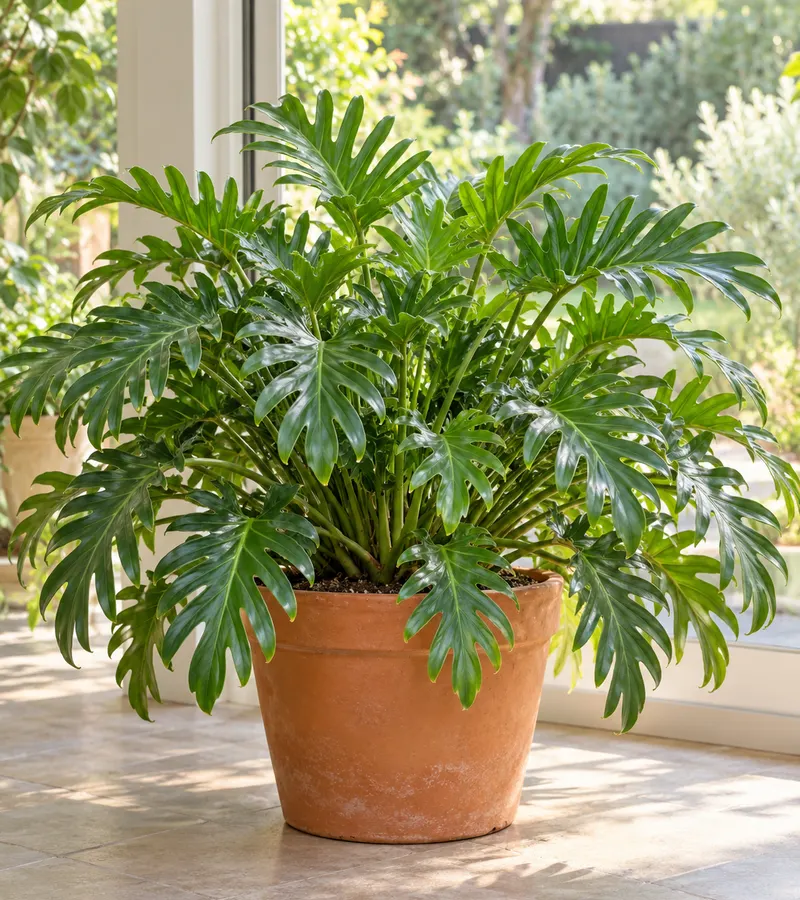
A compact, self-heading philodendron with glossy, deeply lobed green leaves; every part can irritate and is poisonous if eaten.
Care and placement
Needs medium to bright indirect light, a loose well-draining mix kept slightly moist and about 18–30 °C, never below 13 °C; repot every 1–2 years.
Draft mature dimensions
Maximum height (cm): 120 cm · Maximum spread (cm): 120 cm
Things to consider
Every part contains calcium oxalate crystals; chewing or swallowing can cause swollen lips and mouth, pain and drooling, and the sap can irritate skin. Keep away from children, cats and dogs; wear gloves when pruning or repotting and wash hands afterwards.
How to grow and care for it
Planting and pot
Plant in a pot with drainage holes using a loose, humus-rich mix, for example rice husk, charcoal or coir blended with soil, without packing it down. Choose a pot only slightly wider than the root ball and repot every 1–2 years once roots fill it. On a balcony use only a roofed, shaded spot away from afternoon sun and driving rain.
Light
Indoors it needs medium to bright indirect light near a window, with no harsh direct sun that scorches and bleaches the leaves. In a dark spot the plant stretches and the gaps between leaves grow to several centimetres. No source gives a minimum lux, and a windowless room needs a plant grow light on for many hours a day.
Watering
Keep the mix slightly moist but never soggy: feel the top 2–5 cm and, once it is dry, water thoroughly and empty the saucer. Overwatering turns leaves yellow and rots roots, while too little makes them wilt. Dry air invites spider mites, so mist or group it with other plants.
Feeding
In the warm season feed a diluted balanced N-P-K fertiliser, slow-release granules or a thin layer of organic pellets about every two weeks. Do not overdose, which burns leaves, and ease off when growth slows in cooler weather.
Pruning
Cut old or yellow leaves off close to the stem, since older leaves yellowing is natural. Wipe dust away with a damp cloth and check both leaf surfaces regularly to catch pests early. Always wear gloves, because the sap irritates skin.
Propagation
Stem cuttings: cut a section of stem, keep only a few leaves near the tip and set it in moist mix, and roots form in a few weeks. You can also divide the clump at repotting, keeping as much root as possible.
Pests and common problems
Spider mites in dry air, aphids and mealybugs are common; NC State also lists scale, thrips and fungal leaf spots. Yellowing at the top usually means too much water, and scorched, bleached leaves mean harsh sun. Waterlogging leads to root rot, so empty excess water from the saucer.
For plentiful, healthy leaves
For a full, glossy clump: bright indirect light, even watering, regular feeding, wiped leaves and a bigger pot when roots crowd. Indoors it rarely flowers, so the value is the lobed foliage in a tidy mound.