
Tamarind
Tamarindus indica
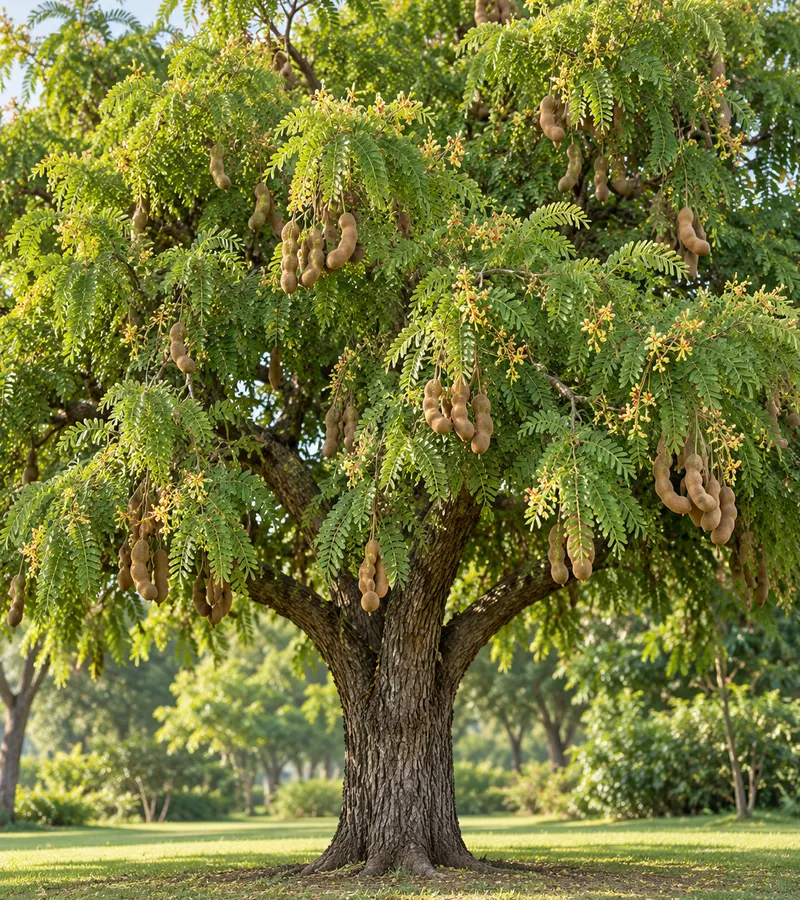
A broad crown of fine feathery leaflets and sour pods used in cooking; wind-firm and drought-tolerant once established.
Care and placement
Needs full sun and well-drained soil (best in moist, fertile sandy soil); very drought-tolerant once established and very wind-resistant, but frost-tender and with low salt tolerance, so not for the beachfront. Grows to 12–20 m with a wide crown and should be trained to one central trunk while young; the pods make litter; propagated by seed, cuttings or grafting.
Draft mature dimensions
Maximum height (cm): 1500 cm · Maximum spread (cm): 1200 cm
Things to consider
PFAF lists no known hazards, but there is no official toxicity rating for cats, dogs or children, so it is not claimed safe for them; eat the fruit only once the tree is correctly identified and the pods are washed. In a city the main risks are its great size (UF/IFAS 40–65 ft, about 12–20 m, with a 12–15 m crown), brittle pods that drop on pavements and make a mess, dense shade that suppresses other plants beneath it, and the need for pruning to build a strong trunk.
How to grow and care for it
Planting and pot
Pick a sunny site with room for a 12–15 m crown and loose, well-drained soil at pH about 5.5–6.5. UF/IFAS lists it for streets without sidewalks, grass strips wider than about 1.8 m, parking islands over about 18 m² and highway medians, and rates roots as not a problem, while PFAF describes an extensive root system with a deep taproot; distance from buildings, pipes, pavements and overhead lines therefore still needs a site survey. Avoid the beachfront because salt tolerance is low. Planting on public land needs permission from the owner or the street-tree authority.
Light
Needs full sun: UF/IFAS lists it as sun-loving and PFAF says it cannot grow in shade. The fine feathery leaves cast dappled shade (UF/IFAS says enough sun reaches lawn beneath, while PFAF says the dense shade stops grass growing). It is very sensitive to frost and suits hot regions, including dry ones.
Watering
Very drought-tolerant once established (UF/IFAS rates it high); NTBG says the leaves may shed briefly in very dry areas in the hot season. It grows slowly (PFAF: seedlings gain about 60 cm a year), so water a newly planted tree regularly until it roots in, then rely mostly on rain; avoid places where water stands, because it prefers free drainage.
Feeding
UF/IFAS says it grows best in moist, fertile sandy soil but tolerates many soil types; PFAF notes the roots form nitrogen-fixing nodules. The sources give no feeding schedule: use a base dressing of well-rotted compost at planting and feed lightly afterwards only if growth is slow.
Pruning
UF/IFAS says pruning is needed for strong structure: keep the main branches well spaced along one central trunk. Shape the crown while the tree is small so large cuts are avoided later; leave a big tree near houses or wires to a qualified arborist.
Propagation
Seed germinates readily: PFAF advises soaking it for 24 hours in warm water and sowing at about 21 °C for roughly 90% germination in 40–50 days, and Vietnamese Wikipedia also mentions nicking the seed to help it sprout. Cuttings work too; for dependable fruit, UF/IFAS recommends air-layering, grafting or shield-budding.
Pests and common problems
UF/IFAS lists both leaves and fruit as litter: the brittle velvety pods drop onto sidewalks and streets and are sticky and messy for a short time. The tree is very tall and its dense shade suppresses growth beneath (PFAF also mentions allelopathic effects on other plants). UF/IFAS reports no serious pests or diseases and branches that resist wind and breakage, but it suits only frost-free regions and should not be sited near the beach. The sources say nothing about pollen or scent.
For heavy fruiting
For plenty of fruit: give full sun, moist well-drained soil and an open, well-shaped crown. UF/IFAS recommends air-layering, grafting or budding for dependable quality fruit; seedlings may differ from the parent.