
Big-leaf mahogany
Swietenia macrophylla
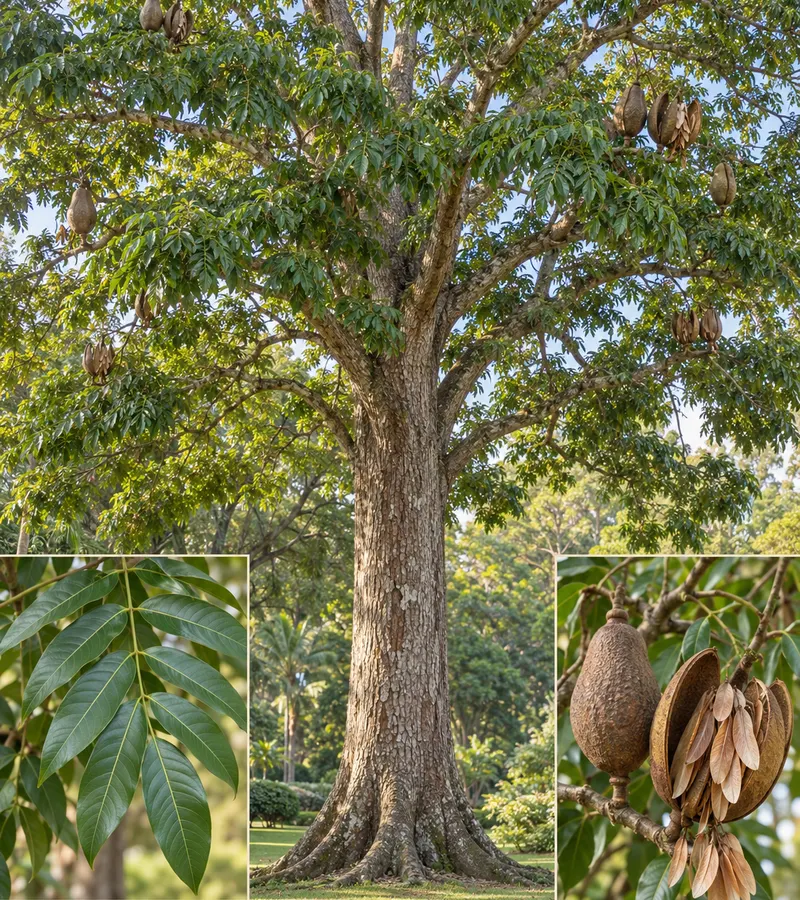
A large mahogany-family tree with pinnate leaves and upright woody capsules, giving a broad crown but needing open space.
Care and placement
Needs full sun once grown, deep fertile well-drained soil kept reasonably moist, and tolerates drought and storm wind fairly well; the tree is very large with strong roots so it needs open ground away from structures; propagated by fresh seed.
Draft mature dimensions
Maximum height (cm): 2500 cm · Maximum spread (cm): 1500 cm
Things to consider
Wikipedia notes reports of liver injury after eating raw seeds or capsules and PFAF says the seed oil is very bitter and purgative; the sources give no toxicity rating for cats, dogs or children, so it is not claimed safe. Do not eat the seeds or capsule husks or use them as medicine, and keep children and pets from chewing the seeds. In a city, mind the very large tree, its strong roots and the woody capsule husks that fall under the crown.
How to grow and care for it
Planting and pot
Plant only in wide spaces such as parks, broad avenues with a wide median or large grounds: a Vietnamese source gives 20–30 m tall, and PFAF says a fully grown tree can reach and spread about 35 m. A Vietnamese source warns that the strong roots can damage nearby structures; the sources give no safe distance from buildings, pipes, pavements or overhead lines, so a site survey is needed before planting. Planting on public land needs permission from the landowner or the tree authority.
Light
Young trees tolerate shade, but larger trees need full overhead light. It is common across Vietnam, especially in the south, and sheds its leaves briefly around January–February according to a Vietnamese source. PFAF places it in USDA zones 10–12, so it does not suit frosty places.
Watering
PFAF says it prefers moist soil, and a Vietnamese source says it tolerates drought well once established. Water young trees regularly in the dry season until the roots go deep.
Feeding
It likes deep, fertile, well-drained soil at about pH 6–8.5 and tolerates heavy clay. The sources give no fertiliser rates; mix well-rotted organic matter into the hole and feed lightly while young.
Pruning
The sources give no pruning schedule for this tree. As general practice, keep one straight main trunk and remove crowded branches while it is small; a large tree with a high crown should be handled by a trained arborist wearing gloves and protective gear.
Propagation
Propagate by seed: fresh seed needs no treatment, stored seed is soaked in warm water for 12 hours. Sow under about 3 cm of soil; seed germinates in 10–17 days at over 90%, and seedlings should be shaded until they are 50–100 cm tall.
Pests and common problems
In the city: the tree is very large and its strong roots can damage nearby structures; leaf and fruit litter needs seasonal clearing; and the big woody capsule husks (8–20 cm long, up to 40 cm in one source) fall once split, so avoid parking bays or busy walkways right under the crown. PFAF says it tolerates strong winds and resists cyclones and a Vietnamese source says it tolerates storm wind fairly well, but PFAF also says it does not tolerate maritime exposure while the Vietnamese source says it tolerates salt fairly well, so the sources disagree. PFAF notes pinhole borers spoil the wood. It may invade native forest after disturbance, so do not plant it near conservation areas. It is listed Endangered by the IUCN and in CITES Appendix II (Neotropical populations).
For plentiful, healthy leaves
For a handsome crown: give full sun, deep well-drained soil and regular watering while young. The pinnate leaves, up to about 45 cm long with several pairs of glossy leaflets and no terminal leaflet, give a broad, rounded, open crown.