
Stevia
Stevia rebaudiana
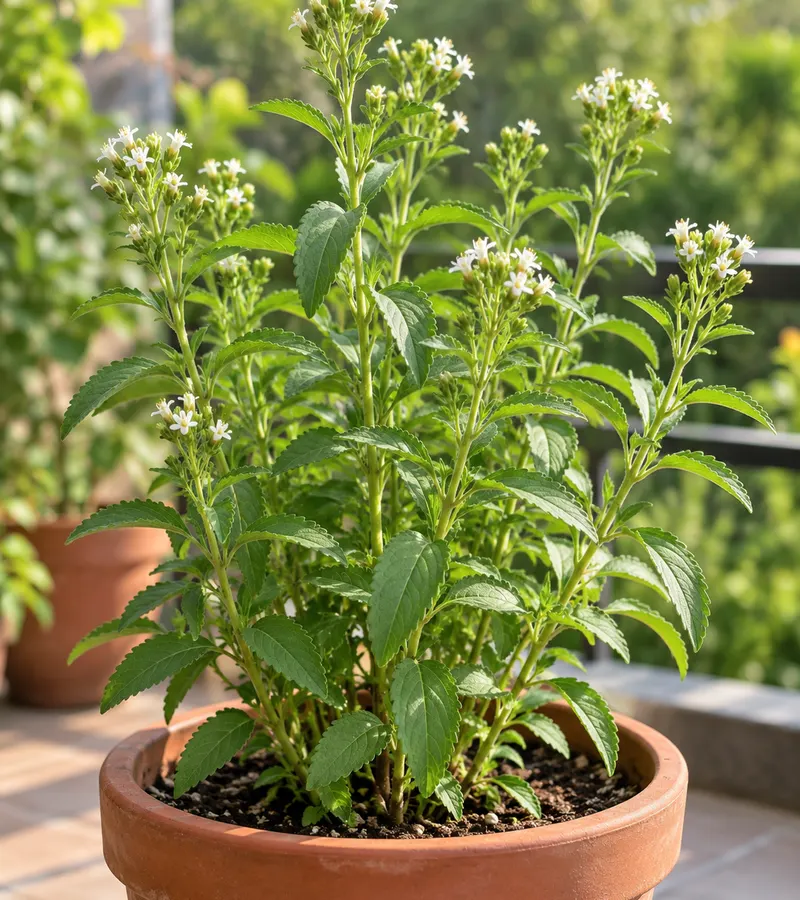
A small herb whose sweet leaves flavour tea and drinks in place of sugar; it needs full sun and moist soil and cannot take frost.
Care and placement
Needs full sun (PFAF: it cannot grow in shade) and well-drained sandy soil with a pH from mildly acid to mildly alkaline, kept moist. It is frost tender (USDA 8–11) and grown as an annual in cold climates. Wikipedia: native to Paraguay and Brazil.
Draft mature dimensions
Maximum height (cm): 50 cm · Maximum spread (cm): 30 cm
Things to consider
PFAF says it may cause dizziness, headache, flatulence, nausea and muscle pain, with caution for diabetic patients and people on blood-pressure-lowering drugs. Wikipedia says the WHO's JECFA allows a daily intake of up to 4 mg of steviol glycosides per kg of body mass, while in 2019 the US FDA placed an import alert on stevia leaves and crude extracts over safety concerns. No rating exists for dogs, cats or young children. PFAF rates its medicinal use 0/5 and records no traditional medicinal uses, so this is a sweet culinary herb, not a medicine.
How to grow and care for it
Planting and pot
Choose a full-sun spot with well-drained sandy soil, or a pot at least 25 cm deep (our inference). PFAF: it grows about 0.5 m tall; in cold climates plant out only after the last frost. In Vietnamese uplands with frost, use a pot and bring it somewhere warm (our inference).
Light
Needs full sun: PFAF says it cannot grow in shade. In too little sun it stretches and the leaves pale (general practice; the sources do not say).
Watering
PFAF: it prefers moist soil. Keep the soil evenly moist but draining, watering when the top layer dries and never letting the pot stand in water (our inference). PFAF also says to keep the compost from drying out while seedlings start.
Feeding
The sources I read give no feeding schedule. Use sandy soil with well-rotted organic matter and feed lightly to the label, avoiding heavy nitrogen if you want sweet leaves (general practice; the sources do not say).
Pruning
The sources do not cover pruning. Pick the tips often to encourage branching (general practice); remove flower buds early so the leaves stay sweeter (general practice; the sources do not say).
Propagation
PFAF: by seed only, sown in spring somewhere warm, barely covered, with the compost kept moist, then pricked out and planted out after the last frost. PFAF's propagation section does not mention cuttings, so buy a healthy young plant.
Pests and common problems
The sources I read name no pests or diseases. The biggest problems are frost and soil that is dry or waterlogged; yellowing and dropping leaves usually signal one of the two (our inference). Wash the leaves before use.
For a bigger harvest
PFAF: leaves are used fresh, cooked, or dried and ground, and steeped to sweeten preserves or tea. Wikipedia: the Guaraní have sweetened teas with the leaves for hundreds of years. Use it in moderation and watch how you feel, especially if you have diabetes or take blood-pressure-lowering drugs.