
Siamese senna
Senna siamea
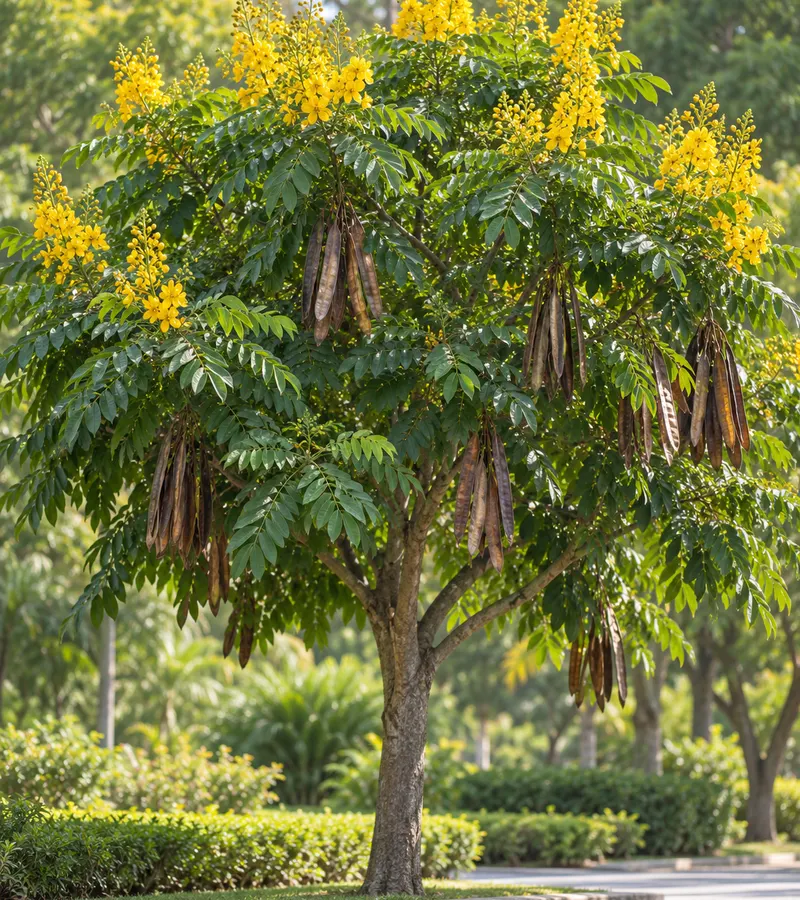
An evergreen with a dense rounded crown and sprays of yellow flowers at the branch tips, often planted for shade along roads and in school yards.
Care and placement
Needs full sun and deep, well-drained soil at pH 5.5–7.5; copes with a dry season of a few months but not waterlogging, salt or cold below 10 °C; the wide-ranging surface roots need open space and the crown needs pruning to stay tidy.
Draft mature dimensions
Maximum height (cm): 1200 cm · Maximum spread (cm): 1200 cm
Things to consider
The leaves, flowers and pods contain toxins: PROSEA calls them highly toxic to non-ruminants such as pigs and poultry, and PFAF says parts are poisonous if eaten; young leaves and pods are only eaten after boiling with the water changed three times. Sawdust and the yellow powder from the wood can irritate the nose, throat, eyes and skin. It grows fast, seeds heavily and is treated as invasive in some places, so do not let seed spread into forests and river banks.
How to grow and care for it
Planting and pot
Choose a sunny spot with deep, fertile, well-drained soil at pH 5.5–7.5 (PROSEA). A dense mat of rootlets forms in the top 10–20 cm of soil and can spread about 7 m in a year and eventually up to 15 m (PROSEA), so do not plant against pavements, pipes, buried cables or foundations; the exact distance needs a site survey. Feedipedia says it is easily uprooted by strong wind, so it needs open ground for its roots rather than a narrow paved-in strip. Planting on public land needs permission from the tree authority or the land owner. It suits the lowland monsoon tropics, is killed by frost and does not tolerate temperatures below 10 °C (Feedipedia), and grows poorly above 1,300 m (PROSEA), so it is not for cold highlands.
Light
It is a full-sun species (Feedipedia, PFAF). PFAF says the tree tolerates semi-shade, but seed germination drops sharply with even slight shade. Being evergreen, it keeps its leaves all year.
Watering
The dry season should not last longer than 4–8 months, and in semi-arid areas (500–700 mm of rain) it only survives where roots reach groundwater (PROSEA, PFAF). It prefers moist soil and grows poorly when drainage is bad. Water young trees through their first dry season and avoid standing water in the rainy season.
Feeding
The sources give no specific fertiliser rates. PROSEA says it does best on deep, well-drained, fertile soil and still survives on degraded lateritic soil if drainage is not impeded. Mix rotted organic matter into the planting hole and add more around the edge of the canopy at the start of the rainy season. Young trees need weeding around the base for the first 1–2 years (PROSEA).
Pruning
PROSEA says that without careful pruning the crown turns straggling and misshapen, while the tree tolerates coppicing, lopping and pollarding well. For a city tree, prune regularly to keep the crown balanced and thin it before the storm season; leave this to licensed crews, especially near power lines. Wear a mask, goggles and gloves when sawing, because the sawdust irritates the nose, throat and eyes (PFAF).
Propagation
Propagate by seed; the coat is hard, so soak seed in near-boiling water and then in warm water for 12–24 hours or abrade the coat, and sow in full light. Treated seed germinates at about 90% within 60 days (PFAF). Seedlings are transplanted at 25–40 cm tall, about 8–12 weeks after germination (PROSEA), and seed-grown trees flower and fruit after 2–3 years (PFAF).
Pests and common problems
The main recorded pests and diseases are caterpillars feeding on leaves and shoot tips (reported in Vietnam), Ganoderma wood rot in young trees in Indonesia and Phaeolus root damage (PROSEA). In a city, the wide-ranging roots can compete with structures and other plants; Feedipedia says the tree is easily uprooted by strong wind, so the risk of falling in a storm is real, especially when the roots are cut or paved over; the sources say nothing about allergenic pollen or scent. The flat 20–30 cm pods and seeds drop to the ground and spread readily, so the tree is considered invasive in Australia, Mexico, the Caribbean, the Pacific and Africa. It does not tolerate salt (PROSEA, PFAF), so it is unsuited to saline coastal soil.
For plentiful, healthy leaves
For a dense, green, fast crown: give full sun, deep well-drained soil, keep it moist through the first dry season and prune for an even shape. Feedipedia records growth of up to 2.5 m a year in India. The yellow flowers open in large clusters at the branch tips, and seed-grown trees can flower after 2–3 years (PFAF).