
Dragon fruit
Selenicereus undatus
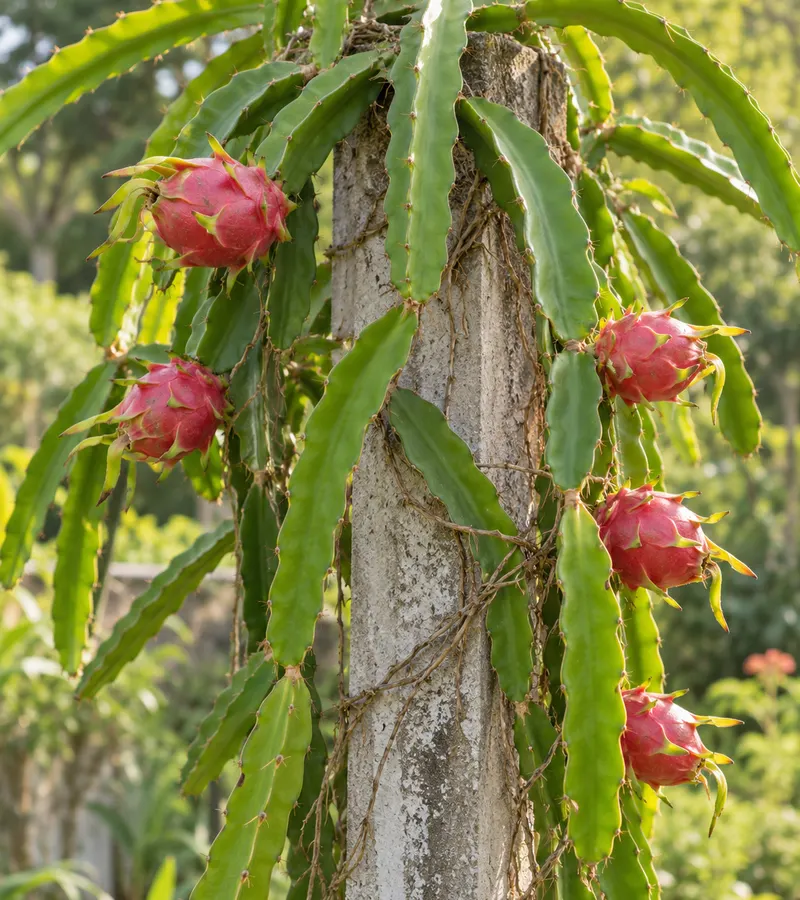
A climbing cactus with aerial roots, huge white night flowers and red fruit with white flesh; drought-tolerant but spiny.
Care and placement
Tolerates full sun to part shade and well-drained soil, even poor soil, with a preferred pH of 5.3–6.7 (PFAF). Drought-tolerant, with best daytime temperatures of 18–28 °C and 12–34 °C tolerated (USDA 10–12); PFAF notes rainfall of 300–3,500 mm. A climbing cactus with aerial roots and stems up to 7 m, so it needs a post or frame.
Draft mature dimensions
Maximum height (cm): 400 cm · Maximum spread (cm): 200 cm
Things to consider
PFAF warns that it has spines or sharp edges and needs extreme caution when handled (Wikipedia: spines 1–4 mm long on adult branches). No official toxicity rating exists for children, dogs or cats, so it is not claimed safe. The long, heavy climbing stems need a very strong post, and it should not stand near narrow paths, gates or play areas.
How to grow and care for it
Planting and pot
Pick a sunny or part-shade spot with free drainage (a large draining pot also works). Erect a very strong post or frame first, since stems reach 7 m (PFAF) and Wikipedia says it can climb 10 m or more. Leave room for the stems to spill around the top and keep thorns away from paths.
Light
PFAF: grows in part shade or full sun. Where the sun is fierce, shade a young plant at midday (our inference; the sources do not say); it needs light to flower.
Watering
PFAF: it prefers dry or moist soil and tolerates drought, with suitable rainfall of 300–3,500 mm a year. Water sparingly, only once the soil is dry deep down, and make sure it drains; waterlogging is the main risk for a cactus (our inference).
Feeding
The sources give no feeding schedule. PFAF says it tolerates nutritionally poor soil, so add well-rotted organic matter at planting and feed only lightly to the label when it buds (general practice; the sources do not say).
Pruning
The sources do not cover pruning. Thin old, straggly and ground-touching stems for air and easy picking; wear thick gloves and eye protection because of the spines (PFAF). Cut stems can be used as cuttings.
Propagation
PFAF: by seed or stem cuttings; cuttings are usually dried for one to two weeks before planting. The plant is self-fertile but cross-pollination improves fruit set; the night flowers are pollinated by bats and moths, and PFAF recommends hand pollination for good yields.
Pests and common problems
The sources I read do not name the main pests and diseases. For a cactus, waterlogging and stem rot are the usual risks: if a stem turns soft, cut away the damaged part and keep the soil drier (our inference). The spines are the main safety risk when tending it.
For heavy fruiting
For fruit: enough sun, a strong post, sparse watering and hand pollination on the night the flowers open. PFAF: it often fruits 1–3 years after planting, with harvest about 30–50 days after flowering and 4–6 fruiting cycles a year. Fruit is 7–12 cm long; Wikipedia says the scented night flowers are 25–30 cm long.