
Rain tree
Samanea saman
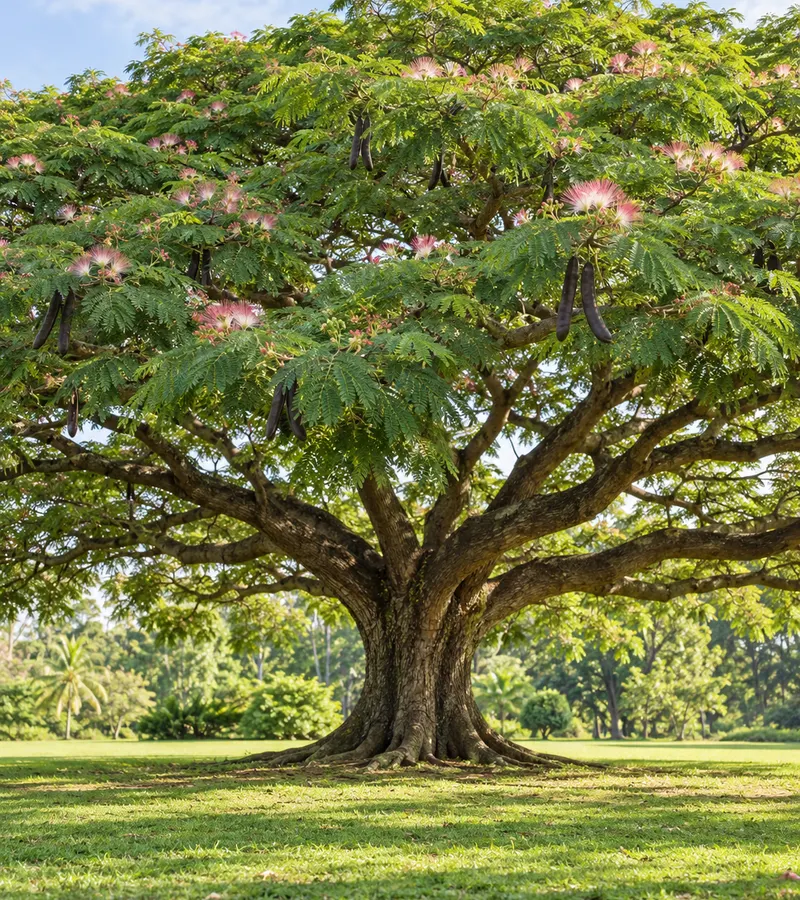
A huge umbrella-shaped crown whose leaflets fold at dusk and before rain, with pale pink powder-puff flowers.
Care and placement
Needs full sun and very generous room; very drought tolerant once established and tolerates poor acid soil and waterlogging; water young trees well, remove dead wood and have large limbs checked before the storm season.
Draft mature dimensions
Maximum height (cm): 2000 cm · Maximum spread (cm): 3000 cm
Things to consider
PFAF says some parts are poisonous if eaten and that handling may cause skin irritation or an allergic reaction, even though the pod pulp is eaten in places; do not eat it or use it as medicine. Large limbs can break in storms, and a tree this big can be dangerous over roads, roofs or car parks. Flowers and fruit drop heavily and the pod pulp is sticky.
How to grow and care for it
Planting and pot
Plant only where there is real space: NParks gives a height of 20–30 m and a crown width of 20–30 m and recommends 18 m spacing along roads and 24 m in open areas. The roots include a tap root and fibrous roots (NParks), but PFAF says it tends to be shallow-rooted in high-rainfall areas and the Vietnamese Wikipedia notes a large buttressed base, so do not plant near buildings, buried pipes, pavements or power lines; the exact distance needs a site survey. Planting on public land needs permission from the tree authority or the land owner. It suits hot, humid areas, is frost tender (PFAF says it may be damaged below 8 °C) and does not tolerate maritime exposure, so it is not for cold highlands or the very edge of the sea.
Light
It likes full sun (NParks); PFAF says it also tolerates semi-shade. The leaflets fold in the early evening and on overcast days or before rain. In areas with a dry season the tree may drop part of its leaves (NParks, Wikipedia).
Watering
NParks lists moderate water needs, while PFAF says established trees are very drought tolerant and also tolerate waterlogged soil. Water young trees regularly through the first dry season. Drought stress promotes twig dieback from the Phomopsis fungus (NParks), so large trees in cramped soil also benefit from extra water in long dry spells.
Feeding
NParks says it grows best on fertile loam but tolerates poor acid soil down to pH 4.6, and PFAF says it fixes nitrogen. It therefore needs little feeding: rotted organic matter at planting and a little more around the edge of the canopy if the tree looks weak. After removing dead wood from fungal dieback, NParks advises fertilising well so the tree recovers.
Pruning
PFAF says the tree responds well to pruning. NParks advises cutting dead branches back to healthy wood. Wikipedia (without a citation) says large branches tend to break off, particularly in rainstorms, so a roadside tree should be inspected regularly and before the storm season by an arborist, removing dead and weak limbs and limbs reaching over roads or roofs. Leave this to licensed crews, especially near power lines.
Propagation
Propagate from seed, stem cuttings or root cuttings (NParks). Fresh, moist seed usually germinates without treatment; dry, hardened seed needs a nick in the coat or a 3-minute hot-water soak followed by 12–24 hours in warm water (PFAF). NParks says treated seed germinates in 3–5 days and seedlings are ready to plant out after 3–5 months; collect seed from fallen pods.
Pests and common problems
The tree has few pests but is prone to twig dieback from the Phomopsis fungus, especially in drought (NParks). In a city, flowers and fruit make litter (NParks), the pod pulp is sticky, and insects feeding on the leaves can leave sticky drips below (Wikipedia). The sources disagree on storm risk: PFAF says it tolerates strong wind and the Vietnamese Wikipedia says it rarely falls, but PFAF also says it is shallow-rooted in high-rainfall areas and Wikipedia says large branches tend to break in rainstorms, so do not assume it is storm-safe. No source discusses pollen allergy; the flowers are slightly fragrant (NParks).
For plentiful, healthy leaves
For a healthy, wide green crown: give enough sun and room, water young trees, cut dead wood properly and feed lightly when the tree looks weak. It flowers freely with pink-and-white powder-puff heads that are slightly fragrant and attract bees (NParks); the pods are flat and do not split open (Vietnamese Wikipedia).