
Royal palm
Roystonea regia
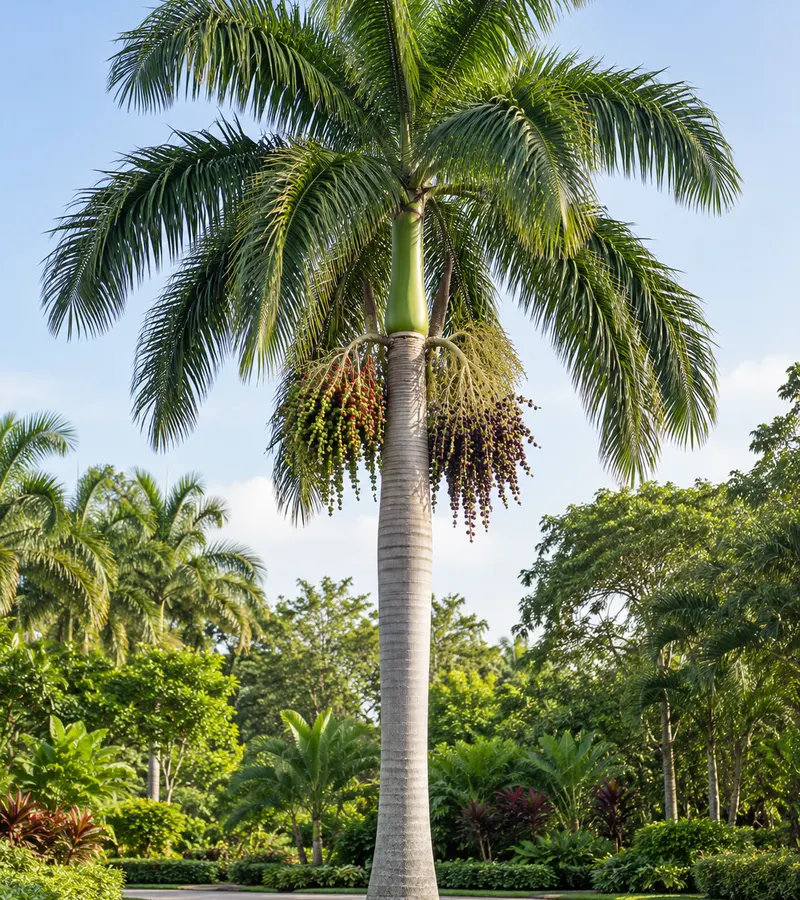
A smooth grey trunk that bulges in the middle under a green crownshaft, often planted in rows along avenues and entrances.
Care and placement
Needs full sun and fertile well-drained soil but copes with both wet soil and drought once established; sturdy in hurricane-force wind and moderately salt tolerant; 15–25 m tall with fronds up to about 23 kg, so plant it well away from buildings, walkways and overhead lines; feed with a controlled-release fertiliser that includes potassium, manganese and boron.
Draft mature dimensions
Maximum height (cm): 2000 cm · Maximum spread (cm): 700 cm
Things to consider
Each frond, 3–4 m long, can weigh up to 50 lb (about 23 kg) and drops naturally about once a month, so it can injure people or damage property below. The fruit pulp contains calcium oxalate crystals that irritate skin, so wear gloves when handling fruit and seed; fallen fruit is slippery and messy. Ganoderma butt rot or crown rot can bring the whole palm down without warning. The sources consulted give no toxicity data for eating it, so safety is not claimed. Planting, pruning or felling on public land needs the authority's permission.
Sources to cross-check
Kew Plants of the World Online · Roystonea regiaUF/IFAS EDIS · Roystonea regia: Royal PalmUF/IFAS Gardening Solutions · Royal palmNParks Flora & Fauna Web · Roystonea regiaWikipedia · Roystonea regiaWikipedia tiếng Việt · Cau vuaChính phủ · Nghị định 64/2010/NĐ-CP về quản lý cây xanh đô thịHow to grow and care for it
Planting and pot
It suits streets, parks and large grounds but is too big for a typical home garden: the trunk reaches 15–25 m and the crown spreads about 6–7 m. Plant it well away from buildings, walkways and parking because the heavy fronds fall, and away from overhead lines, with the exact distance set by a site survey (the decree requires the electricity safety corridor to be kept). The sources consulted give no distance to pavements or pipes; NParks says only that the roots are fibrous and underground. Dig a hole about twice the width of the root ball and set the top of the ball about 2.5 cm below the soil surface; planting on a pavement or public land needs the tree authority's permission.
Light
Plant in full sun all day; it does not suit spots shaded by tall buildings or large trees. The palm grows straight up above other trees, so it needs open space overhead.
Watering
The palm tolerates both wet soil and drought once established, but grows best in moist to wet soil, so water regularly in the first year and the dry season. It tolerates salt spray, but not high salt in the root zone, so avoid salty irrigation water.
Feeding
The palm is prone to potassium, manganese and boron deficiencies, especially on calcareous or fill soil. Use a controlled-release fertiliser at about 8-2-12-4 Mg (or 8-0-12-4 Mg) with micronutrients, at the label rate; severe manganese deficiency needs manganese sulfate.
Pruning
There is no need to cut old fronds because the palm is self-cleaning, dropping about one a month. Do not pull or cut green fronds, because wounds on the upper trunk can let in rot fungi that make the crown topple suddenly. Only trained people should remove fully dead fronds at height, and pruning shade trees 10 m or taller on public land needs a permit under the decree.
Propagation
Propagate by seed: remove the pulp and rinse the seed well (wear gloves because the pulp irritates skin), then sow in well-drained, evenly moist soil and keep it warm, ideally around 35 °C. The seed falls with an immature embryo so germination is slow, taking 5–8 months; move seedlings to containers after the second leaf appears.
Pests and common problems
Rhinoceros beetles can attack the growing point and kill the palm; the royal palm bug feeds on new leaves and leaves them frizzled, which can look like potassium or manganese deficiency. Ganoderma butt rot in the bottom metre of the trunk makes the palm wilt; if a conk appears at the base, remove the palm promptly because it may fall. In a city there are also the heavy falling fronds and slippery, messy fallen fruit below. The sources consulted do not report allergenic pollen.
For plentiful, healthy leaves
For fast growth and a glossy green feather crown: plant in full sun in fertile moist soil, feed with a controlled-release fertiliser containing potassium, manganese and boron, and avoid wounding the trunk. The smooth grey trunk with a bulge in the middle under a green crownshaft is the palm's signature look.