
Southern live oak
Quercus virginiana
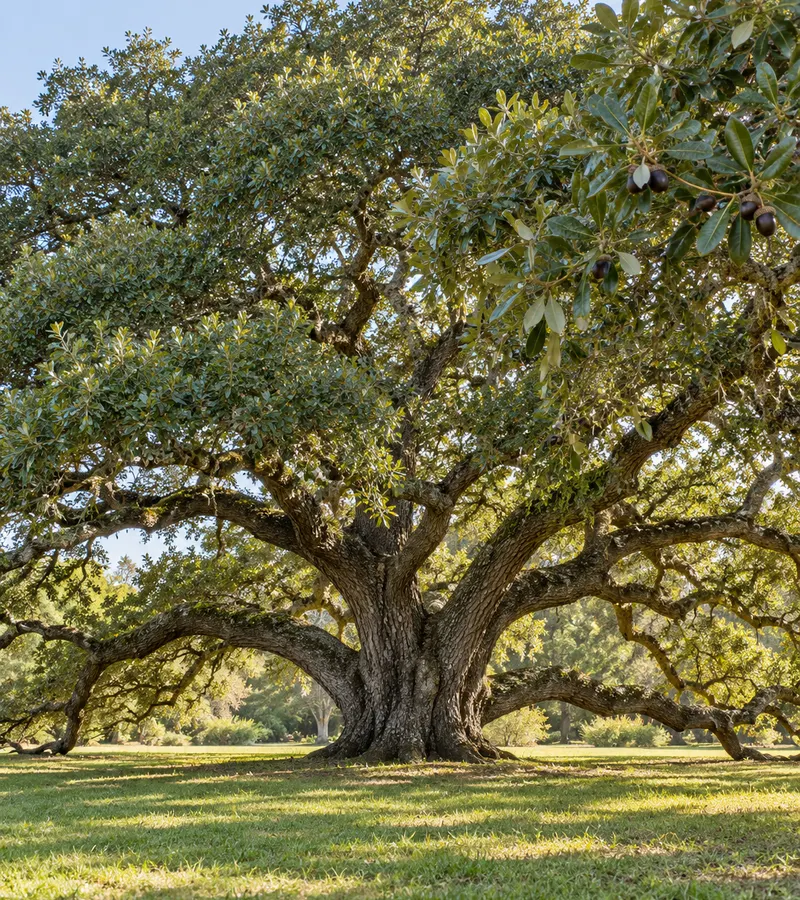
An evergreen oak with a short stout trunk and very wide, sweeping limbs, at home in the hot, humid southern United States.
Care and placement
Needs full sun to part shade, well-drained soil (best moist and slightly acidic) and a very big site: the tree is about 18–24 m tall with a 18–37 m crown according to UF/IFAS. It is native to the southern United States (USDA zones 7b–10b) and handles wind and coastal salt well; no source records it in Vietnam.
Draft mature dimensions
Maximum height (cm): 2000 cm · Maximum spread (cm): 2700 cm
Things to consider
Eating raw acorns or young leaves may cause stomach pain, constipation then diarrhea, thirst and frequent urination (NC State rates it low severity); the ASPCA lists oak (Quercus) as toxic to horses because of gallotannin and gives no separate rating for dogs or cats. Large surface roots lift paving, leaves and fruit litter the ground, the tree is highly flammable, and its very wide crown needs a site well away from buildings and overhead lines.
How to grow and care for it
Planting and pot
Plant only where there is room for a giant: UF/IFAS gives 60–80 ft (about 18–24 m) tall with a 60–120 ft (about 37 m) crown, and a trunk that can exceed 6 ft (1.8 m) across. Large surface roots and roots that run under kerbs and pavements will slowly lift them, so do not plant close to pavements, driveways or houses; UF/IFAS also advises against planting near or under overhead lines and light posts. The sources give no set distance from buildings and pipes, so that needs a site survey. The soil must drain well, and planting on a pavement or public land needs the owner's or the authority's permission.
Light
Takes full sun (6+ hours of direct sun) to part shade (2–6 hours). It is native to the warm coastal southeast United States, where annual rainfall is usually 650–1,650 mm, and is hardy only to about USDA zone 8a. No source discusses it in Vietnam's tropical climate; many parts of Vietnam are wetter than that range, so drainage is the key condition (our inference). It does not need a cold winter to survive.
Watering
UF/IFAS calls it amazingly adapted to drought, while NC State and Wikipedia say it handles periodic flooding and survives on both dry and wet sites provided drainage is good. The sources give no amounts or schedule for young trees, so keep the soil lightly moist at planting, taper off, and watch the leaves.
Feeding
The sources give no feeding schedule. It grows best in moist, slightly acidic soil (pH about 5.5–6.5 per Wikipedia) and lives on poor sandy soil, so well-rotted organic matter at planting is enough; mature trees usually need no extra feeding. UF/IFAS stresses that the best prevention is a stress-free environment.
Pruning
Prune for a strong structure: one UF/IFAS document advises pruning yearly for 3 years then every 5 years to age 30, another says yearly for 5 years then every 3 years. Remove competing trunks and narrow-angle branches, which split later. Along streets, prune for 14–15 ft (about 4.3–4.6 m) of vehicle clearance; leave this to tree-care crews once the tree is tall.
Propagation
NC State lists propagation by seed. The acorns ripen after one growing season and fall around September to November in North America. Young trees are anchored by a deep taproot (Wikipedia), so if sowing in pots choose deep ones and plant out early; larger trees are best bought from a nursery.
Pests and common problems
It holds its leaves until the new ones emerge and then drops them together (NC State, Wikipedia), and leaves and acorns litter the ground heavily (UF/IFAS), so expect regular clean-up. Surface roots lift pavements, kerbs and driveways. Oak wilt and root rot can occur, along with shoestring root rot, cankers, leaf spots and powdery mildew; aphids, scale, mites, galls and borers mostly attack stressed trees. It is rated highly flammable, so do not plant it hard against a house. Sources call it very wind resistant, but narrow-angle branches split, so big trees in typhoon-prone areas still need an arborist's check.
For plentiful, healthy leaves
For a wide, dark-green, balanced crown: give it room, full sun and drained soil, build a strong branch frame while young, and avoid stress such as waterlogging or damage to the roots and trunk. Its wide, sweeping limbs and year-round green leaves are its best features.