
Guava
Psidium guajava
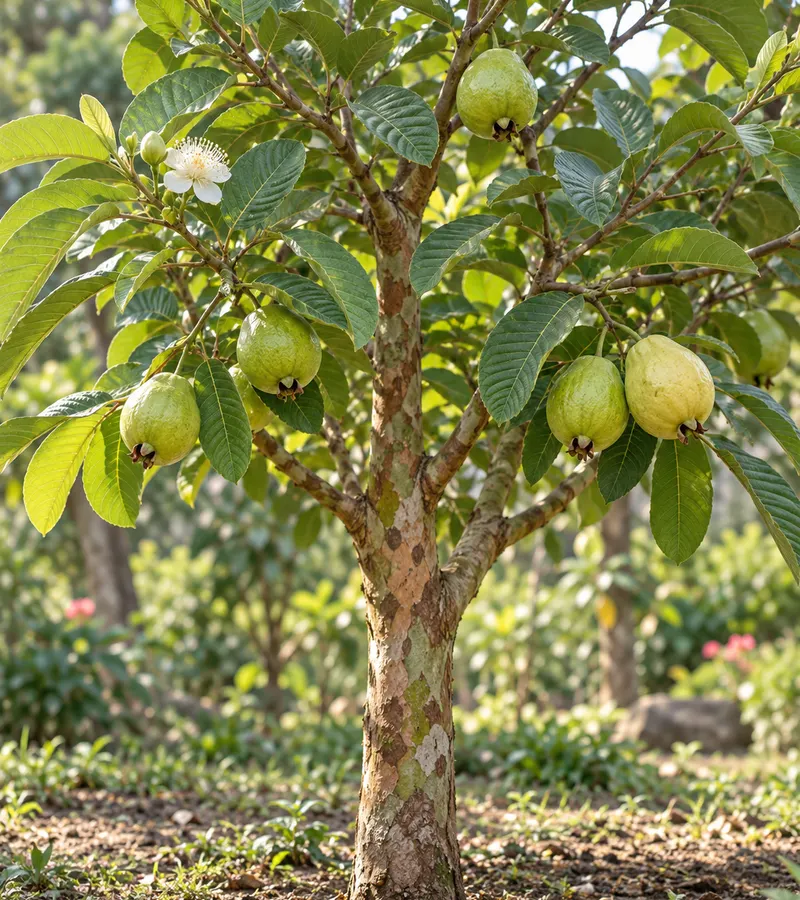
A familiar fruit tree of Vietnamese yards that flowers year-round where it is warm and is more drought-tolerant than many tropical fruit crops.
Care and placement
Needs full sun (PFAF: it cannot grow in shade) and well-drained soil, although it copes with heavy clay; preferred pH is 5.5–7.5. It is more drought-tolerant than most tropical fruit crops and moderately tolerant of saline soil. Dormant trees survive about −5 °C, but young growth is badly damaged at about −1 °C.
Draft mature dimensions
Maximum height (cm): 1000 cm · Maximum spread (cm): 1000 cm
Things to consider
PFAF lists no known hazards, but no official toxicity rating exists for children, dogs or cats, so it is not claimed safe. Overripe or damaged fruit attracts fruit flies that lay eggs in it and makes a mess below. Strawberry guava (Psidium littorale), a relative, is invasive in Hawaii (Wikipedia), so never release seedlings into the wild.
How to grow and care for it
Planting and pot
Pick a full-sun, well-drained spot. PFAF gives a size of about 10 × 10 m, so leave generous room or keep it low by pruning (our inference; the sources do not say). Wikipedia says seed-grown trees can bear fruit after about two years; PFAF says full bearing comes after 5–8 years. Public land needs permission.
Light
Needs full sun: PFAF says it cannot grow in shade, and it flowers all year where it is warm. Avoid frosty spots, since young growth is badly damaged at about −1 °C.
Watering
It prefers moist soil but is more drought-tolerant than most tropical fruit crops. PFAF says good fruiting needs at least 1,000 mm of rain a year (preferring 1,000–3,000 mm) with a clear dry period for ripening. Water newly planted trees evenly until rooted, then rely mostly on rain and water extra in long dry spells (our inference; the sources do not say).
Feeding
The sources give no feeding schedule. Mix well-rotted organic matter in at planting, then feed lightly to the label while the tree is making leaves and flowers; avoid heavy nitrogen, which gives leaf over fruit (general practice; the sources do not say).
Pruning
The sources do not cover pruning. Because it can reach about 10 m, growers commonly head it back to keep fruit within reach (general practice; the sources do not say). Remove dead and crowded branches, and leave large high limbs to someone qualified.
Propagation
PFAF: by seed (very easy, and it often self-sows), air layering, cuttings and grafting, with cuttings and grafting the usual ideal methods. Wikipedia describes air layering: nick a healthy branch, apply rooting hormone and wrap it in moist moss under plastic; once roots form after several weeks, sever it and plant.
Pests and common problems
Fruit flies lay eggs in overripe or damaged fruit (Wikipedia), so clear fallen fruit regularly. Wikipedia also records mites, moth caterpillars, bacterial fruit rot and fungal scab in some regions. Young plants are hurt by frost. PFAF says the wood resists insects and fungi.
For heavy fruiting
For more fruit: full sun, a layered or grafted tree from a variety that fruits well, even water while young and in flower, then a dry spell for ripening (PFAF). Pick when the skin changes: Wikipedia says it is usually green before maturity and may be yellow, maroon or green when ripe, so learn your variety.