
London plane
Platanus × hispanica
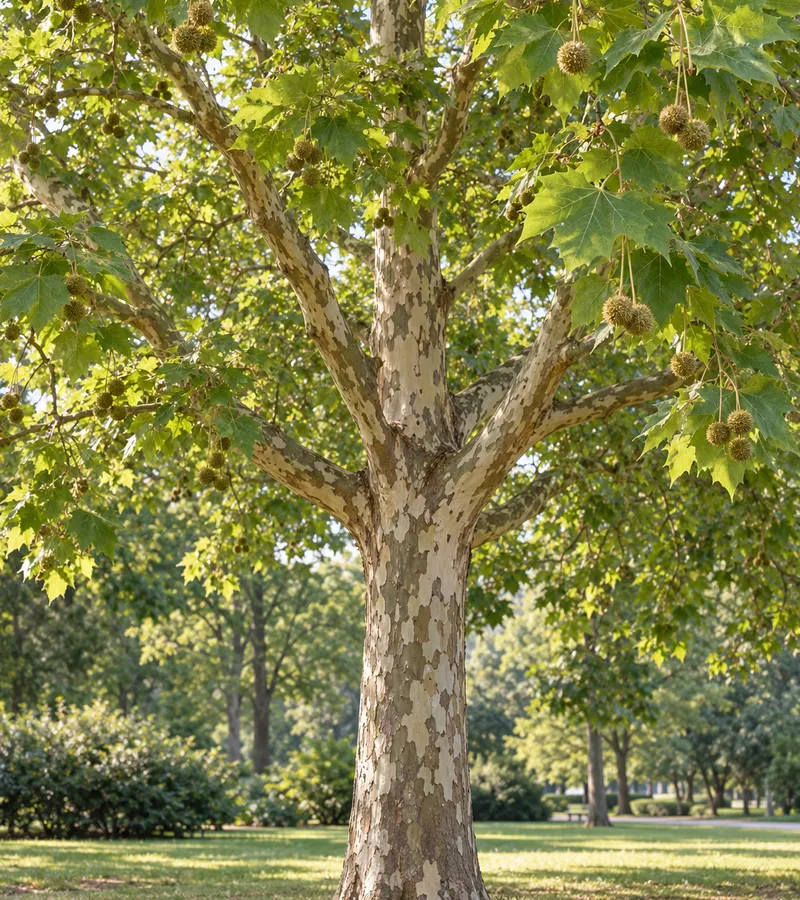
A large deciduous street tree with camouflage-patterned flaking bark, common on temperate avenues and tolerant of city grime.
Care and placement
Needs full sun, moist humus-rich yet well-drained soil, and room for a crown 20–25 m tall and 15–20 m wide. It is a temperate tree: a University of Florida source says it is unlikely to thrive in hot humid climates, and no source confirms it does well in Vietnam's hot humid lowlands.
Draft mature dimensions
Maximum height (cm): 2500 cm · Maximum spread (cm): 2000 cm
Things to consider
Short stiff hairs shed from young leaves and seeds irritate when breathed in and can worsen asthma. Strong roots can lift paving and enter sewer pipes, and leaves, bark, twigs and fruit balls drop heavily. Canker stain disease can kill the tree. No source rates its toxicity for children or pets, so it is not claimed safe.
Sources to cross-check
Kew Plants of the World Online · Platanus × hispanicaUF/IFAS · Key Plant, Key Pests: Sycamore (Platanus spp.)RHS · Platanus × hispanicaNC State Extension Plant Toolbox · Platanus × acerifoliaMilton Keynes Council · Street tree specification: London planeWikipedia · London planeHow to grow and care for it
Planting and pot
Pick a roomy, full-sun spot. The Milton Keynes (UK) street-tree specification asks for boulevard trees at least 9 m from buildings and 3 m from the kerb edge, a pit of at least 1.2 × 1.2 × 0.9 m, and root barriers when the tree is within 1.2 m of underground services or kerbs. The RHS advises keeping it away from buildings because of its vigorous roots; no source gives a distance from overhead lines, so that needs a site survey. Planting on a pavement or public land needs the owner's or the authority's permission.
Light
Needs full sun, meaning 6 or more hours of direct sun a day; it tolerates light shade. It is a temperate tree: the University of Florida lists it as growing best in USDA zones 5–8 and unlikely to thrive in central Florida (zone 9). No source confirms it does well in Vietnam's year-round hot humid climate, so treat it as a temperate tree and try it cautiously.
Watering
It tolerates occasional flooding and dry air, but prefers moist, humus-rich soil that still drains. In hot dry spells the University of Florida advises mulching the root zone and watering extra; the sources give no amounts, so water according to how dry the soil actually is, especially for newly planted trees.
Feeding
The sources give no feeding schedule. The RHS says it grows easily in moist, fertile, humus-rich soil, so well-rotted organic matter at planting is a sound start. The University of Florida notes that over-fertilizing makes new growth more prone to powdery mildew, so do not feed heavily.
Pruning
It tolerates hard pruning, and in Europe it is often pollarded into clusters of stunted club-like branches. The University of Florida advises pruning in midwinter when fungal activity is lowest, because summer wounds are the likeliest to get infected; where winter is not distinct, avoid the wet season (our inference, the sources do not say). Sanitize tools between trees with near-boiling water, soap or a bleach solution, and leave tall trees to tree-care crews.
Propagation
As a hybrid it is usually propagated vegetatively. The RHS advises hardwood cuttings in winter, or removing suckers in autumn or late winter. Buy young trees from a reputable nursery rather than propagating your own, because different clones vary in how susceptible they are to anthracnose.
Pests and common problems
Leaves, bark, twigs and fruit balls (about 2.5–4 cm across, sometimes staying on the tree into winter) drop heavily and take effort to clear; stiff hairs from young leaves and seeds irritate the airways. Strong roots lift paving into trip hazards and can enter sewer pipes. Canker stain (Ceratocystis platani) spreads through wounds and cutting tools and has no cure, so infected trees must be removed and burned; anthracnose, lace bugs, powdery mildew and bacterial leaf scorch in hot dry weather are also recorded. The sources say nothing about storm breakage, so large trees in typhoon-prone places need an arborist's check.
For plentiful, healthy leaves
For a handsome crown and clearly patterned bark: plant in full sun with deep soil for the roots, mulch and water extra in hot dry spells, and avoid scarring the trunk with mowers. Prune at the right season with clean tools to keep the tree healthy. The flaking olive-green and cream bark is its best feature.