
Khasi pine
Pinus kesiya
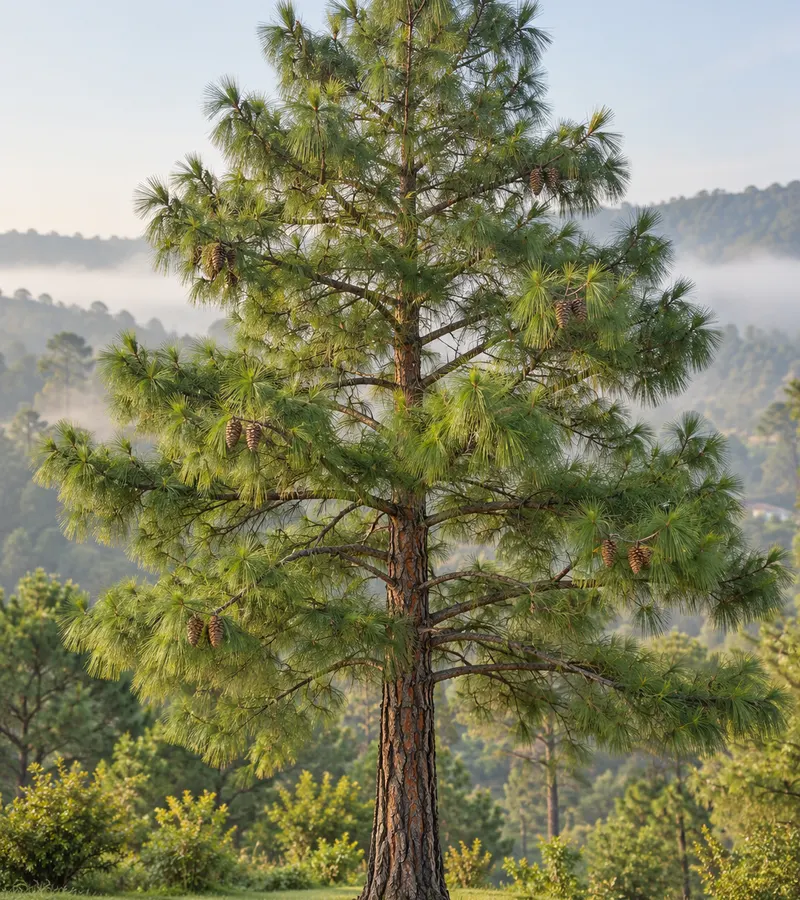
Needles grow in bundles of three on a pyramid-shaped crown; it suits cool highlands such as Đà Lạt and is not for the hot lowlands.
Care and placement
A tree of cool highlands, not hot lowlands: it grows naturally where the yearly mean is about 17-22 °C and does best at 1,000-1,500 m. It needs full sun and poor, acidic, well-drained soil, does not tolerate shade and is frost-sensitive while growing.
Draft mature dimensions
Maximum height (cm): 2500 cm · Maximum spread (cm): 900 cm
Things to consider
Wood, sawdust and resin can cause dermatitis in sensitive people, and terpenes washed from the needles by rain can stop seeds of some other plants from germinating. No source rates its toxicity to children or pets, so it is not claimed safe. It grows very tall, so plant it only where there is plenty of room; where introduced it can spread quickly onto open ground.
How to grow and care for it
Planting and pot
Plant only in cool highlands such as Đà Lạt, where the year-round temperature is about 18-21 °C; do not plant in hot, humid lowlands, since the sources give much lower natural temperatures, which is an inference from the climate data rather than a lowland city trial. Choose a sunny, acidic, well-drained spot (about pH 4.5-5.5) away from frost pockets. The tree reaches 20-40 m and its roots are listed as able to damage structures; the sources give no safe distance, so spacing from buildings, pipes, pavement and overhead lines needs a site survey. Planting or felling pines on public land needs the authority's permission.
Light
Needs full sun: it is strongly light-demanding, does not tolerate shade, and seedlings regenerate well only where light reaches the ground. It tolerates light frost but is very sensitive to frost while actively growing.
Watering
Its natural range gets about 700-1,800 mm of rain a year with a pronounced dry season. Established trees are fairly drought-tolerant; young trees need moderate moisture, and the soil must drain well with no standing water.
Feeding
The tree is adapted to nutrient-poor, acidic soil, so it needs little feeding, and the sources give no fertiliser schedule. At planting just keep the soil loose and free-draining, and avoid liming away the acidity or heavy nitrogen doses.
Pruning
Little pruning is needed: the trunk sheds its own lower branches, leaving a branch-free bole of 15-20 m. Cut only dead or broken limbs, and leave high pruning or removal to qualified crews, especially near buildings and power lines. Keep resin off bare skin since it can cause dermatitis.
Propagation
Propagate by seed. Some highland seed sources need soaking and 2-3 weeks of refrigeration, or soaking in 40-50 °C water then cooling overnight; seed germinates in about 5-20 days. Nursery seedlings take about 6 months to 1 year and are planted out at 14-20 cm tall; growth is slow for the first 5 years and faster afterwards.
Pests and common problems
Roots go deep but are listed as able to damage structures, so keep the tree away from foundations, drains and pipes. It grows very tall, so toppling or falling large limbs can injure people in storms; the sources say nothing about wind tolerance, so inspect trees regularly. Needles and cones drop through the year, forming a thick mat on pavements and in gutters. The genus is prone to honey fungus, the resin can cause dermatitis, and where introduced it can invade quickly. If planted somewhere too hot it may decline because the climate does not suit it. No source mentions pollen or scent causing allergies.
For plentiful, healthy leaves
For a healthy green crown: a cool climate, full sun, acidic well-drained soil, no waterlogging, no frost, and enough spacing so trees do not shade one another. The needles come in bundles of three, 15-20 cm long, on a pyramid or egg-shaped crown.