
Sweet basil
Ocimum basilicum
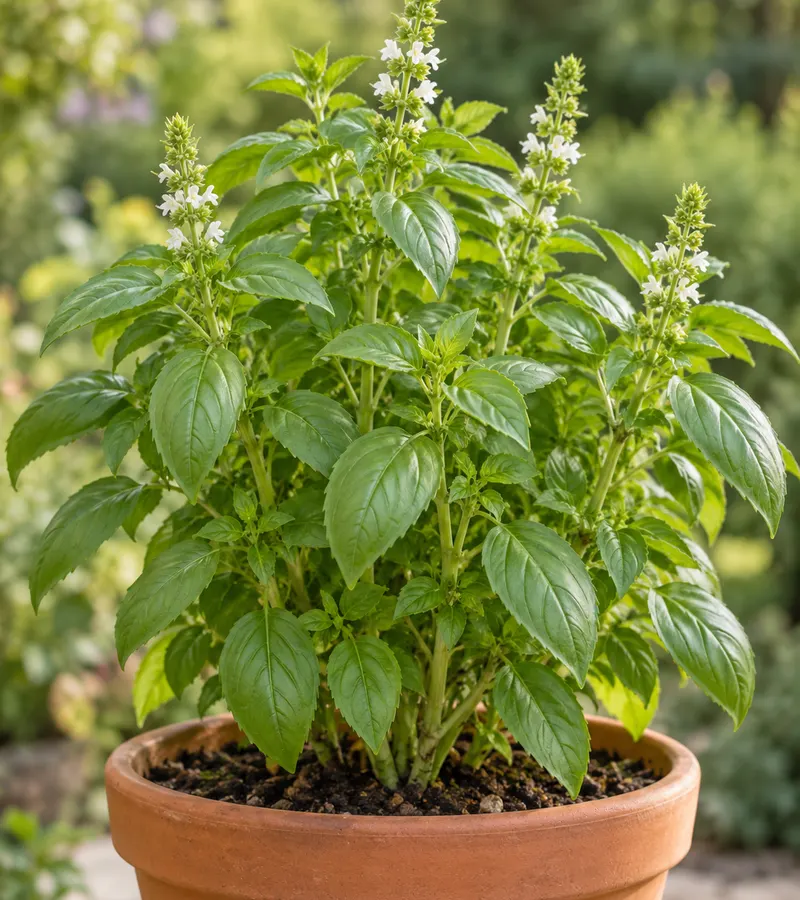
Fragrant leaves for phở and fresh herbs; branches more when tips are picked.
Care and placement
Needs 6–8 hours of sun, about 25 mm of water a week when the top 2–3 cm is dry, a pot at least 30 cm wide, and pinching tips and flower buds to keep harvesting.
Draft mature dimensions
Maximum height (cm): 60 cm · Maximum spread (cm): 40 cm
Things to consider
ASPCA lists basil as non-toxic to dogs and cats. Wash before eating; do not eat leaves that were sprayed or are infected with downy mildew.
How to grow and care for it
Planting and pot
Plant in a pot at least 30 cm wide with drainage holes or in the ground, in loose humus-rich soil at pH 6.0–7.0. Frost-tender; plant when warm.
Light
At least 6 hours of direct sun, 8 is better.
Watering
Keep evenly moist at about 25 mm a week; water deeply when the top 2–3 cm is dry, at the base and not on foliage; no standing water in the saucer. Letting it go bone dry stresses it and speeds bolting.
Feeding
A light feeder: balanced liquid feed every 3–4 weeks or organic feed every 4–6 weeks. Avoid high nitrogen: big leaves but bland flavour.
Pruning
Once 15 cm tall with at least 3 leaf pairs, pinch just above a node so two branches grow; repeat every 1–2 weeks. Pinch flower buds the moment they appear to extend harvest by 4–6 weeks; flowering turns leaves bitter.
Propagation
Sow seed or root tip cuttings in water. Seeds germinate quickly in warmth. (Water cuttings follow common practice; the sources checked mainly cover seed.)
Pests and common problems
Aphids, whiteflies and spider mites: check weekly, use neem oil or insecticidal soap and keep airflow. Downy mildew (yellow leaves, grey fuzz underneath): plant in sun with airflow, avoid wetting leaves and remove affected leaves; sweet types are very susceptible. Fusarium wilt also occurs.
For a bigger harvest
For plenty of leaves: pinch often, remove flower buds, give enough sun, water steadily, feed lightly with low nitrogen and always harvest the tips. Pinching can nearly double yield.