
Moringa
Moringa oleifera
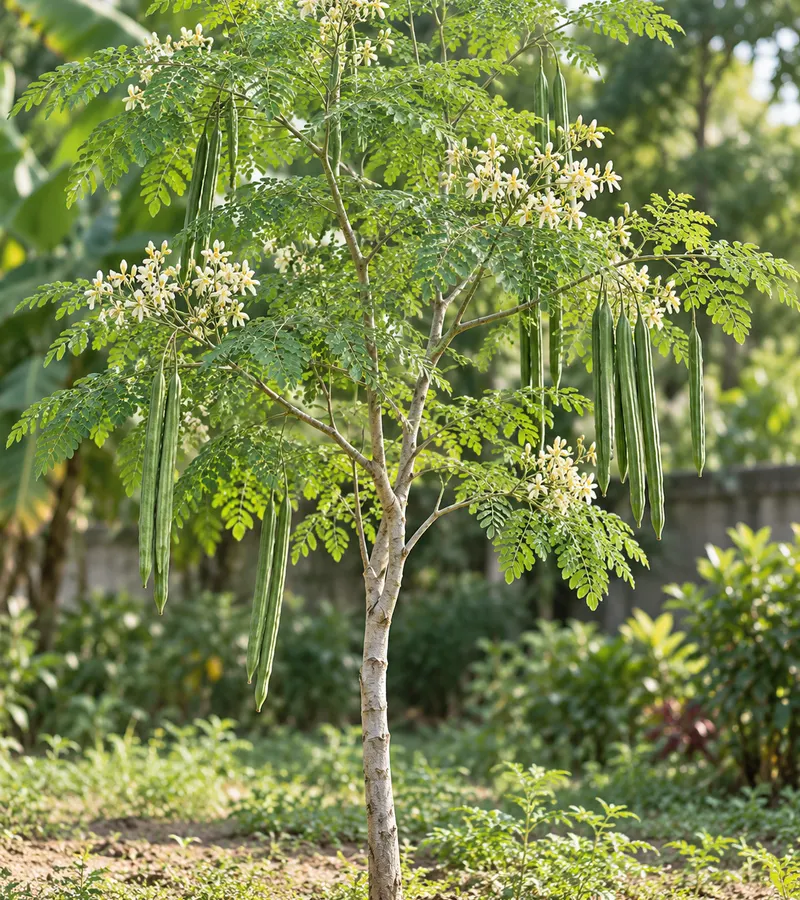
A small, very fast tree whose leaves and young pods are cooked in soups; it tolerates drought but not waterlogging, frost or sea spray.
Care and placement
Needs full sun (PFAF: it cannot grow in shade) and well-drained soil, preferred pH 5.5–7. Established plants are fairly drought tolerant but yield much less foliage under continuous water stress; Wikipedia: roots tend to rot in waterlogged soil. It suits warm climates (USDA 10–12); PFAF: it tolerates light frost but a freeze can kill it to ground level. It tolerates strong wind but not maritime exposure.
Draft mature dimensions
Maximum height (cm): 800 cm · Maximum spread (cm): 800 cm
Things to consider
PFAF lists no known hazards but warns the condiment made from it may be harmful in excess and that the root contains the alkaloid spirachin, described as a nerve paralyzer. Wikipedia says compounds in the bark and roots may cause adverse effects in excess, leaf extract may interfere with drugs metabolized by cytochrome P450 and with sitagliptin, human toxicity data are limited, and Australia's FSANZ rejected it as a novel food for lack of safety evidence. So eat only the leaves and young pods as a vegetable, never the root or bark, and ask a doctor if you take medication. No rating exists for dogs, cats or young children.
How to grow and care for it
Planting and pot
Choose a full-sun, well-drained spot with some wind shelter, away from roofs and overhead lines if you let it grow tall. PFAF: it reaches about 8 m tall and wide (up to 12 m) and young plants can grow 3–4 m a year. Most growers keep it low by cutting it back (see pruning).
Light
PFAF: needs full sun and cannot grow in shade. Wikipedia: sun- and heat-loving, and it does not tolerate freezing or frost.
Watering
PFAF: established plants are fairly drought tolerant. Wikipedia: where rainfall is below 800 mm a year it needs irrigation for leaf production, and roots tend to rot in waterlogged soil. Water young plants evenly until rooted, then water sparingly and make sure the soil drains.
Feeding
The sources give no feeding schedule. Add well-rotted organic matter at planting and feed lightly to the label while it makes leaf; since PFAF says it wants free drainage, avoid fertiliser pooling at the base (general practice; the sources do not say).
Pruning
PFAF: it coppices and pollards well, and constant pruning of up to 1.5 m a year is suggested for a multi-branched shrub. Wikipedia: annual cutting back to 1–2 m is common to keep leaves and pods within reach, with leaves cut from plants cut back to within about 60 cm of the ground.
Propagation
PFAF: sow seed with no pre-treatment, sprouting in 1–2 weeks; or take stem cuttings, with branches 100–150 cm long rooting in a few months. Wikipedia: cuttings should be at least 1 m long and 4 cm thick, with the first harvest 6–8 months after planting.
Pests and common problems
Wikipedia says it is generally not affected by serious diseases; pests include bark-eating caterpillars, budworms (which can cause serious defoliation), aphids, stem borers, fruit flies and termites, and powdery mildew and Noorda blitealis caterpillars can cause complete leaf loss. Waterlogged plants rot at the root. It is short-lived, about 20 years.
For a bigger harvest
Wikipedia: leaves can be cut from young plants about 60 days after sowing and then about seven more times a year; flowering begins within six months and a good tree gives hundreds of pods. PFAF: young leaves, pods, flowers and seeds are edible (edible rating 4/5); traditional medicinal uses centre on root juice and young leaves for nursing mothers (medicinal rating 4/5), but no high-quality evidence confirms health benefits (Wikipedia). That is folk information, not treatment advice.