
Spearmint
Mentha spicata
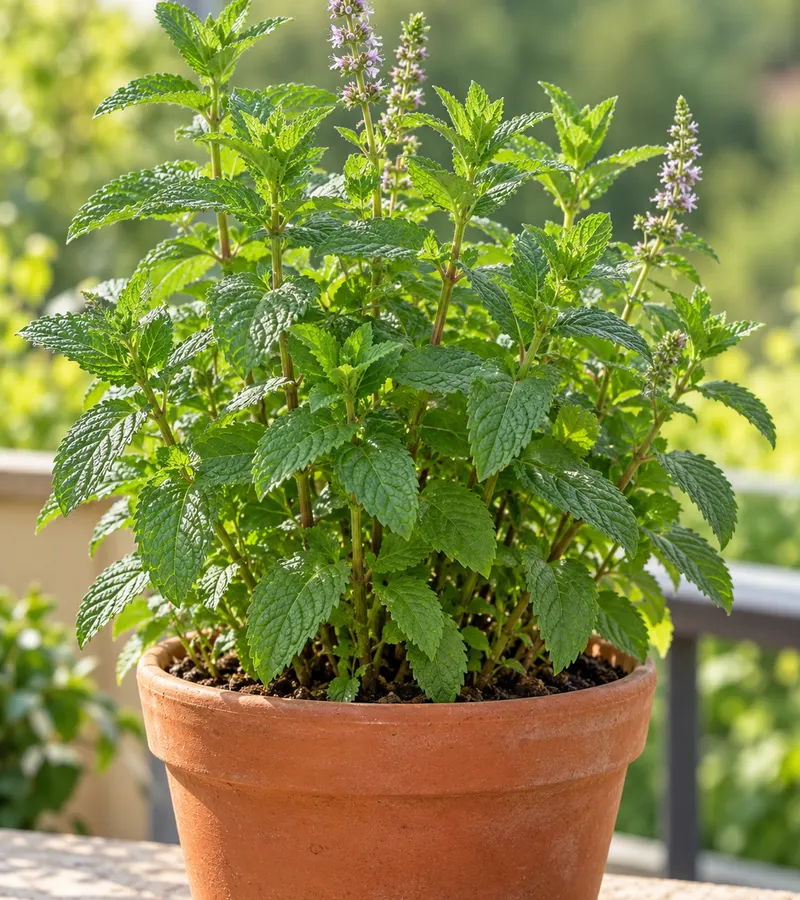
A fast-spreading rhizomatous herb with cool, fragrant leaves for drinks, salads and fresh platters; grow it in a pot of its own.
Care and placement
Grows in full sun or part shade (PFAF: sun gives the most essential oil), in clay, loam or sand, with a pH from mildly acid to mildly alkaline; it prefers moist soil that is not too dry; USDA 3–9. Wikipedia: prefers deep, well-drained, humus-rich soil with an ideal pH of 6.0–7.5. It spreads by runners, so PFAF advises containers or barriers.
Draft mature dimensions
Maximum height (cm): 60 cm · Maximum spread (cm): 100 cm
Things to consider
PFAF records no toxicity for this species but warns that large quantities of some mints, especially the essential oil, can cause abortion, so pregnant women should be cautious. It spreads very aggressively by rhizomes and PFAF calls it highly invasive in some warm regions; never release it into the wild. No toxicity rating exists for dogs or cats, so it is not claimed safe.
How to grow and care for it
Planting and pot
Grow it in a pot or crate of its own, or in a bed with deep edging to stop the runners; PFAF advises containers or barriers because the roots spread aggressively. Choose a sunny or part-shade spot with moist, humus-rich soil; it reaches about 0.6 m tall and 1 m wide (PFAF), or 30–100 cm (Wikipedia).
Light
PFAF: grows in full sun or part shade, with sun giving the most essential oil. Wikipedia: thrives in full sun to part shade. Where the sun is fierce, shade it from afternoon sun so the leaves do not scorch (our inference; the sources do not say).
Watering
PFAF: it prefers moist soil and does well as long as the soil is not too dry. Wikipedia: it even tolerates wet sites such as swamps and creeks. Keep the soil evenly moist, watering when the top layer dries, and make sure the pot drains.
Feeding
The sources give no feeding schedule. Wikipedia says it prefers soil with plenty of organic matter, so mix well-rotted organic matter into the mix and feed lightly to the label after heavy cutting (general practice for the latter; the sources do not say).
Pruning
Wikipedia: cut shoots just before or at peak flowering, about halfway to three-quarters down the stalk, because leaves lose their aroma after the plant flowers. Frequent picking encourages branching; remove flower stalks to keep the leaf aroma (our inference from Wikipedia's note).
Propagation
PFAF: seed sown in spring, but seedlings may not breed true because of hybridisation; division in spring or autumn keeps the aroma consistent, or pot root sections of no more than 3 cm in light shade. The easiest way is to take a rooted piece from a bush whose aroma you like.
Pests and common problems
Wikipedia records rust (Puccinia menthae) causing pustules and leaf drop, Alternaria leaf spot, nematodes and viruses such as mosaic; PFAF notes it as a companion that helps keep cabbages and tomatoes free of insect pests. Keep it airy and remove diseased stems; the biggest problem is that it spreads too fast.
For a bigger harvest
For plenty of aromatic leaf: sun, moist soil, frequent picking and cutting before it flowers (Wikipedia). Leaves can be used fresh, dried or frozen (Wikipedia); PFAF records leaf tea used traditionally for fevers, headaches and digestive complaints (medicinal rating 3/5), but that is folk information, not treatment advice.