
Chinaberry
Melia azedarach
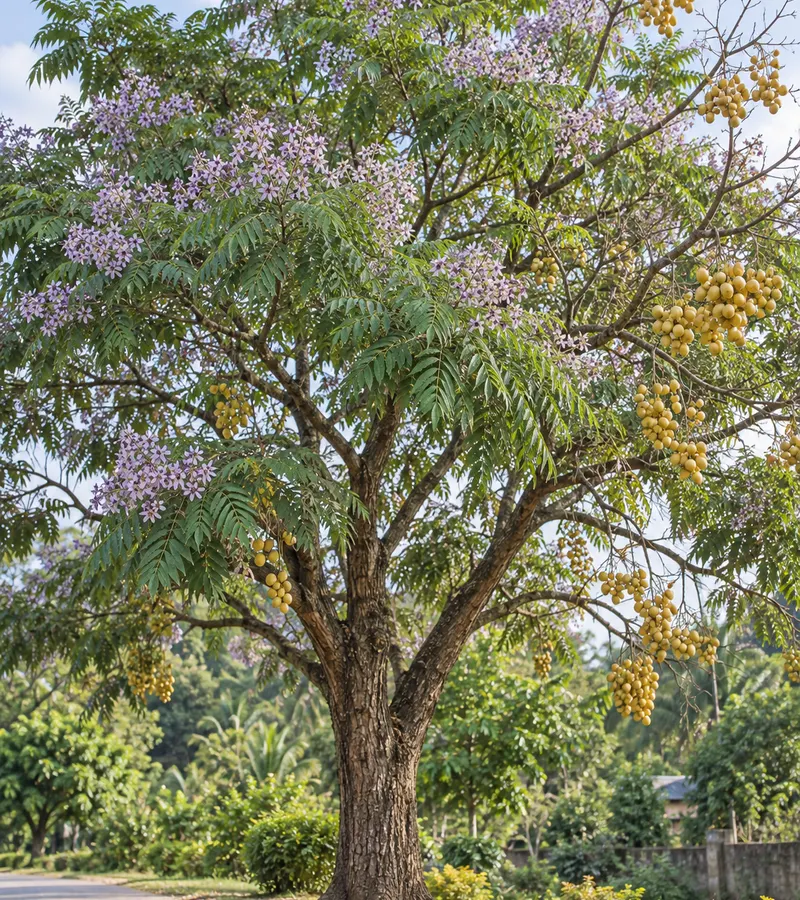
A deciduous tree with fragrant lilac flowers and yellow fruit clusters, but the fruit is poisonous if eaten, so take care where children play.
Care and placement
Likes sun, grows in most soils except waterlogged ones and is very drought tolerant; the wood is brittle, so shape the crown early; the fruit is poisonous, so do not plant it near where children and pets play; propagated by seed or root cuttings.
Draft mature dimensions
Maximum height (cm): 1000 cm · Maximum spread (cm): 600 cm
Things to consider
The fruit is poisonous: UF/IFAS says it is poisonous to people eaten in quantity (birds are not harmed), and Pharmacity and Wikipedia say all parts, above all the fruit and root bark, are toxic, causing vomiting, diarrhoea, stomach pain and convulsions, and sometimes death; cats and dogs are poisoned too. Avoid planting at schools and playgrounds; do not eat it or use it as medicine; wear gloves when pruning and wash hands after handling. If poisoning is suspected, get medical or veterinary help at once.
How to grow and care for it
Planting and pot
The tree grows about 7–15 m tall with an open, rounded crown roughly 5–8 m wide, so it needs open ground. Choose a spot well away from playgrounds, schools and livestock pens because the fruit is poisonous. The sources give no safe distance from buildings, pipes, pavements or overhead lines, so a site survey is needed; UF/IFAS rates roots as not a problem but the wood is brittle. Planting on public land needs permission from the landowner or the tree authority.
Light
Prefers full sun and establishes readily in open sites. It is deciduous, so the crown is bare in the cool season; Cal-IPC says older trees resist frost, so a cool northern winter is not a big obstacle.
Watering
Water young trees regularly until established; mature trees are very drought tolerant but dislike long waterlogging. UF/IFAS says it grows in nearly any soil except wet soil.
Feeding
It adapts to many soils so it needs little feeding; add well-rotted organic matter to the planting hole and feed lightly while young. The sources give no specific rates, so feed lightly and watch leaf colour to adjust.
Pruning
Shape the crown from the start: UF/IFAS advises choosing a few well-spaced main limbs and thinning the crown for strong structure. The wood is very brittle and breaks at weak crotches, so remove those early. Wear gloves when pruning because every part is toxic.
Propagation
Propagated by seed or root cuttings (UF/IFAS). Birds that eat the fruit carry seed far away, and the tree resprouts from roots and cut stumps, so it is hard to remove once it spreads.
Pests and common problems
In the city: the wood is brittle so branches break in storms and weak crotches split; fruit and leaves cause heavy litter, the ripe fruit hangs through winter and drops gradually; and the poisonous fruit needs care where children play. The flowers are strongly scented and the sources say nothing on pollen allergy. Birds can spread it widely, and some regions class it as invasive (no source states this for Vietnam). Pests and diseases: scale, whitefly, sooty mould, and leaf spot causing early leaf drop.
For more flowers
For plenty of flowers: give full sun and keep the crown open by thinning. The very fragrant pale lilac flowers open in large sprays around February–March in Vietnam, then turn into round fruit that ripens from green to pale yellow.