
Mango
Mangifera indica
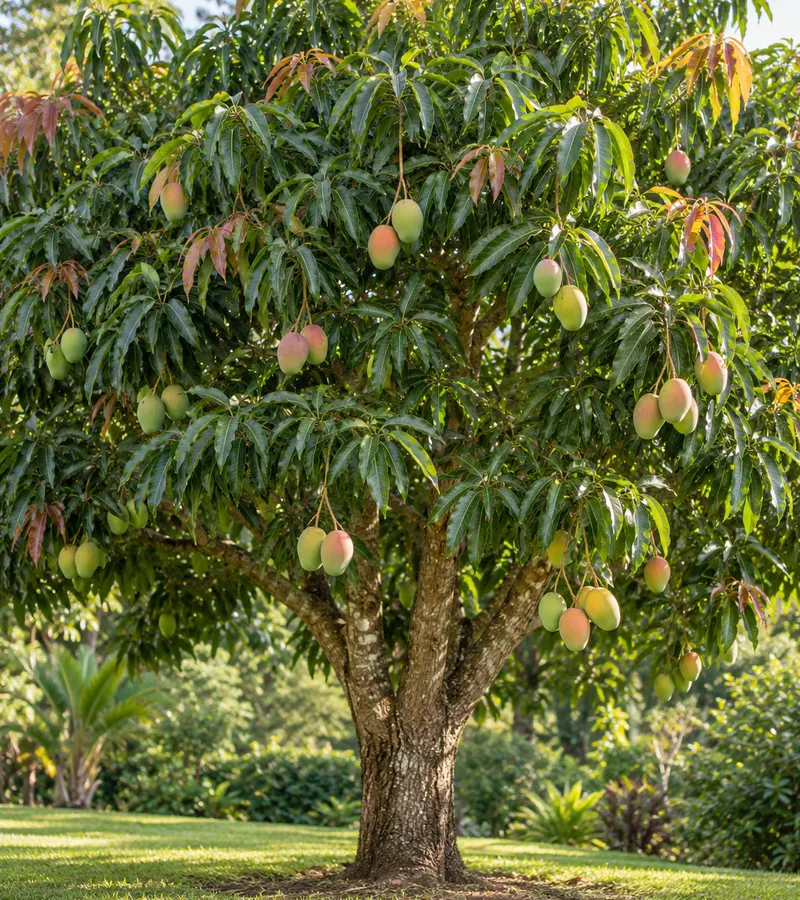
A very large, long-lived shade and fruit tree that needs plenty of room and sun.
Care and placement
Needs full sun (PFAF: it cannot grow in shade) and well-drained soil, with a preferred pH of 6–7; established trees tolerate drought and occasional inundation, but young trees need water. It is frost tender: dormant trees survive about −1 °C but young growth is hurt at 0 °C. It tolerates strong wind but not maritime exposure, and can grow in saline soil (PFAF).
Draft mature dimensions
Maximum height (cm): 2500 cm · Maximum spread (cm): 2500 cm
Things to consider
Sap, fruit skin and leaves contain oils that cause dermatitis and can cause anaphylaxis in susceptible people, especially those allergic to poison ivy (PFAF, Wikipedia): wear gloves when pruning. It grows very large (PFAF: 25 × 25 m), big limbs can break in storms and fruit drop makes a mess. No official toxicity rating exists for children, dogs or cats, so it is not claimed safe. Do not plant close to houses, septic tanks, pipes or overhead lines; public land needs permission.
How to grow and care for it
Planting and pot
Plant only where there is very wide space, full sun and a good distance from houses, pipes and overhead lines: PFAF says it can reach about 25 m tall and wide, Wikipedia says 30–40 m tall with a crown radius of 10–15 m, and the taproot can reach 6 m in deep soil. Choose a grafted tree: PFAF says seedlings fruit after 5–8 years and grafted plants after 3–5.
Light
Needs full sun; PFAF says it cannot grow in shade and does best sheltered from strong, drying winds. Choose an all-day sun spot and shield young trees from frost.
Watering
PFAF: it prefers moist soil; established trees tolerate drought and occasional inundation, while young trees need regular watering. Water deeply and infrequently for newly planted trees until rooted, then rely mostly on rain (our inference).
Feeding
The sources give no feeding schedule. Add well-rotted organic matter at planting and feed young trees lightly to the label; large trees usually need little extra (general practice; the sources do not say).
Pruning
The sources do not cover pruning. The tree gets very large, so leave high pruning to tree-care crews; remove dead and crowded branches while it is still low, wearing gloves and eye protection for the sap. Wikipedia says contact with the oils in leaves, stems and sap can cause dermatitis and anaphylaxis in susceptible people.
Propagation
PFAF: sow seed as soon as the fruit is ripe, about 5 cm deep with the convex side up, germinating in about 18 days if the husk is removed and 30 if not; grafting onto polyembryonic stock is also used. Wikipedia: many monoembryonic cultivars must be grafted to come true, and seedlings grow readily but may differ from the parent.
Pests and common problems
Wikipedia records anthracnose, Alternaria rot, bacterial black spot and powdery mildew; mealybugs reduce fruit set. PFAF says the wood is susceptible to fungi, borers and termites. Fallen fruit draws flies and makes a mess, so clear it often. Allergic reactions to the sap and fruit skin are a risk for sensitive people.
For heavy fruiting
For fruit: full sun, a grafted tree, enough water while young, and protection from frost and salty sea wind. Wikipedia: fruit takes four to five months from flowering to ripening, with many cultivars ripening in summer; PFAF: grafted plants start bearing in 3–5 years.