
African mahogany
Khaya senegalensis
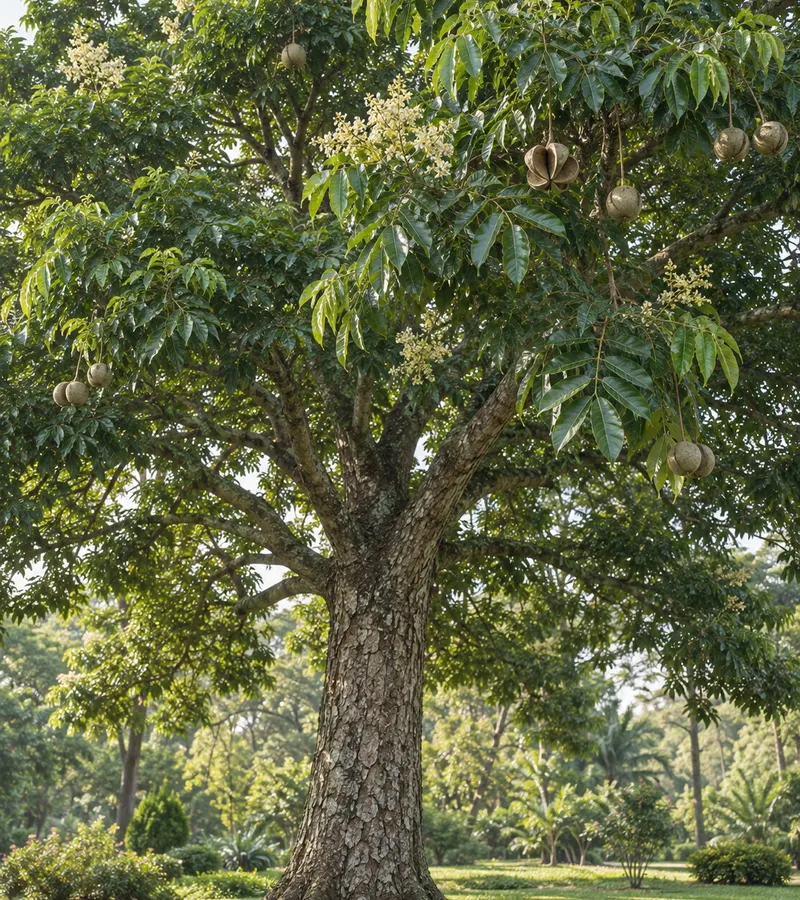
A large evergreen with a dense crown and bark that cracks into coin-like plates, a familiar street tree in Hanoi.
Care and placement
Needs sun, deep fertile soil and plenty of room for roots and crown; very drought tolerant thanks to its taproot and tolerant of flooding; prune regularly before the rainy-storm season and watch for leaning or bent trunks and cut roots.
Draft mature dimensions
Maximum height (cm): 2500 cm · Maximum spread (cm): 2000 cm
Things to consider
There is no official toxicity rating for this tree, so it is not claimed safe or toxic; PFAF says the bark has been used as an arrow poison and a fish poison in Africa. Do not eat it or use it as medicine, and keep children and pets from chewing bark or fruit. The main city risk is a large tree falling or shedding limbs in storms, especially on narrow pavements, with cut roots or a leaning trunk.
How to grow and care for it
Planting and pot
Plant only where there is plenty of room: the Vietnamese Wikipedia gives a height of 35–40 m in good conditions, while PFAF gives about 25 m tall and 20 m wide in cultivation. It has a deep taproot (PFAF), but the article on Hanoi's xà cừ trees shows that trees fall easily when pavements are narrow, roots are cut for underground works close to the trunk and the crown is unbalanced. So the sources give no general distance from buildings, pipes, pavements and overhead lines; that distance needs a site survey. Planting on public land needs permission from the tree authority or the land owner. It suits hot, humid areas (PFAF says it grows up to about 1,800 m and in USDA zones 10–12) and grows on the sandy soils of coastal central Vietnam (Vietnamese Wikipedia). Plant containerised seedlings rather than bare-root ones, which give better results (PFAF).
Light
It likes full sun (Vietnamese Wikipedia); PFAF says young trees are fairly shade tolerant but older trees prefer a sunny position. Plant in the open so the crown stays balanced, since a tree reaching toward the light ends up with a leaning, bent trunk (the Hanoi xà cừ article).
Watering
It is very drought resistant once established thanks to a deep taproot that forms in the first year, and very resistant to flooding (PFAF); PFAF gives a preferred rainfall of 800–1,300 mm a year. Water young trees regularly until the taproot has gone deep, then only top up in very long dry spells.
Feeding
PFAF says it grows best in deep, fertile, moist and slightly acid soil (pH 5–6, tolerating 4.5–7.5), but no source gives a fertiliser rate. Mix rotted organic matter into the planting hole, mulch the base and feed young trees lightly in the rainy season. Trees begin bearing seed only after 20–25 years (PFAF).
Pruning
The article on Hanoi's xà cừ trees calls for full inspection of street trees as well as pruning and for dealing at once with trees leaning or bending over the roadway; the Vietnamese Wikipedia advises limiting the trunk diameter of pavement trees to under 400 mm to reduce the risk of falling. The tree has a wide, many-branched crown with drooping young branches, so prune regularly to keep it balanced, especially before the rainy-storm season. Leave this to licensed crews, especially near power lines.
Propagation
Propagate by seed: fresh seed germinates best, often close to 100%, in lightly shaded nursery beds, starting after about 3 weeks. Seedlings are potted at about 5 cm and grown for about 12 months before planting out (PFAF). The tree also coppices and sends up suckers after cutting (PFAF).
Pests and common problems
Recorded pests and diseases are the shoot-boring moth Hypsipyla robusta, Lytus beetles that damage the trunk and the bacterium Xanthomonas that causes tumour-like growths and sap flow (Vietnamese Wikipedia); termites also attack the wood (PFAF). In a city, a tall tree with a wide crown and heavy limbs can fall or shed branches in storms, especially where pavements are narrow, roots are cut, the trunk leans or the crown is unbalanced (the Hanoi xà cừ article). The woody capsules, up to 8 cm long, and the leaves that drop make litter, and the tree seeds prolifically so seedlings can spread (Daley's Fruit). The white flowers are slightly sweet-scented (Wikipedia); the sources say nothing about pollen allergy.
For plentiful, healthy leaves
For a dense, balanced, evergreen crown: give enough sun, deep fertile soil, plenty of room and regular pruning. The small white flowers open around April–May and the fruit ripens around October, mostly on older trees (Vietnamese Wikipedia).