
Jacaranda
Jacaranda mimosifolia
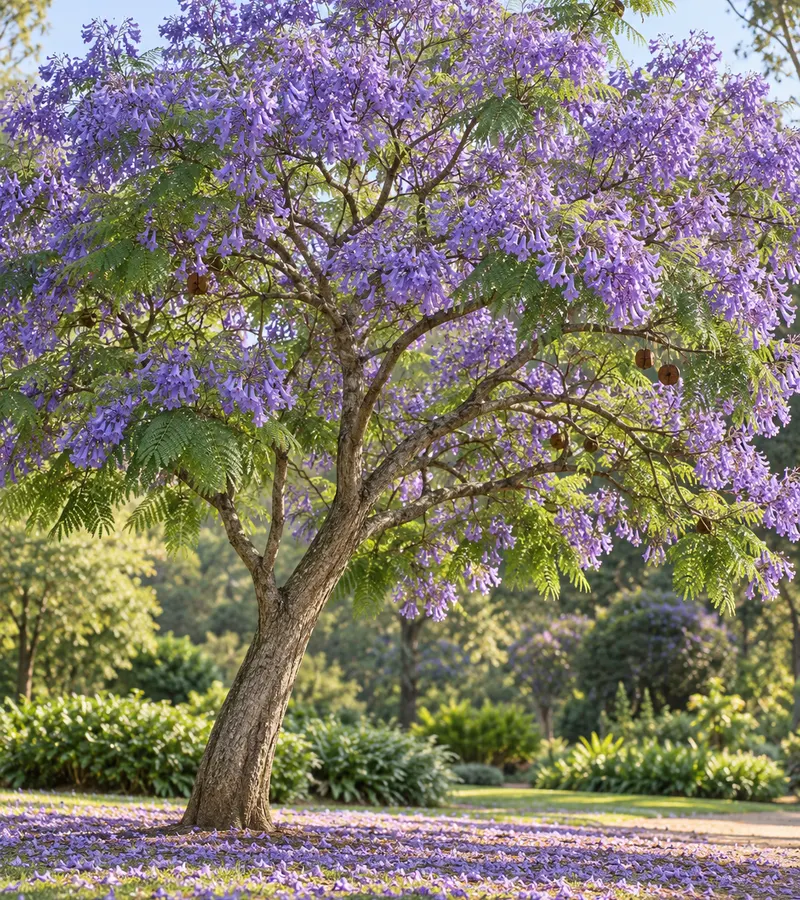
Fine fern-like feathery leaves and masses of blue-purple flowers that cover the crown and then carpet the ground below.
Care and placement
Needs full sun, well-drained soil (waterlogging rots the roots) and room for a crown 8–12 m tall and 14–18 m wide according to UF/IFAS. It is a warm-climate tree (USDA 9b–11), very drought tolerant but not salt tolerant; the weak wood breaks in storms, so it needs pruning for a sound branch structure. In Vietnam it is grown and flowers in Đà Lạt, with trial plantings in many other places.
Draft mature dimensions
Maximum height (cm): 1200 cm · Maximum spread (cm): 1000 cm
Things to consider
The wood is weak and breaks easily: branches can split at the crotches if not pruned into a sound structure, and the tree is prone to storm damage. Large surface roots form, and flowers, leaves and pods drop heavily. NC State tags it non-toxic to cats, dogs and horses, but no source rates it for children, so it is not claimed safe; do not let children chew the seeds or pods.
Sources to cross-check
Kew Plants of the World Online · Jacaranda mimosifoliaUF/IFAS · Jacaranda mimosifolia: JacarandaNC State Extension Plant Toolbox · Jacaranda mimosifoliaUF/IFAS Gardening Solutions · JacarandaWikipedia · Phượng tímDân tộc và Phát triển · Phượng tím Đà LạtWikipedia · Jacaranda mimosifoliaHow to grow and care for it
Planting and pot
Choose a sunny, well-drained spot with room for the roots and clear space overhead: UF/IFAS gives 25–40 ft (about 8–12 m) tall with a 45–60 ft (about 14–18 m) crown and possible large surface roots. Avoid planting near pools or walkways that must stay clean, because flowers, leaves and pods drop heavily. The sources give no safe distance from buildings, pipes, pavements or overhead lines, so that needs a site survey; with such weak wood it also should not stand right under wires or hard against a house. Planting on a pavement or public land needs the owner's or the authority's permission.
Light
Needs full sun (6+ hours of direct sun); young trees tolerate light shade. UF/IFAS rates it for USDA zones 9b–11 and NC State lists it as resistant to heat, humidity and drought; a mature tree tolerates brief cold down to about −7 °C (Vietnamese Wikipedia). In Vietnam it was brought to Đà Lạt in 1962 and flowers well there around March–April; it is also planted in Hà Nội and saplings were given to Ho Chi Minh City, Cần Thơ and Cà Mau, but the sources do not say how well it flowers in the hot humid lowlands.
Watering
Once established it is very drought tolerant; UF/IFAS advises watering only in prolonged drought, while a new tree needs regular water until it roots in. The bigger danger is wet soil: the sources record mushroom root rot where drainage is poor, so in rainy areas plant on a raised, well-drained spot or a mound.
Feeding
The sources give no feeding schedule or flower-boosting feed. The tree grows fast and tolerates poor sandy soil, so well-rotted organic matter at planting is enough; mature trees usually need no extra feeding.
Pruning
Pruning is a must for a durable tree: UF/IFAS says it is needed for strong structure. Keep a single trunk when young with major limbs spaced apart, remove branches that compete with the leader every three years until the tree is 15–20 years old, and keep side branches less than half the trunk diameter. Leave large trees to tree-care crews.
Propagation
The sources differ: UF/IFAS and NC State list seed, cuttings or grafting, while Vietnamese Wikipedia says cuttings root poorly so propagation in Vietnam is mostly from seed. Seed-grown trees can take a few years up to about 10 years to flower, so grafted or cutting-grown trees are preferred. For home growers, buying a young tree from a nursery is the practical route.
Pests and common problems
Flowers, leaves and pods drop heavily and need regular clearing, and UF/IFAS advises against planting near pools. The wood is weak: branches split at the crotches without structural pruning and the tree is prone to storm damage; surface roots can be large. Mushroom root rot occurs on poorly drained soil, and NC State also lists scale, aphids and a bacterial disease specific to jacaranda. In places such as South Africa, Namibia and Queensland (Australia) it has become invasive; the sources I checked say nothing about Vietnam.
For more flowers
For plentiful flowers: plant in full sun and well-drained soil, and prefer a grafted or cutting-grown tree because seedlings flower late. The pale blue-purple bell flowers open in big clusters (around March to April in Đà Lạt), covering the crown and then carpeting the ground. Wikipedia notes flowering is poor in cool places with sea winds and little heat, so a sunny warm site helps.