
Ginkgo
Ginkgo biloba
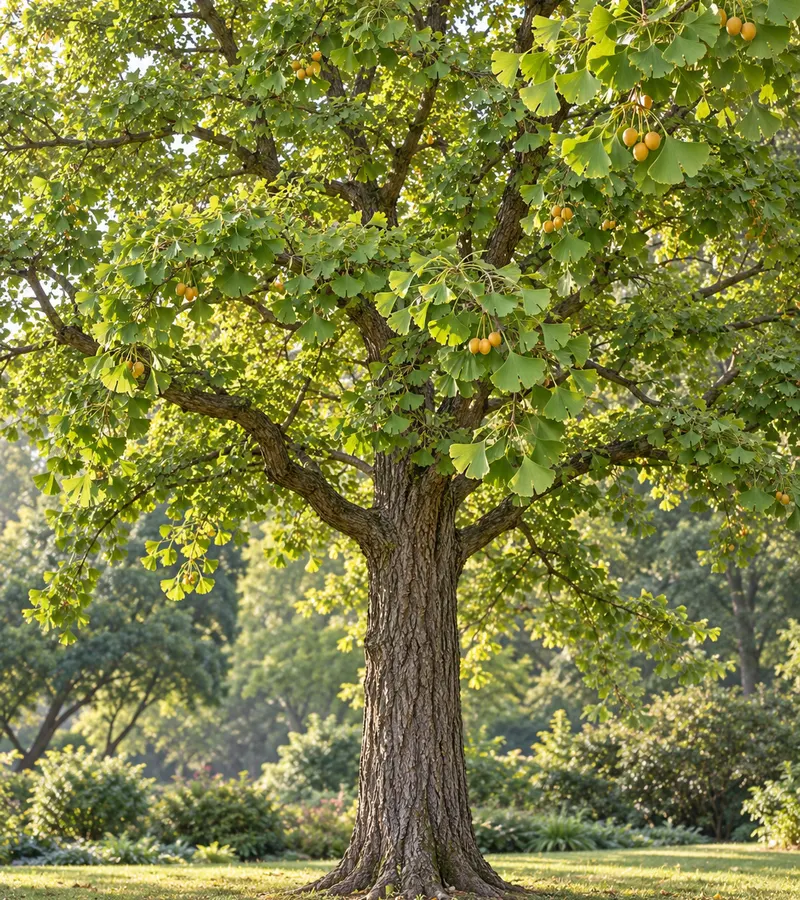
An ancient deciduous tree with fan-shaped leaves that turn golden in autumn; the fallen fruit of female trees smells foul.
Care and placement
Needs full sun to part shade, well-drained soil and room for a crown 15–25 m tall. It grows slowly and tolerates pollution, drought and moderate salt; choose a grafted male tree because the fruit that falls from females smells foul. In Vietnam it is only recorded as a trial planting in cool Sa Pa (Lào Cai), where it grows very slowly.
Draft mature dimensions
Maximum height (cm): 2000 cm · Maximum spread (cm): 1000 cm
Things to consider
The flesh of female trees' fruit smells foul and drops messily under the tree; touching the pulp can cause contact dermatitis, and eating it irritates the mouth and throat and can cause stomach pain, nausea and diarrhea. The seeds are poisonous if eaten: the RHS says they are toxic to pets and advises wearing gloves. Keep children and pets from picking up and eating fallen fruit.
How to grow and care for it
Planting and pot
Pick a sunny, well-drained spot with room for a big tree: UF/IFAS gives 50–75 ft (about 15–23 m) tall with a 50–60 ft (about 15–18 m) spread, and says it adapts to confined soil such as pavement cut-outs if there is enough overhead room. UF/IFAS says the roots are not a problem, but the sources give no safe distance from buildings, pipes, pavements or overhead lines, so that needs a site survey. Buy a named grafted male cultivar, because seedlings can take 20 years or more to fruit, so their sex is unknown. Planting on a pavement or public land needs the owner's or the authority's permission.
Light
Needs full sun (6+ hours of direct sun) and tolerates part shade. It is a temperate tree (USDA zones 3–8 per UF/IFAS, up to 9 per NC State); UF/IFAS does not recommend it in central and southern Texas or Oklahoma because of summer heat, while NC State rates it heat tolerant, so the sources disagree. For Vietnam, a Vietnamese source says seeds from France and Japan were planted in Sa Pa from 1995 and the trees grow very slowly; no source shows it suits the hot humid lowlands. The sources do not say whether it strictly needs a cold winter to survive.
Watering
Once established it tolerates drought well (UF/IFAS, NC State) but needs drained soil and should avoid wet ground; Wikipedia says it grows best in well-watered, well-drained soil. UF/IFAS notes it grows very slowly for several years after planting, then at a moderate rate with adequate water and some fertilizer. The sources give no amounts of water.
Feeding
The sources give no feeding schedule. UF/IFAS says only that it grows at a moderate rate with adequate water and some fertilizer, and that it tolerates most soils, including compacted or alkaline ones. Well-rotted organic matter at planting and a light feed for young trees is enough; mature trees usually need little.
Pruning
It needs little pruning, but UF/IFAS says some early pruning to form a single central leader is essential; the RHS says none is required. The sources also describe it as free of serious pests and diseases. Prune while the tree is young and leave tall trees to tree-care crews.
Propagation
UF/IFAS lists propagation by seed or by grafting males, while NC State lists grafting; to be sure of a male tree, growers graft from selected males. The RHS also lists semi-hardwood cuttings. The seed flesh smells foul and irritates skin, so wear gloves when handling it. For home growers, buying a grafted male tree from a nursery is the practical route.
Pests and common problems
The big city problem is a female tree: ripe fruit drops in late autumn with a very foul smell (butyric acid per Wikipedia), fouls pavements and paths, and the pulp causes dermatitis, so the sources advise planting males only. The leaves also fall in about 2 weeks each autumn according to a Vietnamese source. It is mostly free of serious pests and diseases, with rare honey fungus (RHS), but grows very slowly. No source discusses breakage in storms or wind, so large trees in typhoon-prone places need an arborist's check.
For plentiful, healthy leaves
For a handsome crown: plant in full sun and drained soil, water well and feed lightly in the early years, and keep a single trunk. Its best feature is the fan-shaped leaves turning bright yellow in autumn; UF/IFAS notes the fall color is vivid even in the southern United States.