
Cape jasmine
Gardenia jasminoides
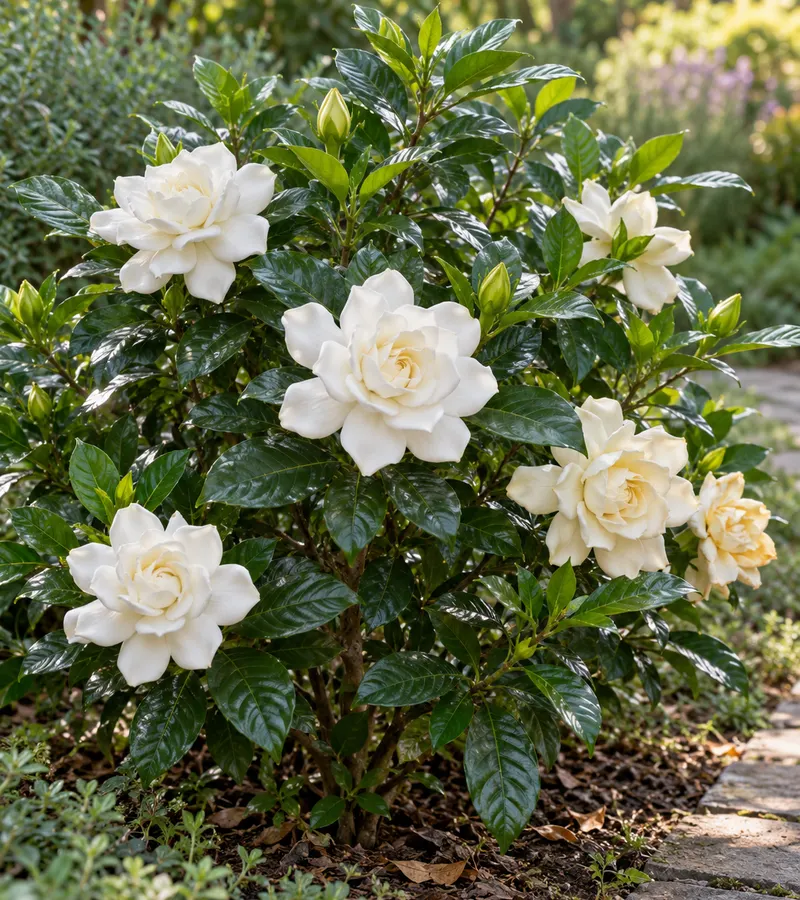
A shrub of glossy dark leaves and very fragrant cream-white flowers in summer and autumn that needs acid, well-drained soil.
Care and placement
Likes bright indirect light or part shade and tolerates full sun (NC State); rich, acidic soil (pH below 6; Wikipedia: 5.0–6.5) that drains well; moderately drought-tolerant. In less acidic soil the leaves yellow from iron shortage (Wikipedia). USDA 7b–11b; Wikipedia says in cold climates it is usually grown indoors or under glass.
Draft mature dimensions
Maximum height (cm): 200 cm · Maximum spread (cm): 200 cm
Things to consider
ASPCA and NC State say it is toxic to dogs, cats and horses (genioposide and gardenoside; mild vomiting, diarrhoea, hives). For people NC State rates it low in severity and says the flowers are edible, but do not eat them unless you are sure. Wikipedia cites a 2020 report linking long-term use of fruit extract to blue-grey skin discolouration; do not self-medicate with it. Keep it from pets and young children.
How to grow and care for it
Planting and pot
Choose a bright indirect or morning-sun, afternoon-shade spot in rich, acidic, well-drained soil. NC State warns that planting beside a concrete walk or foundation can make the soil more alkaline, so use a pot or a bed away from concrete. NC State: it grows about 1.2–2.4 m tall and wide; Wikipedia: 'Radicans' is a 15–45 cm ground cover and 'Mystery' a 1.8–2.5 m hedge.
Light
NC State: prefers bright indirect light or part shade and lists full sun as tolerated. Where the sun is fierce, shade it from afternoon sun (our inference; the sources do not say).
Watering
NC State: moderately drought-tolerant, in good drainage that is moist and occasionally dry. Water evenly when the top soil dries and never waterlog it; stressed plants are prone to whitefly (NC State).
Feeding
NC State: do not fertilize in autumn, which triggers frost-tender growth. Wikipedia: if leaves yellow in less acidic soil, iron chelate can be added to lower the pH. The sources give no other schedule; use a feed for acid-loving plants to the label (general practice; the sources do not say).
Pruning
NC State: prune in spring to keep its shape, since blossoms form on new growth, and remove spent flowers to encourage more bloom. Wear gloves if you are sensitive and wash your hands afterwards, since the plant is toxic to pets.
Propagation
The sources I read do not describe propagation; Wikipedia only notes that in 18th-century England each cutting-grown plant fetched five guineas. It is usually propagated by cuttings (general practice; the sources do not say), so buy a healthy plant from a nursery.
Pests and common problems
NC State lists whitefly on stressed plants, plus aphids, thrips, barnacle scale and citrus whitefly. Wikipedia describes the typical problem as yellowing from iron shortage in less acidic soil. Bud drop is usually from sudden changes in water, temperature or position (general practice; the sources do not say).
For more flowers
For plenty of fragrant flowers: bright light, acid well-drained soil, even watering, no autumn feeding and removal of spent blooms (NC State). Wikipedia: white flowers up to 10 cm across open in summer and autumn and are among the most strongly fragrant of all flowers; cream blooms age to yellow (NC State).