
Ironwood (lim)
Erythrophleum fordii
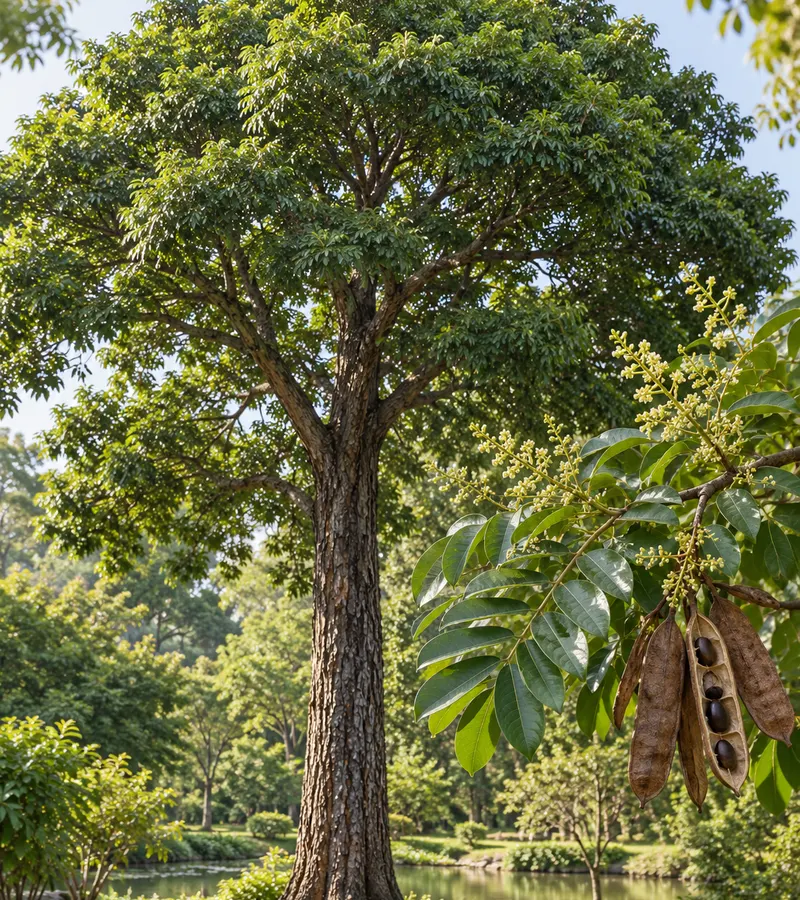
A very hard timber tree that grows slowly and keeps a broad evergreen crown; the genus holds toxic alkaloids, so never chew or taste the seeds, bark or leaves.
Care and placement
A slow-growing large timber tree: young plants accept part shade while mature trees need sun; it suits deep, moist, well-drained soil and a warm, wet climate. It needs room for its crown and deep roots, and its seeds and bark are poisonous, so children and pets must not chew any part.
Draft mature dimensions
Maximum height (cm): 2000 cm · Maximum spread (cm): 800 cm
Things to consider
The whole genus Erythrophleum contains toxic alkaloids in all parts, and the seeds and stem bark of lim xanh yield cassaine compounds; no source gives species-specific figures, so do not taste or chew leaves, bark, seeds or pods, and avoid breathing wood dust. Keep children and pets away from fallen pods and seeds, wear gloves when handling and wash hands afterwards. The species is threatened, so do not take or fell wild trees.
Sources to cross-check
Kew Plants of the World Online · Erythrophleum fordiiUseful Tropical Plants · Erythrophleum fordiiGỗ lim xanh: nhận biết, đặc điểm và ứng dụngCây lim xanh giống · Kỹ thuật trồngCây lim xanh · Đặc điểm sinh trưởng và nhân giốngMolecules · Cassaine diterpenoid amide from stem bark of Erythrophleum fordiiHow to grow and care for it
Planting and pot
Buy nursery stock from a legal nursery and never take trees from the forest, because lim xanh is listed as threatened worldwide and in Vietnam's Red Data Book. Plant at the start or end of the rainy season in a pit of about 40×40×40 cm or 50×50×50 cm, with seedlings 25-30 cm tall after 7-12 months in the nursery, and mix well-rotted manure into the soil. The tree reaches 25-30 m with a wide crown and deep roots, so the safe distance from buildings, pipes, pavement and overhead lines needs a site survey because the sources give only forestry spacing. Choose a spot where children will not pick up pods and seeds. Planting on public land needs the owner's or authority's permission.
Light
Seedlings of 4-5 months tolerate shade and grow normally under 25-75% cover, best at about 50%; young plants in full harsh sun or deep shade both grow slowly. From about age 5 trees grow normally in natural light, and mature trees need sun.
Watering
Water new plantings once or twice a day in the early morning or cool afternoon; mature trees need periodic watering, especially in the dry season, and good drainage in the rainy season. Its natural range gets about 1,500-3,000 mm of rain a year at 80-86% average humidity.
Feeding
Apply well-rotted manure or NPK at planting; mature trees are fed 2-3 times a year at the start, middle and end of the rainy season with NPK or organic fertiliser. The roots carry nitrogen-fixing nodules that improve soil, while thin, degraded soil supports only weak growth.
Pruning
Prune only dead and diseased wood and water shoots to shape the crown, and keep the base weeded with the soil lightly loosened. The wood is very hard, so large cuts need a sharp saw and a qualified crew near buildings or power lines; wear gloves and a dust mask because leaves, bark and wood dust may be harmful.
Propagation
Propagate by seed. Pick pods when they turn dark brown in December-January, dry them and extract the seed; soak seed in 60-80 °C water for about 10-12 hours, rinse off the sticky coat and soak in cold water for 14-16 hours before sowing. Dry seed keeps for 1-2 years, and seedlings are ready after 7-12 months. Wear gloves when handling seed because it is poisonous.
Pests and common problems
Growth is slow, about 0.8 m a year, with planted trees 17-21 m tall at 25 years, so it looks small for the first years. It has deep roots and a wide crown when mature, so keep it away from foundations, drains and overhead lines; the sources do not cover typhoon wind or branch brittleness. The flat pods and seeds that fall are poisonous, so sweep them up and keep children from picking them. Common pests are leaf-eating caterpillars, stem borers and fungal disease. Do not confuse it with lim xẹt (Peltophorum pterocarpum) when buying stock. No source mentions pollen or scent causing allergies, but the wood has a pungent smell many find unpleasant.
For plentiful, healthy leaves
For a dense, healthy green crown: deep, moist, free-draining soil; light shade while small then full sun; steady watering in the first year, 2-3 feeds a year in the rainy season, and patience since growth is slow. The twice-pinnate leaves are glossy green and the crown stays dense all year.