
Tiger's claw
Erythrina variegata
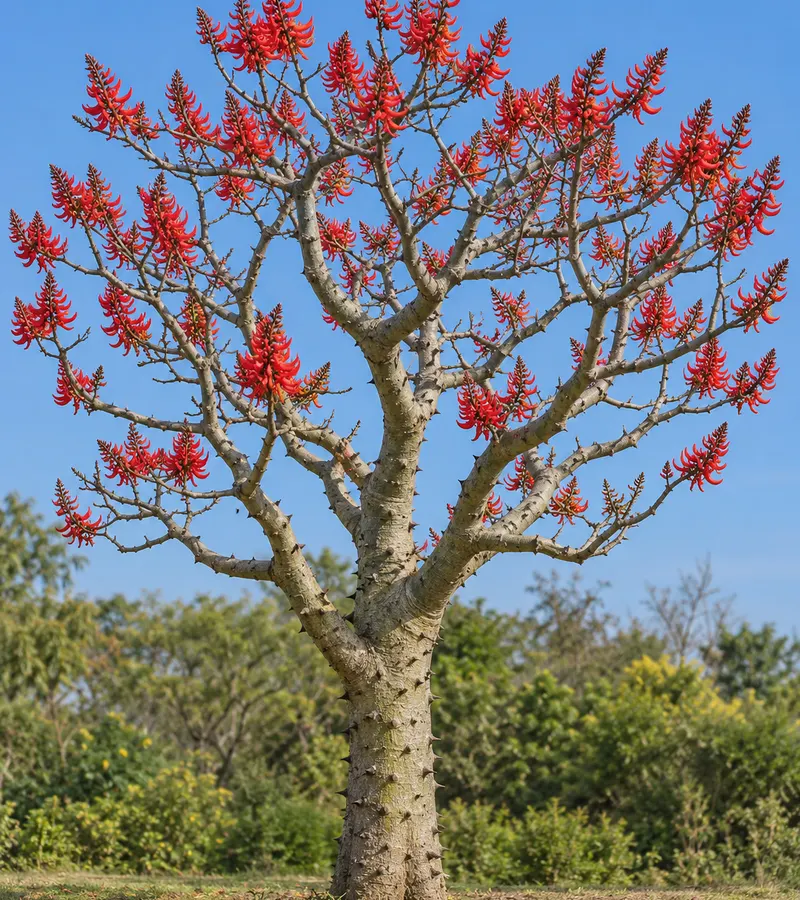
Scarlet flowers open on leafless branches; the three-part leaves wrap Vietnamese nem, and the soft wood carries prickles.
Care and placement
Needs full sun and moist, well-drained soil (it tolerates waterlogging and some salt), pH about 5–7; only for frost-free regions. It is leafless for a few months a year, with a prickly trunk, light spongy wood and poisonous raw seeds; easy to propagate from cuttings or seed.
Draft mature dimensions
Maximum height (cm): 1200 cm · Maximum spread (cm): 900 cm
Things to consider
Raw seeds are poisonous (Wikipedia), the leaves and stems contain the poisonous alkaloid erythrine (Vietnamese Wikipedia), and leaves and seeds hold low levels of narcotic alkaloids (Useful Tropical Plants); do not eat the seeds, and keep children and pets away from pods and seeds. The trunk and branches are prickly and the wood is light and spongy, so wear gloves when pruning. There is no toxicity rating specific to cats or dogs, so it is not claimed safe for them.
Sources to cross-check
Kew Plants of the World Online · Erythrina variegataUseful Tropical Plants · Erythrina variegataNParks Flora & Fauna Web · Erythrina variegataWikipedia · Erythrina variegataKaren's Garden Tips · Plant profile: Tiger clawWikipedia tiếng Việt · Vông nemWikipedia · Quadrastichus erythrinaeHow to grow and care for it
Planting and pot
Choose a spot in full sun with average, moist but well-drained soil (it tolerates waterlogging and some salt). The tree reaches 10–20 m and grows fast (15–20 m in 8–10 years if unpruned) with a prickly trunk and spongy wood, so plant it away from footpaths, windows and wires; the sources give no safe distance from buildings, pipes or pavements and do not describe the roots, so a site survey is needed. Planting on public land needs permission from the owner or the street-tree authority. It is frost-tender (USDA 9–10) and suits hot lowlands and coasts.
Light
Needs full sun (NParks, Karen's Garden Tips). It bears bright red flower clusters at the branch tips but is leafless for a few months a year; Useful Tropical Plants advises against using it as a shade tree in Java for that reason, so do not expect year-round shade. It does best where the mean minimum is around 20 °C and the mean maximum around 32 °C.
Watering
Moderate water needs (NParks) and it tolerates waterlogged soil (Karen's Garden Tips). It thrives with roughly 800–1,500 mm of rain a year (Useful Tropical Plants), so water newly planted trees regularly until they root in, after which a large tree mostly relies on rain.
Feeding
The sources give no feeding schedule. Useful Tropical Plants says it likes moderately fertile, well-drained soil at pH 5–7 and notes it is also used as green manure to improve soil. Usually it is enough to mix well-rotted compost into the planting hole and feed lightly if growth is slow.
Pruning
Karen's Garden Tips advises pruning to improve structure; the sources give no specific schedule. Shape the crown while the tree is young, remove dead and low prickly branches, wear thick gloves and eye protection, and leave large limbs or work near wires to a qualified arborist.
Propagation
Easy from cuttings: Useful Tropical Plants says large branches 2–3 m long and 5–8 cm thick root well; it can also be grown from seed (NParks, Karen's Garden Tips). Wear gloves and keep children from handling the seeds, which are poisonous when raw.
Pests and common problems
The wood is light, soft and spongy and the trunk is prickly (Useful Tropical Plants, Karen's Garden Tips), but the sources do not rate branch strength in storms, so a tree near houses or wires needs an arborist's check before the typhoon season. It sheds leaves seasonally and drops flowers and pods under the crown. The gall wasp Quadrastichus erythrinae makes galls that deform leaves, shoots and flower clusters (Wikipedia lists Singapore, Thailand, the Philippines, Hong Kong and China, not Vietnam), and the fruit-piercing moth Othreis fullonia is also mentioned.
For more flowers
For plenty of red flowers: give full sun and moist, well-drained soil, shape the crown while young and avoid heavy pruning just before the flowering season. The scarlet racemes, 10–40 cm long, stand out on the sparsely leafed branches.