
Vietnamese balm
Elsholtzia ciliata
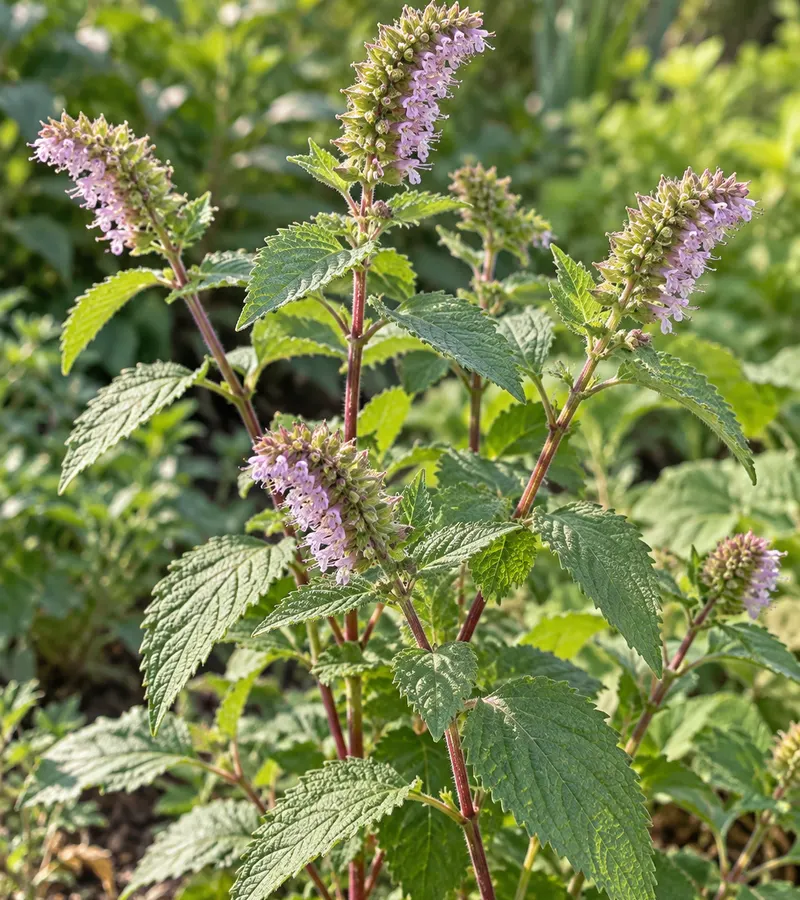
A lemon-scented herb for meat, soups and salads that grows fast in sun and moist soil and can self-seed into a weed.
Care and placement
Needs full sun (PFAF: it cannot grow in shade) in clay, loam or sand with a pH from mildly acid to mildly alkaline, and prefers moist soil; an erect herb about 0.6 m tall that is cold-hardy (USDA 4–8). Wikipedia: an erect herb 30–50 cm tall found on riverbanks, in forests and on hills, preferring moist soil and also found on exposed rocky slopes.
Draft mature dimensions
Maximum height (cm): 60 cm · Maximum spread (cm): 30 cm
Things to consider
PFAF lists no known hazards. Wikipedia notes Connecticut (USA) bans it and classes it as a noxious weed because it spreads, so do not let it seed everywhere and never release it into the wild. No toxicity rating exists for dogs, cats or young children, so it is not claimed safe. The folk-use information below does not replace medical advice.
How to grow and care for it
Planting and pot
Choose a full-sun spot with moist soil, in a pot or bed of its own so it does not self-seed elsewhere. PFAF: sow seed in place in late spring. Pick young leaves while the plant is still low.
Light
PFAF: needs full sun and cannot grow in shade. Where the sun is fierce, shade it from afternoon sun so the leaves do not scorch (our inference; the sources do not say).
Watering
PFAF: it prefers moist soil. Keep the soil evenly moist, watering when the top layer dries and making sure the pot drains (our inference).
Feeding
The sources give no feeding schedule. Mix well-rotted organic matter into the mix when sowing and feed lightly to the label after heavy picking (general practice; the sources do not say).
Pruning
The sources do not cover pruning. Picking the tips often helps it branch; cut off the flower heads before the seed ripens so it does not self-seed (our inference from Wikipedia's weed note). PFAF: it is harvested in flower and dried for later use.
Propagation
PFAF: sow seed in place in late spring; it is usually a one-season plant, so resow every year. Wikipedia does not describe propagation.
Pests and common problems
The sources I read name no pests or diseases. The main problem is self-seeding into a weed; pull seedlings that appear in the wrong place (Wikipedia). In low light it stretches, and dry soil leaves the leaves tough and weak in scent (general practice; the sources do not say).
For a bigger harvest
Wikipedia: the leaves have a lemony flavour and flavour meat dishes, soups and salads; PFAF: young leaves are eaten raw or cooked and finely cut as an aromatic condiment (edible rating 2/5). PFAF records folk use for colds, fevers, headaches and diarrhoea (medicinal rating 2/5); Wikipedia says herbal medicine uses it as a carminative. That is folk information, not treatment advice.