
Vietnamese dragon plum
Dracontomelon duperreanum
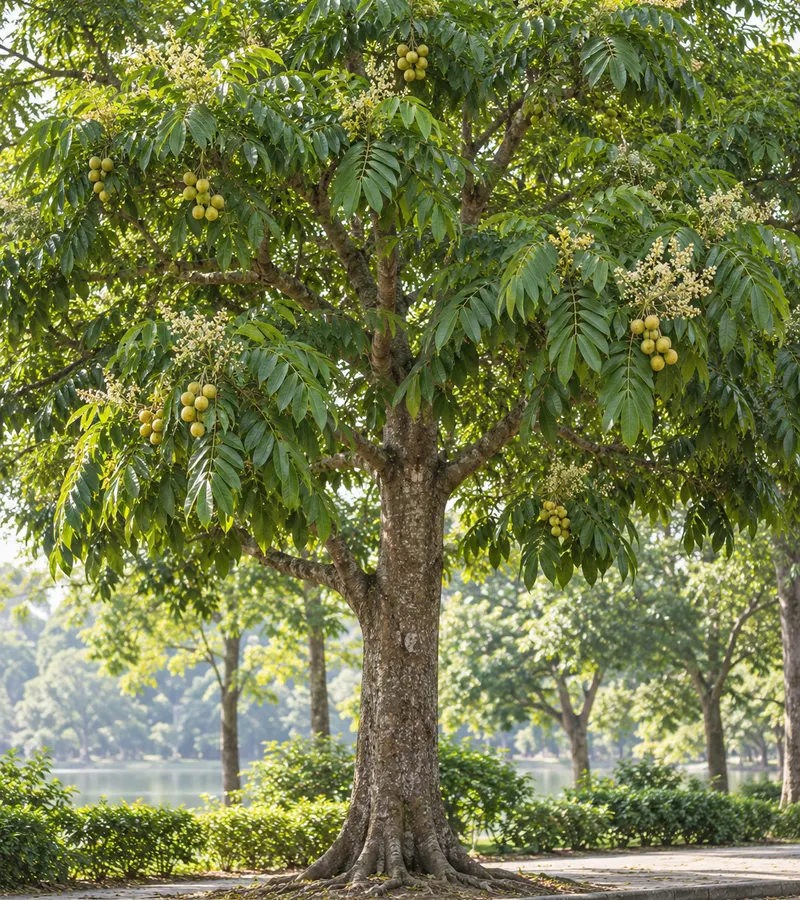
A large shade tree of Hanoi streets with feathery compound leaves and sour yellow fruit cooked with duck or preserved in sugar for a summer drink.
Care and placement
A light-loving tree that is not fussy about soil but prefers well-drained sandy or light loam; the taproot goes deep. It needs a wide root zone, pruning guided by a tree-care assessment and firm staking after planting.
Draft mature dimensions
Maximum height (cm): 2000 cm · Maximum spread (cm): 1200 cm
Things to consider
It is a tall tree and many old sấu trees in Hanoi fell in Typhoon Yagi in 2024, especially old trees or those whose roots were boxed in by pavement and road surfaces. No source rates its toxicity or sap irritation, so it is not claimed safe; the fruit is used as food and tastes sour, but children and pets should not chew other parts of the tree.
How to grow and care for it
Planting and pot
Dig a hole more than twice the root ball, plant straight and stake right away so it does not fall. Leave a wide root zone and do not box it in with concrete or paving, because roots need room; many fallen Hanoi trees had roots boxed in. One supplier gives 4–6 m for planting street-tree stock, while safe distances from buildings, pipes, pavements and overhead lines for a mature tree are not given and need a site survey. Planting on a pavement or public land needs the authority's permission.
Light
A light-loving tree that grows quickly with enough sun. It is evergreen or only sheds some leaves in winter and flushes again in spring; it is very common in Hanoi with its cool winters, but no source confirms how it copes with hard frost.
Watering
Newly planted trees need gentle watering from a bucket or small hose so the fresh soil is not washed away. The deep taproot helps big trees cope with drought; in cities large trees are usually watered by tanker and the frequency depends on the weather.
Feeding
One tree supplier feeds trees under 5 years old about every 2–3 months, and fruiting trees get a boost after harvest together with pruning. The sources give no reliable dose for mature trees, so ask a local tree-care service.
Pruning
Prune on an expert assessment of species, age and soil rather than arbitrarily, since poor pruning unbalances the crown and invites toppling in storms. Leave tall trees to a tree-care crew with safety gear, especially near overhead lines.
Propagation
Grow it from seed taken from ripe fruit of 7–10-year-old trees: soak 5–7 days to remove the pulp, sow 3–4 cm deep in 5×10 cm bags and shade 50–70%. Move seedlings to bigger bags when they are 15–20 cm tall with 2–4 true leaves. A supplier says it takes about 3–6 years to reach shade-tree size.
Pests and common problems
The tree is usually healthy with few pests; seedlings are prone to collar rot in heavy rain, and leaf-eating caterpillars and trunk fungi occasionally appear. Large trees can have roots surfacing and can fall in storms if the roots are boxed in, the crown is heavy or the tree is old; trees near tall buildings also face funnelled wind. The fruiting season runs from about June to November, so ripe fruit that falls onto the pavement and road needs clearing.
For heavy fruiting
For a good fruit crop: plant in sun, keep the crown balanced and look after the root zone. Trees start fruiting when the trunk reaches about 15 cm across; per a supplier, flowers open around April–May, fruit appears from June–July and is harvested from July to September.