
Resin tree
Dipterocarpus alatus
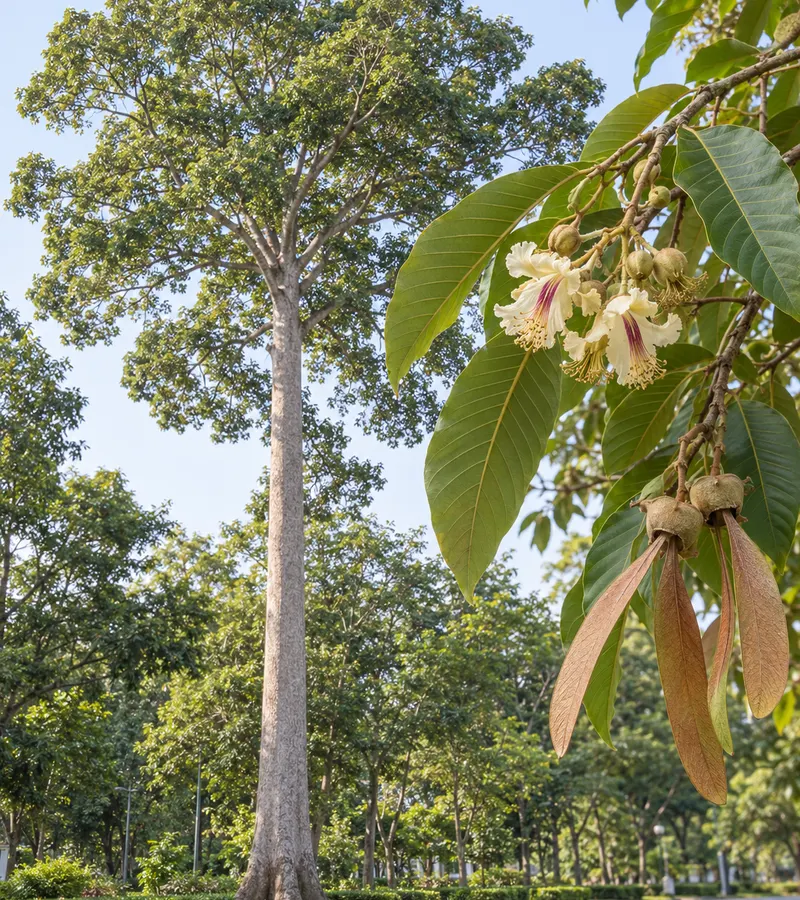
A very tall tree with a round straight trunk and long-winged fruits, planted for shade in large parks and campuses.
Care and placement
Needs full sun once grown (seedlings tolerate shade for some years), moist well-drained soil and moderate watering; a 30–40 m tree with a massive trunk that does not tolerate strong wind or fire, so plant it only on roomy, sheltered sites; propagated by fresh seed.
Draft mature dimensions
Maximum height (cm): 3000 cm · Maximum spread (cm): 1000 cm
Things to consider
A very tall tree that one source says does not tolerate wind; big limbs tens of metres up can break and fall in storms, and old trees need regular inspection. Wood dust can cause boils in people who saw or cut it. The sources consulted give no toxicity data for leaves or fruit, so safety is not claimed. Planting, pruning or felling on public land needs the authority's permission.
Sources to cross-check
Kew Plants of the World Online · Dipterocarpus alatusNParks Flora & Fauna Web · Dipterocarpus alatusUseful Tropical Plants · Dipterocarpus alatusWikipedia tiếng Việt · Dầu ráiWikipedia · Dipterocarpus alatusTuổi Trẻ · Đốn hàng loạt cây xanh ở TP.HCM vì lo ảnh hưởng bởi bão YagiChính phủ · Nghị định 64/2010/NĐ-CP về quản lý cây xanh đô thịHow to grow and care for it
Planting and pot
Plant only where there is plenty of room: the tree usually reaches 30–40 m with a trunk up to about 1.5 m wide, so distances to buildings, buried pipes, pavements and overhead lines must come from a site survey (the decree requires the electricity safety corridor to be kept). Choose moist, well-drained soil, ideally alluvial-like at pH 5–6.5; shelter from strong wind and stake young trees until the roots hold. Planting on a pavement or public land needs the tree authority's permission; buy nursery stock, because the species is Vulnerable in the wild.
Light
Seedlings tolerate shade and can survive under a canopy for years, but older trees need full sun. Once a young tree is about 1.2 m tall, open the canopy above it so it grows faster.
Watering
Water moderately and keep the soil evenly moist while the tree is small. It tolerates flooding but needs soil that drains well; sources give different preferred rainfall figures, so rely on watching the soil rather than one number, and avoid both drying out and standing water.
Feeding
The sources consulted give no fertiliser schedule for this species. Mix well-rotted compost into the planting hole and mulch the base; the soil under mature trees is reported to be richer in organic matter and in N, P and K than soil farther from the canopy.
Pruning
The trunk is straight and round, so little shaping is needed; remove only dead or diseased branches. The bark is thin and very sensitive to fire, so avoid burning rubbish or scraping the bark near the base. Pruning shade trees 10 m or taller on public land needs a permit; workers should wear a dust mask because wood dust can cause boils.
Propagation
Propagated by seed, sown as soon as the fruit ripens because the seed loses viability quickly and needs no pre-treatment. Seeds germinate in about 4–7 days and seedlings can be planted out at about 30 cm tall, after roughly 8–12 months. Cuttings from coppice shoots also work but root at only about 44%.
Pests and common problems
The main city problems are size and wind: Wikipedia says the tree does not tolerate wind, and after the storm of 4 September 2024 a dầu tree branch about 6 m long fell from roughly 25 m in Ho Chi Minh City and killed a motorcyclist, so big trees need inspection and crown lightening. Fruits with wings up to 14 cm long drop in the fruiting season; the sources consulted do not describe the root system, so safe distances to pavements and pipes need a site survey. The sources consulted do not report allergenic pollen.
For plentiful, healthy leaves
For a handsome tree: plant on a roomy, wind-sheltered site with full sun once it is taller than about 1.5 m, moist well-drained humus-rich soil, and keep fire and wounds away from the trunk. Large hairy leaves and a tall round straight trunk are the hallmarks of a mature tree.