
Flamboyant
Delonix regia
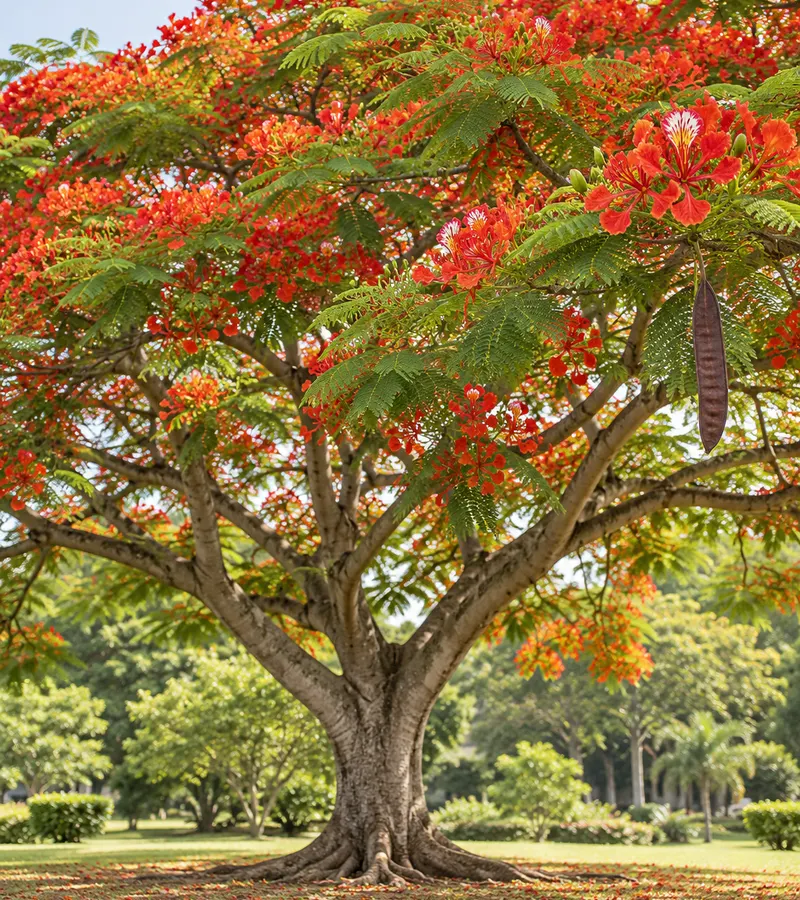
A wide umbrella crown of feathery leaves that carries flaming red-orange flowers in summer, tied in Vietnam to the end of the school year.
Care and placement
Needs full sun for the most flowers; very drought tolerant, suits well-drained soil and is frost-sensitive. The wood is weak, so shape the branch structure early and plant at least about 3 m from pavements because of large surface roots.
Draft mature dimensions
Maximum height (cm): 1200 cm · Maximum spread (cm): 1500 cm
Things to consider
The weak wood means branches can snap in storms, long pods and twigs litter the ground, and surface roots can damage pavements. In Vietnam many schools cut down or heavily pruned trees after a fatal falling-tree incident. No source rates its toxicity for children or pets, so it is not claimed safe.
How to grow and care for it
Planting and pot
Choose an open, full-sun spot with well-drained sandy or loamy soil; heavy clay does poorly. A mature tree is about 11–12 m tall with a 12–18 m spread and large surface roots, and UF/IFAS advises keeping it about 3 m from pavements. No source gives distances from buildings, pipes and overhead lines, so that needs a site survey. A Vietnamese nursery digs a hole at least 40 cm, ideally 60 cm each way, and supports seedlings around 1.2 m tall. Planting on a pavement or public land needs the authority's permission.
Light
Full sun gives the most flowers and best growth. It needs a tropical or near-tropical climate (USDA 10B–11) so frost can hurt it; in areas with a marked dry season it sheds its leaves, elsewhere it is nearly evergreen.
Watering
Water well until established, then only in the severest droughts; big trees are very drought tolerant and usually need only rain. Seedlings need about twice a week, avoiding both drought and waterlogging.
Feeding
At planting, a nursery source adds about 5–10 kg of well-rotted manure or roughly 100 g of NPK per hole and rests the hole about 15 days before planting. Seedlings get dilute NPK every 2 weeks; big drought-tolerant trees need little extra care.
Pruning
Early pruning is essential: train the main limbs about 2.4–3.7 m above ground and keep each under half the trunk diameter so the branches attach strongly. Leave tall trees to a tree-care crew with safety gear, especially near overhead lines.
Propagation
Mostly grown from seed, soaked or nicked before sowing. Semi-hardwood cuttings keep a variety true to type, and air layering is also used.
Pests and common problems
Caterpillars may eat the foliage and a root fungus can kill weakened trees. The flat pods, 0.3–0.6 m long, hang through winter and fall in spring, making a mess. The wood is weak so branches can snap in storms, large surface roots can crack pavements, and the tree drops leaves around January to March per a Vietnamese source.
For more flowers
For flaming blooms: full sun, a strong branch frame from early on, and no overwatering since it is used to dry spells. In Vietnam it carries red-orange flower clusters at the branch tips around May to July, coinciding with the end of the school year, hence the 'pupil's flower'.