
Globe artichoke
Cynara cardunculus
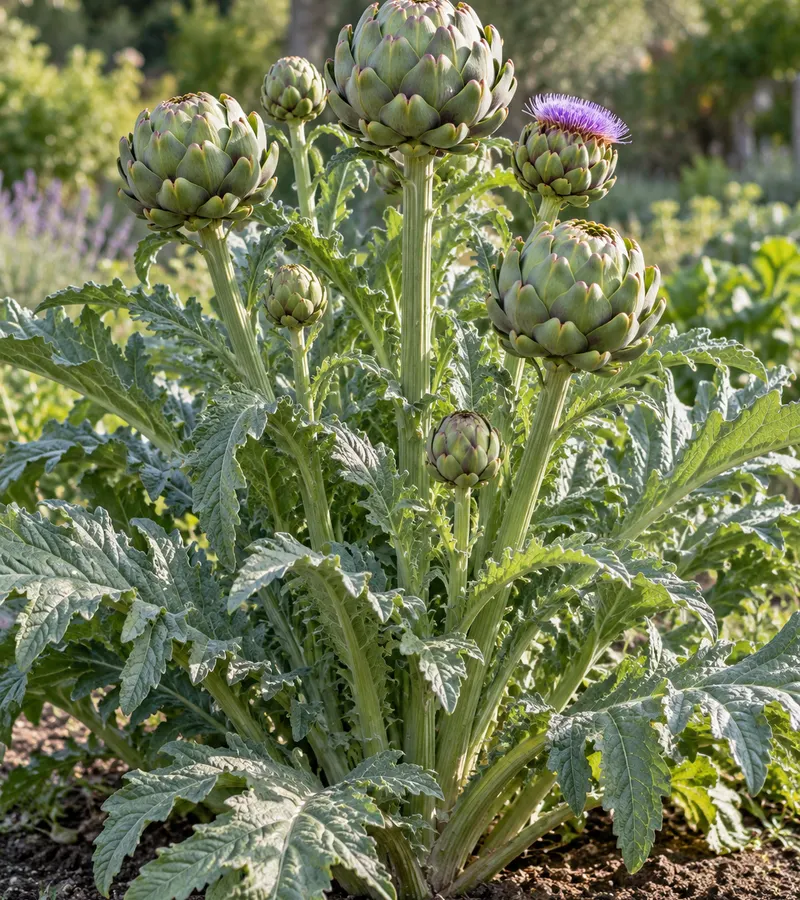
A large herb with silvery cut leaves whose flower buds are picked before they open as a vegetable and whose leaves make tea; it suits cool climates such as Da Lat.
Care and placement
Needs full sun (PFAF: it cannot grow in shade), well-drained soil, and prefers moist soil with plenty of moisture in the growing season. It suits cool climates (USDA 5–9) but may need protection in cold winters; PFAF says wet winters cause more problems than cold ones. Wikipedia: it needs good soil, regular watering and feeding and frost protection; no source confirms it does well in Vietnam's hot humid plains, so treat it as a cool-climate plant such as Da Lat.
Draft mature dimensions
Maximum height (cm): 150 cm · Maximum spread (cm): 100 cm
Things to consider
PFAF warns it can cause allergic dermatitis from lactones, calls for caution with biliary obstruction and may hinder lactation. No toxicity rating exists for dogs, cats or young children, so it is not claimed safe. Wikipedia attributes health benefits to a medical source it does not summarise, so the folk-use information below is not evidence and does not replace medical advice.
How to grow and care for it
Planting and pot
Choose a full-sun spot with deep, well-drained soil and some wind shelter. PFAF: it reaches about 1.5 m tall and 1 m wide; Wikipedia: 1.4–2 m tall with leaves 50–83 cm long and flower buds 8–15 cm across. It lives only a few years (Wikipedia), so plant new suckers each year.
Light
PFAF: needs full sun and cannot grow in shade. As a cool-climate plant, where it is hot all year it wants afternoon shade (our inference; the sources do not say).
Watering
PFAF: it prefers moist soil and needs plenty of moisture in the growing season; wet winters cause more problems than cold ones. Wikipedia: it needs regular watering. Water evenly when the top soil dries but make sure it drains, especially in the rainy season.
Feeding
Wikipedia: it needs regular feeding. The sources give no specific schedule; add well-rotted organic matter at planting and feed lightly to the label while it makes leaves and buds (general practice).
Pruning
The sources do not cover pruning. Remove old leaves and the stems that have borne buds after harvest (general practice; the sources do not say). PFAF: divide the suckers every three years.
Propagation
PFAF: sow seed in a greenhouse in early spring or in place in April, 2 cm deep with 2–3 seeds per spot and protected from mice; or divide suckers in March–April or November. Wikipedia: by division, root cuttings or micropropagation, and rooted suckers can be planted each year.
Pests and common problems
Wikipedia records the fungi Verticillium dahliae and Rhizoctonia solani; wet winters cause more problems than cold ones (PFAF). A bud left to open into a flower becomes coarse and barely edible. It is weaker in year-round hot humid weather (our inference from its cool-climate profile).
For a bigger harvest
Wikipedia: the edible part is the flower bud before it opens, cut leaving an inch or two of stem; once it blooms it is coarse and barely edible. PFAF: only the bract bases and the heart are eaten; the leaves make tea and PFAF records folk use for the liver and gallbladder (medicinal rating 5/5), while Wikipedia says artichoke tea is drunk in Vietnam, Romania and Mexico. That is folk information, not medical evidence.