
Cannonball tree
Couroupita guianensis
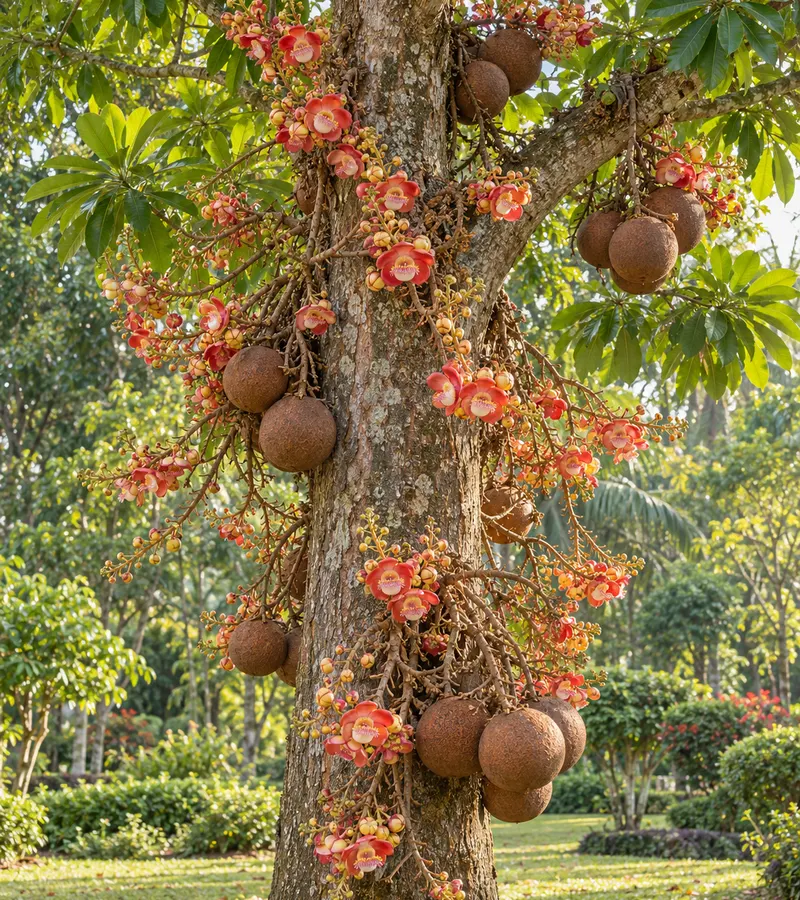
Fragrant flowers open in clusters straight from the trunk, followed by heavy cannonball-sized fruit, so it needs space away from paths.
Care and placement
Needs full sun, deep, moist, humus-rich soil and regular watering; very sensitive to frost. The hard round fruit, up to 25 cm across and about 1 kg on average, falls without warning, so never plant over or beside paths, car parks or playgrounds; propagated by seed.
Draft mature dimensions
Maximum height (cm): 2000 cm · Maximum spread (cm): 900 cm
Things to consider
The fruit is hard and round, up to 25 cm across and about 1 kg on average (Wikipedia), and falls without warning (NParks); Useful Tropical Plants notes it can cause accidents. Do not allow walking, parking or play under the crown, and put up warning signs in public places. NParks says the pollen and fruit pulp may irritate some people, and the ripe fruit smells unpleasant. There is no toxicity rating for cats, dogs or children, so it is not claimed safe.
How to grow and care for it
Planting and pot
Choose a sunny site with deep, moist, humus-rich, well-drained soil. NParks advises a spacing of 6–9 m and not planting too close to roads or paths; because a fruit of about 1 kg can fall without warning, leave a buffer zone around the crown and put no seating, walkway, car park or playground beneath it. The roots include a taproot and fibrous roots; the sources give no safe distance from buildings, pipes, pavements or overhead lines, so a site survey is needed for a tree 20–25 m tall. Planting on public land needs permission from the owner or the street-tree authority.
Light
Needs full sun (NParks, Useful Tropical Plants). It suits the hot, humid tropics; Useful Tropical Plants says it is very susceptible to frost, so cold highlands are unsuitable. It can shed its leaves seasonally (Wikipedia, canhquan.net).
Watering
NParks lists moderate water and regular watering; Useful Tropical Plants says it grows on moist to wet riverside soil in the wild but can also live on dry soil. A Vietnamese source (canhquan.net) says it tolerates waterlogging fairly well but drought poorly, so keep a newly planted tree evenly moist.
Feeding
NParks says it likes deep, moist, humus-rich soil; the sources give no feeding schedule for a large park tree. A Vietnamese source (xuannong.vn) suggests organic fertilizer or NPK every 2–3 months for home-grown plants; for a tree in the ground, mix well-rotted compost into the hole, mulch the base and feed lightly if growth is slow.
Pruning
The sources give no pruning schedule. Cut only dead branches and low ones that block paths; the fruit takes about a year to 18 months to ripen (Wikipedia, NParks) and can hang on the trunk for a long time, so inspect regularly and clear fallen fruit. Removing fruit or large limbs from the crown should be left to qualified workers with protective gear.
Propagation
Propagate by seed: Useful Tropical Plants says to sow it soon after harvest with no pretreatment, giving over 80% germination in 8–15 days and seedlings ready to plant at about 7 months. NParks says seed can be difficult and woody cuttings may be used; a Vietnamese source soaks seed in warm water for 24 hours or roots cuttings.
Pests and common problems
The main risk is falling fruit: hard, heavy and dropping without warning, with an unpleasant smell when ripe. The fragrant flowers grow in racemes up to 80 cm long straight from the trunk; each flower lasts a day but many open together through the year (NParks, Wikipedia), so flowers drop constantly. NParks says the pollen and fruit pulp may irritate. The wood is soft and non-durable (Useful Tropical Plants) and the sources do not rate storm resistance, so a large tree near houses needs an arborist's check of its limbs.
For more flowers
For plenty of fragrant flowers: give full sun, moist humus-rich soil and regular watering. The scent is strongest at night and in the early morning (Wikipedia), and the petals are pink-red at the base and yellowish toward the tips. More flowers mean more heavy fruit, so judge the falling-fruit risk before planting anywhere busy.