
Coconut palm
Cocos nucifera
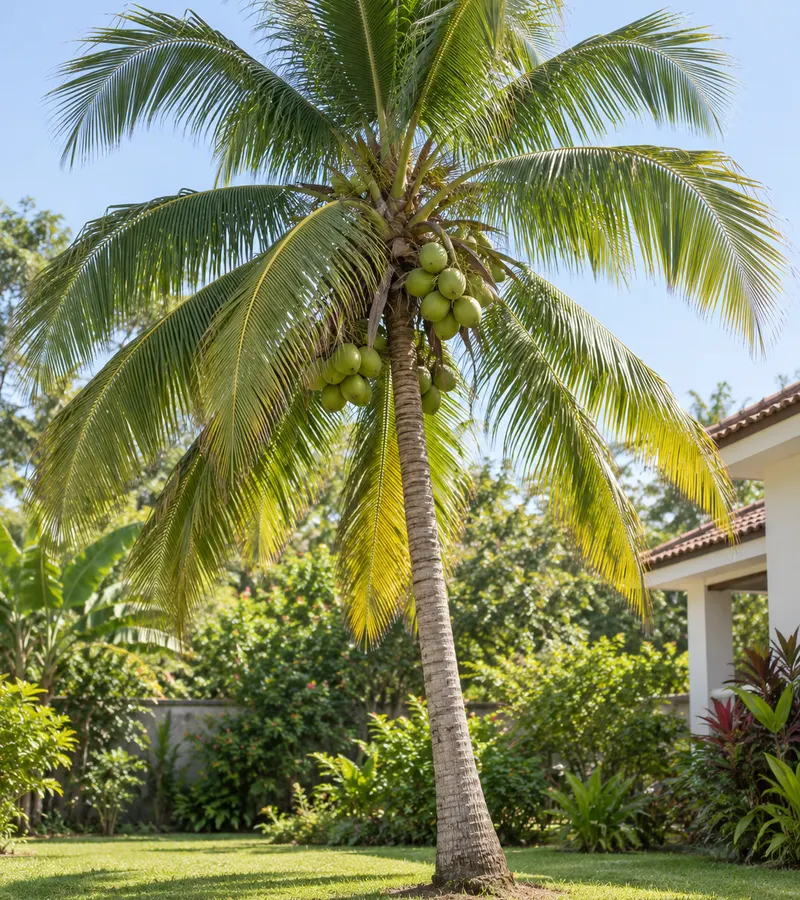
The tall coastal palm of the delta that tolerates salt and wants lots of sun; dwarf varieties fruit sooner.
Care and placement
Needs full sun (PFAF: it cannot grow in shade, even when small) and well-drained soil with a high water table, preferred pH 5.5–7. It tolerates saline soil and salt spray (PFAF: halophytic) and does not tolerate cold: best where temperatures never fall below 10 °C. Wikipedia: it needs 1,500–2,500 mm of rain a year and humidity above 60%, cannot tolerate waterlogging and resists hurricane-strength wind if its roots are well developed.
Draft mature dimensions
Maximum height (cm): 2500 cm · Maximum spread (cm): 700 cm
Things to consider
PFAF lists no known hazards, but no official toxicity rating exists for children, dogs or cats, so it is not claimed safe. The palm is very tall (PFAF: about 25–30 m), so heavy fronds and nuts can fall from height; do not plant beside paths, parking or roofs (our inference; the sources do not say). PFAF also notes it can form dense thickets in new coastal areas. Wikipedia: harvesting by climbing is more dangerous and a long pole is safer.
How to grow and care for it
Planting and pot
Plant only where there is plenty of sun and drainage, well away from houses and paths. Wikipedia: tall coconuts first fruit in 6–10 years and live 60–100 years; PFAF: dwarf palms begin bearing in their third year, and Wikipedia says dwarf varieties have a shorter lifespan. A small yard should choose a dwarf if it wants fruit sooner.
Light
Needs full sun: PFAF says it grows well in full sun even when small and cannot grow in shade; Wikipedia says it needs abundant sunlight and shade seriously limits growth.
Watering
Wikipedia: it needs about 1,500–2,500 mm of rain a year and humidity above 60% and cannot tolerate waterlogging; dry climates need frequent irrigation. PFAF wants well-drained soil with a high water table. Water young palms evenly until rooted and through dry seasons (our inference from the sources' water needs).
Feeding
The sources give no feeding schedule. PFAF says it tolerates nutritionally poor soil, so add well-rotted organic matter at planting and feed young palms lightly to the label (general practice; the sources do not say).
Pruning
The sources do not cover pruning. A tall palm should be left to people with the skill and tools to remove dead fronds and harvest nuts; do not climb without skill (Wikipedia: climbing needs skill and is more dangerous). The apical bud is edible but kills the trunk (PFAF), so do not take it.
Propagation
PFAF: fresh seed germinates readily at 27–30 °C with no dormancy, and may germinate while still on the palm; tissue culture is a popular vegetative method. Wikipedia: the embryo sits under the one functional pore and pushes out through it, so a whole fresh nut is laid on moist sand to sprout.
Pests and common problems
Wikipedia records lethal yellowing (a phytoplasma), caterpillars of several Batrachedra moths, the coconut leaf beetle Brontispa longissima and the eriophyid mite Aceria guerreronis, which can damage up to 60% of production. Waterlogged or shaded palms grow poorly.
For heavy fruiting
For fruit: full sun, moist but draining soil, humid air, and a dwarf variety if you want fruit sooner. PFAF: fruit takes about a year to mature; Wikipedia: fewer than 30 nuts a year is typical, with up to 75–80 at best.