
Butterfly pea
Clitoria ternatea
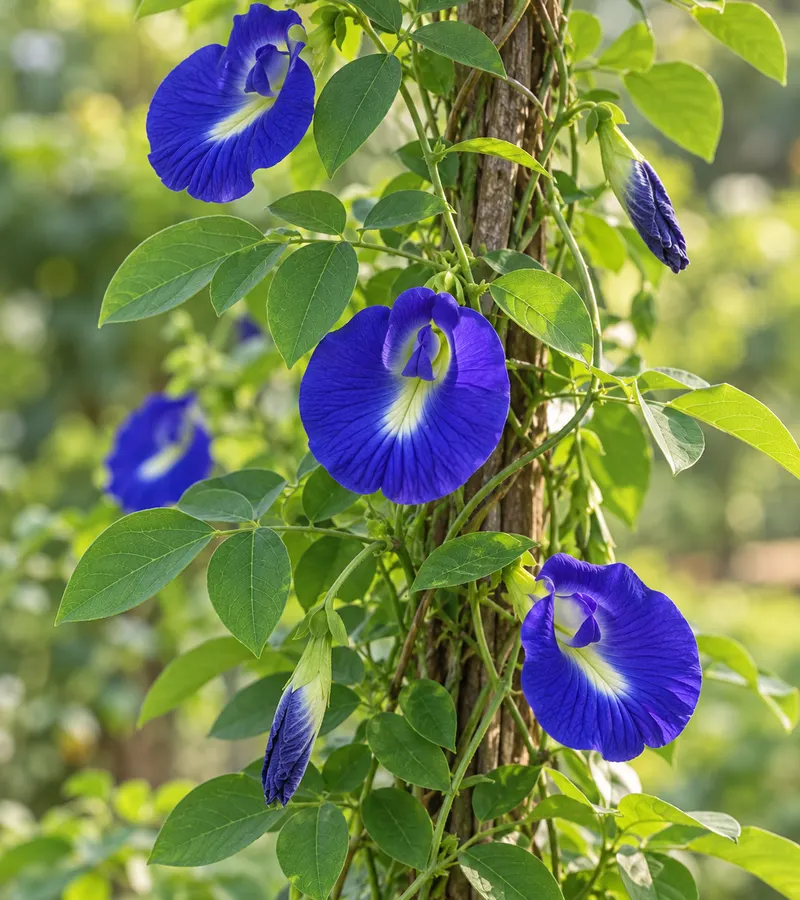
Deep violet-blue flowers familiar as natural colouring for sticky rice and tea.
Care and placement
Needs full sun (6–8 hours), an early trellis, deep watering once or twice a week, well-drained soil at pH 5.5–6.5 and warmth of 19–28 °C; flowers colour sticky rice and tea.
Draft mature dimensions
Maximum height (cm): 300 cm · Maximum spread (cm): 150 cm
Things to consider
NC State notes the flowers are edible and yield a blue food dye for drinks; seeds and other parts should not be eaten. Use only flowers from unsprayed plants, washed well, and not as a replacement for medicine.
How to grow and care for it
Planting and pot
Sow seed 2–3 cm deep in warm soil above 20 °C, in well-drained soil at pH 5.5–6.5; put up a trellis early because it climbs fast and tangles on the ground. A large pot with drainage holes also works.
Light
Full sun: at least 6–8 hours of direct sun to flower; no frost tolerance.
Watering
Water deeply once or twice a week rather than daily sips; established vines tolerate short dry spells; mulch keeps roots cool and moist. Avoid waterlogging.
Feeding
Not a heavy feeder because it fixes its own nitrogen: a balanced feed every 4–6 weeks in the growing season (other sources say every 2–3 weeks or just once or twice a year) helps flowering.
Pruning
Pinch vine tips for a bushier plant with more flowering sites; deadhead spent flowers to keep it blooming.
Propagation
Seed: break dormancy by soaking in warm water 12–24 hours (discard floaters) or nicking with sandpaper; sow 2–3 cm deep, germinating in 7–14 days above 20 °C. Cuttings 15–20 cm root in 4–6 weeks and flower sooner than seed-grown plants.
Pests and common problems
Spider mites, aphids and whiteflies; caterpillars (hand-pick); root rot, anthracnose and bacterial soft rot. Check leaf undersides monthly and treat with organic products.
For a bigger harvest
For plenty of flowers to harvest: full sun, a sturdy trellis, pinching, deep watering, picking each morning (after dew dries, before midday heat) and deadheading; leave a few pods to dry on the vine if you want seed.