
Pomelo
Citrus maxima
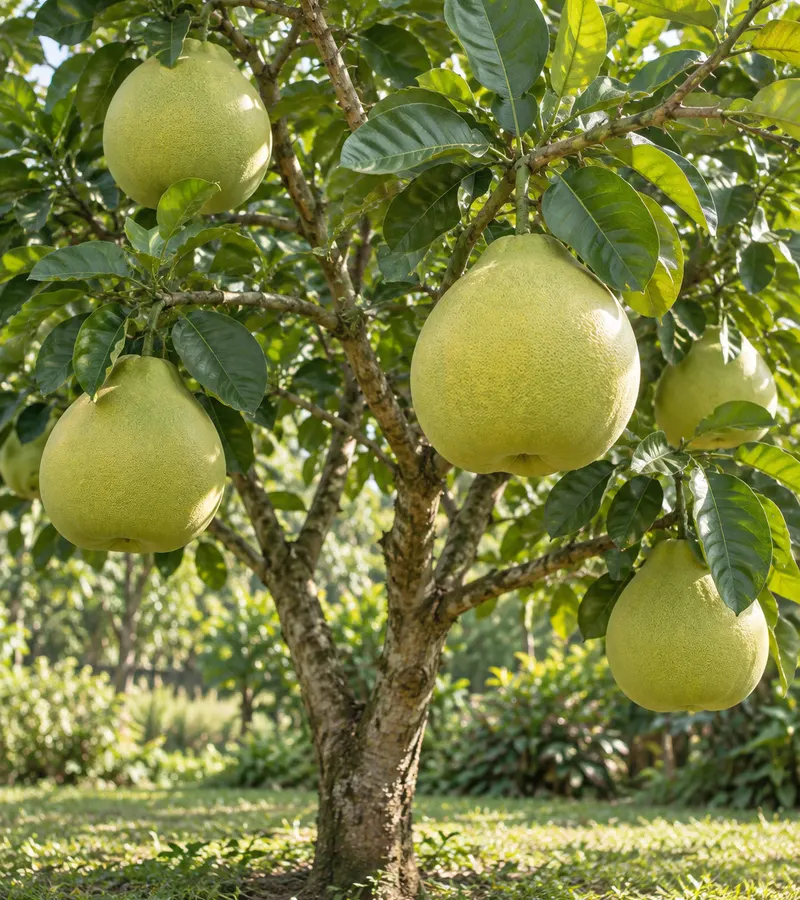
The largest citrus, with big thick-peeled fruit that keeps well; the branches are thorny and it needs well-drained soil.
Care and placement
A tropical to near-tropical tree that grows naturally at low altitudes near the sea (Morton). It suits silt and sand over organically enriched clay loam and tolerates brackish water well; growers on low ground dig drainage ditches, showing it needs drainage. Wikipedia: 5–15 m tall. It does not succeed where it is not warm enough: Morton says it has never performed well in New Zealand for lack of heat.
Draft mature dimensions
Maximum height (cm): 900 cm · Maximum spread (cm): 450 cm
Things to consider
Branchlets, old limbs and the trunk are spiny (Morton), though some cultivars are nearly thornless. Peel oils cause dermatitis with heavy contact (Morton). Wikipedia notes pomelo is not itself toxic but can interact with drugs like grapefruit does (affecting some anticoagulants, statins and immunosuppressants): anyone on medication should ask a doctor. No toxicity rating exists for children, dogs or cats, so it is not claimed safe.
How to grow and care for it
Planting and pot
Choose a sunny, well-drained spot; planting on a mound or raised bed helps avoid waterlogging (our inference from the drainage ditches of pomelo orchards, Morton). Morton says orchards space trees 3–4.5 m apart, but the tree can reach 5–15 m, so leave generous room in a yard. Buy a grafted or layered tree from a reputable nursery rather than a seedling.
Light
The sources I read do not state a specific sun requirement. As a low-altitude tropical tree (Morton), choose the sunniest part of the yard (our inference); citrus generally needs plenty of sun to flower and set fruit.
Watering
Morton: mean annual rainfall in the Bang Bakok pomelo region (Thailand) is about 143 cm, heaviest from May to October, and growers let water into ditches in the dry season. Water the tree regularly but make sure it drains: Morton says Phytophthora root rot kills most older trees in Malaya.
Feeding
The sources give no feeding schedule. Add well-rotted organic matter and a citrus feed to the label for young trees, avoiding heavy nitrogen (general practice; the sources do not say).
Pruning
The sources do not cover pruning. Remove dead, crowded and inward-growing branches to keep the crown open, wearing thick gloves because of the thorns; trimming low branches makes care and picking easier (general practice; the sources do not say).
Propagation
Morton: seedlings usually differ little from their parent, so most Asian pomelos are grown from seed; the best varieties are traditionally air-layered or T-budded onto pomelo, 'King' or 'Cleopatra' mandarin, rough lemon or Rangpur lime. Wikipedia: seed does not breed true but usually resembles the parent; air layering, cuttings, grafting and tissue culture are also used.
Pests and common problems
Morton lists pests and diseases: leaf miner, flea beetle, stinging red ants (which can kill trees), scale insects, citrus rind borer, mistletoe, citrus canker (some cultivars are especially prone), Phytophthora root rot and sooty mould. The tree may flower 2–4 times a year. Fruit left too long on the tree can become tough and indigestible.
For heavy fruiting
For good fruit: plenty of sun, well-drained soil, even watering while young and fruiting, and a good cultivar. Morton: in Thailand fruit is picked just as it begins to turn yellow; the thick peel keeps it well, and fruit stored about 3 months can wrinkle but become juicier and more flavourful, though too long can turn bitter.