
Coastal she-oak
Casuarina equisetifolia
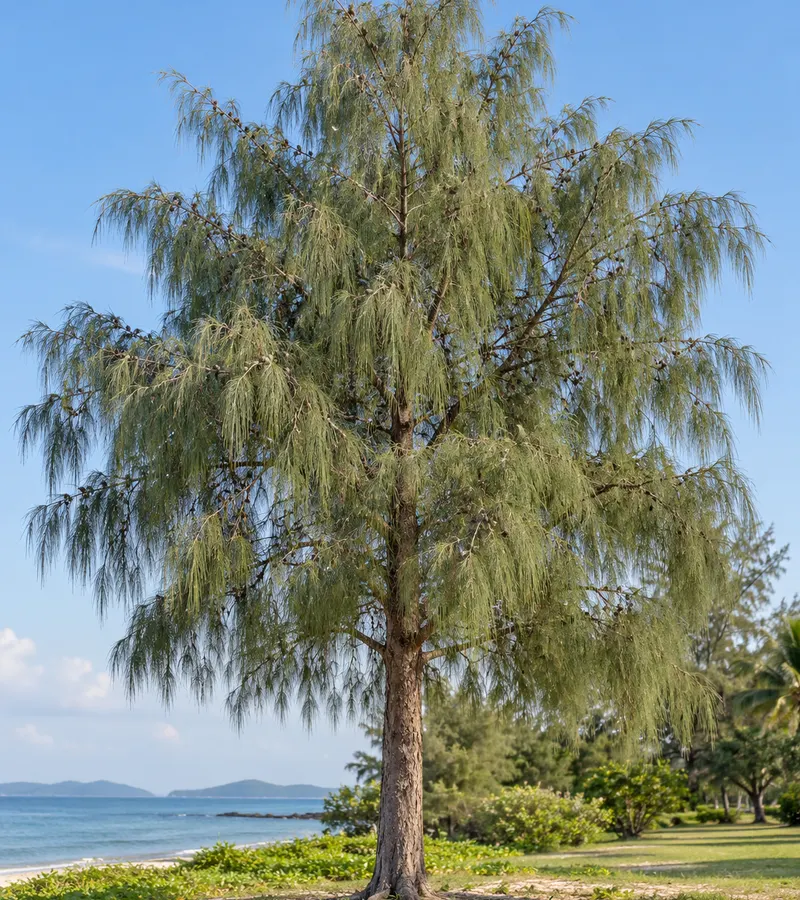
Fine, needle-like green twigs that cope with sand, wind and salt, a familiar coastal windbreak tree.
Care and placement
Needs full sun and well-drained sandy loam (pH about 6–7); very salt-tolerant, tolerates sand burial and is planted as coastal windbreak belts in Vietnam. However UF/IFAS reports very low wind resistance, with trees toppling in Florida storms; propagated by seed sown in nursery bags.
Draft mature dimensions
Maximum height (cm): 2000 cm · Maximum spread (cm): 800 cm
Things to consider
UF/IFAS calls the tree extremely allergenic and PFAF urges extreme caution when handling it because of sharp parts; there is no official toxicity rating for children or pets, so it is not claimed safe. The tree is very tall (15–25 m) and the sources disagree on storm resistance (Vietnamese shelterbelts withstand force-10 storms, while UF/IFAS says it often topples on shallow roots), so a standalone tree near houses or power lines needs an expert's assessment. It is invasive in Florida and South Africa.
Sources to cross-check
Kew Plants of the World Online · Casuarina equisetifoliaUF/IFAS · Casuarina equisetifolia, Australian Pine (FOR298)Plants For A Future · Casuarina equisetifoliaOregon State Landscape Plants · Casuarina equisetifoliaChi cục Kiểm lâm An Giang · Phi laoCông ty Công viên Cây xanh Đà Nẵng · Phi lao (dương liễu)Wikipedia tiếng Việt · Phi laoHow to grow and care for it
Planting and pot
Choose a spot in full sun with loose, well-drained sandy loam at pH about 6–7; growth is very poor on soil at pH 4–4.5, heavy compacted soil or thin stony ground. Dig a hole 30×30×30 or 40×40×40 cm, add well-rotted manure or seaweed, bury about a third of the stem and firm the soil; on moving sand it must be planted from bags. The sources give no safe distance from buildings, pipes, pavements or overhead lines, and they contradict each other on roots (a taproot to 2 m per Vietnamese sources, shallow roots per UF/IFAS), so a site survey is needed for a tree 15–25 m tall. Planting on public land needs permission from the owner or the street-tree authority.
Light
Wants a sunny position; PFAF says it will grow in light shade but needs full sun to do well. The suitable zone has roughly 1,500–2,500 mm of rain a year; PFAF rates it as only half-hardy (USDA 9–12), so it suits warm lowlands and coasts more than cold uplands.
Watering
Keep young trees evenly moist until the roots reach groundwater, usually 2–3 years according to PFAF; after that it is very drought-resistant. On sands hit by hot dry winds, planting in September lets the tree meet the rains; avoid waterlogged or compacted ground because it prefers free drainage.
Feeding
The tree fixes nitrogen through Frankia bacteria in its root nodules, so it grows on nutrient-poor sand and needs little nitrogen fertilizer. A base dressing of well-rotted manure or seaweed at planting is enough; on sandy sites a top-dressing once a year during the first 3 years of care is used.
Pruning
It grows fast (about 2 m a year early on, per PFAF), so watch the branches from the start. The branches and trunk tolerate cutting and training, which is why it is also used as a shade tree and for bonsai. The sources give no pruning schedule; remove dead branches and low ones that block paths, and leave large limbs or work near power lines to a qualified arborist.
Propagation
Propagate by seed: collect ripe fruit in September–October from trees at least 10 years old, soak the seed in 45 °C water and sow on sand trays; when seedlings are 2–3 cm tall move them into 7–12 cm bags (80% topsoil, 20% rotted manure) and raise for 4–6 months; germination is 35–50%. PFAF also describes rooting small branchlet cuttings with rooting hormone.
Pests and common problems
UF/IFAS reports very low wind resistance, shallow roots and frequent toppling in strong wind, while Vietnamese forestry sources say shelterbelts withstand force-10 storms; a standalone tree beside a house or road therefore needs an expert's check. The bark peels constantly, the woody cone-like fruit splits open when ripe and drops under the crown, and UF/IFAS calls the tree extremely allergenic. Its strong seed regeneration makes it invasive in Florida and South Africa; on sandy sites, stem borers need picking off.
For plentiful, healthy leaves
For a dense, green shelterbelt: choose well-drained sandy loam, plant in the right season, care for the first 2–3 years (weed 2–3 times a year, loosen the soil and mound it around the base) and pick off stem borers on sandy sites. The fine grey-green twigs make a soft, horsetail-like crown.