
Papaya
Carica papaya
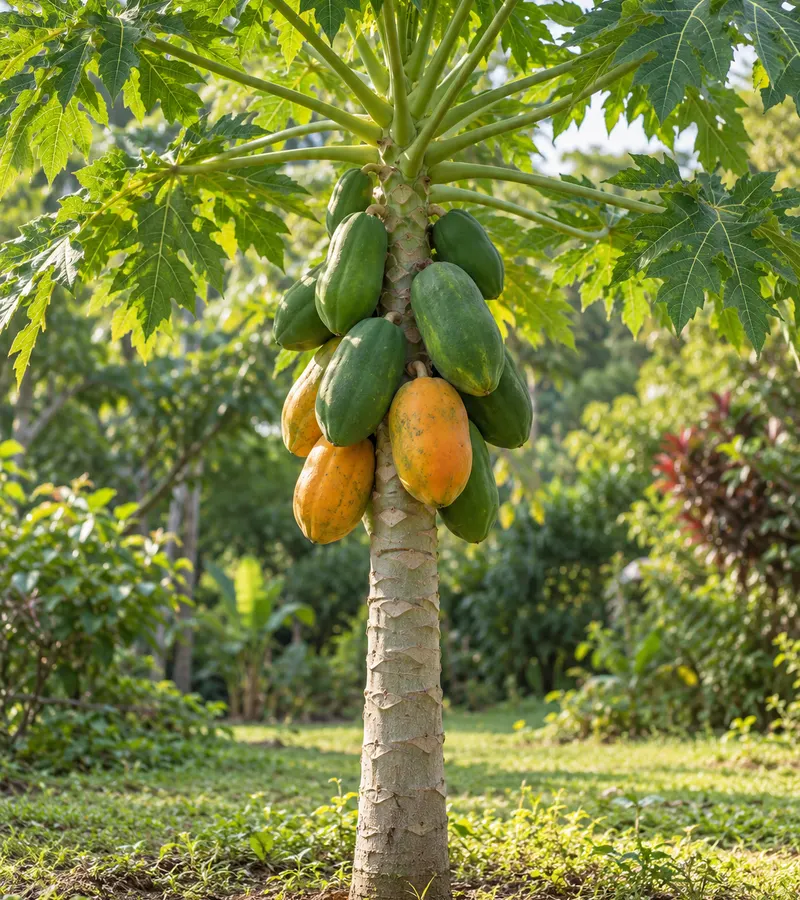
A fast-growing soft-stemmed tree that fruits within about two to three years but dies quickly when waterlogged.
Care and placement
Needs full sun and deep, humus-rich, freely draining soil, with a preferred pH of 5.5–7. PFAF warns that waterlogging is dangerous and can kill trees within days, and Wikipedia says standing water can kill it within 24 hours. It dislikes strong wind and cold: −1 °C or lower can kill it.
Draft mature dimensions
Maximum height (cm): 800 cm · Maximum spread (cm): 400 cm
Things to consider
The white latex from the trunk and unripe fruit can irritate skin or cause allergic reactions in some people (Wikipedia); PFAF says the latex is strongly purgative if eaten, older leaves contain the alkaloid carpaine and the plant contains cyanogenic compounds. Papain is an allergen for sensitive people. No official toxicity rating exists for children, dogs or cats, so it is not claimed safe; eat ripe fruit only, and wear gloves when pruning or picking green fruit.
How to grow and care for it
Planting and pot
Choose a full-sun, deep, very well-drained, wind-sheltered spot; planting on a mound helps avoid waterlogging (our inference from the sources' warning). Wikipedia says plants can be male, female or hermaphrodite and commercial orchards use only hermaphrodites; unpollinated females give small inedible fruit, so plant several and keep the hermaphrodites, or buy stock known to be hermaphrodite.
Light
Needs full sun: PFAF says it cannot grow in shade. The best daytime range is about 21–30 °C, with 12–44 °C tolerated.
Watering
It prefers moist soil but must never sit in water. PFAF prefers 1,500–2,500 mm of rain a year (tolerating 1,000–3,000 mm). Water when the top soil is dry, at the base, and make sure it drains; long wet spells are the riskiest time (our inference).
Feeding
The sources give no feeding schedule. Because it grows fast and fruits continually it is usually fed regularly; use well-rotted organic matter and light feeds to the label, and never feed a waterlogged tree (general practice; the sources do not say).
Pruning
The soft single stem branches little, so there is little to prune; remove only old yellow leaves. Old trees grow tall and hard to pick and many growers replant after a few years (general practice; the sources do not say). Wear gloves because of the latex.
Propagation
PFAF: sow seed as soon as it is ripe, germinating in 2–6 weeks at 24–30 °C; greenwood cuttings and grafting are also listed. Because the sex of a seedling is unknown, sow extra and keep hermaphrodites, since females need a male or hermaphrodite nearby (Wikipedia).
Pests and common problems
Waterlogging kills quickly. Wikipedia records papaya ringspot virus, which yellows young leaves and ringspots the fruit, plus mosaic virus, anthracnose, powdery mildew, Phytophthora (root and fruit rot), fruit flies, two-spotted spider mites and whiteflies. Badly virus-affected plants should be pulled and replaced with healthy ones.
For heavy fruiting
For plentiful, tasty fruit: full sun, free-draining soil, even moisture without waterlogging and little wind. PFAF says it can start cropping at about 6 months, with hand-pollinated fruit ripening after about 150–240 days; Wikipedia: fruit is ripe when soft and the skin turns amber to orange.