
Red silk-cotton tree
Bombax ceiba
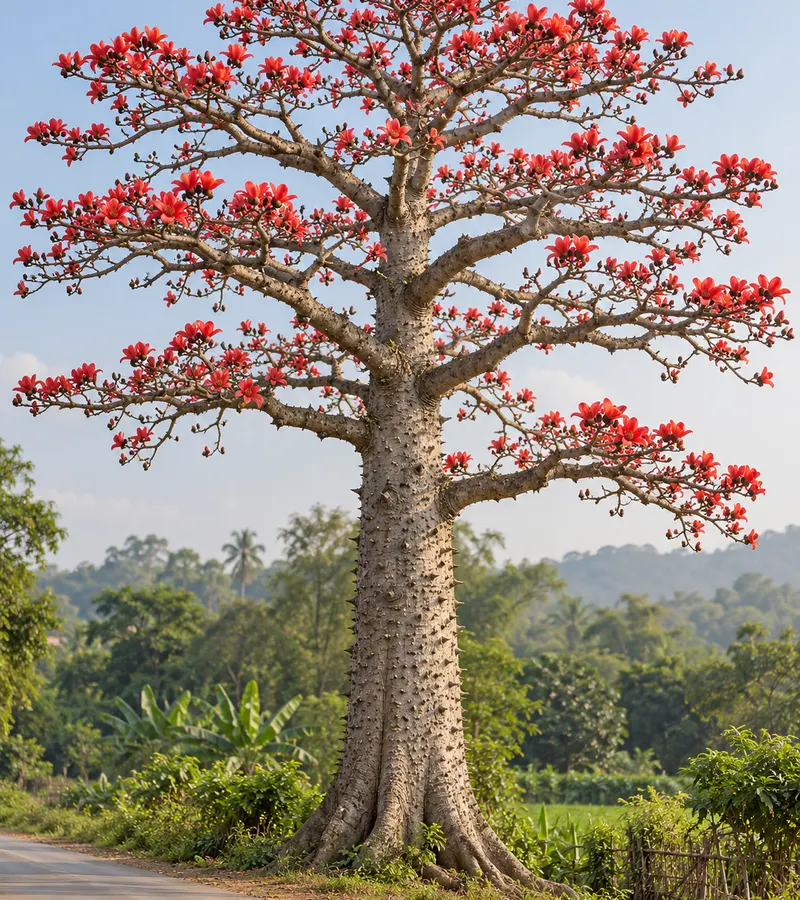
A very tall tree that sheds its leaves and bears large red-orange flowers in early spring; the fruit splits and releases white cotton on the wind.
Care and placement
Needs full sun (it will not grow in shade) and well-drained soil; it likes a hot climate with a distinct dry season, and an established tree is drought-tolerant while new growth is frost-tender. A very tall tree that drops its leaves in winter and then flowers red before new leaves, with a prickly young trunk; the seed is poisonous if eaten; propagated by seed, cuttings or grafting.
Draft mature dimensions
Maximum height (cm): 2000 cm · Maximum spread (cm): 1000 cm
Things to consider
PFAF says the seed is poisonous if eaten (the flowers, young leaves and young roots are eaten in some places, but do not try them casually); there is no toxicity rating for cats or dogs, so it is not claimed safe. The trunk and young branches carry sharp conical prickles, the tree is very tall (about 20–25 m) with soft wood, and the fruit splits open and releases white cotton on the wind. The sources do not rate branch strength in storms or say anything about allergy to the cotton or pollen.
How to grow and care for it
Planting and pot
Choose a sunny, spacious spot with well-drained soil (pH about 5.5–6.5 per PFAF) and avoid ground that stays waterlogged. A Vietnamese source suggests a 60×60×60 cm hole and planting trees 1.5–1.8 m tall 7–10 m apart; but for a tree 20–25 m tall the sources give no safe distance from buildings, pipes, pavements or overhead lines, and PFAF notes it sends up suckers while young, so a site survey is needed. Planting on public land needs permission from the owner or the street-tree authority.
Light
Needs full sun: PFAF says it cannot grow in shade. It prefers daytime temperatures of 28–42 °C (tolerating 5–49 °C), but new growth is killed at about −1 °C, so frosty sites are unsuitable. It drops its leaves in winter and flowers on bare branches, so it does not give year-round shade.
Watering
An established tree is drought-tolerant and likes a distinct dry season; PFAF gives 750–4,000 mm of annual rain as suitable. For a newly planted tree a Vietnamese source advises watering 2–3 times a month in the dry season and says it tolerates wet feet poorly, so avoid long waterlogging.
Feeding
A Vietnamese source advises feeding around the base, favouring nitrogen before the flowering season and then switching to NPK and potash; no source gives exact doses. The tree grows on sandy, loamy and heavy clay soils, so mix well-rotted compost into the planting hole and feed lightly if growth is slow.
Pruning
The sources give no pruning schedule. The trunk and young branches are prickly, so wear thick gloves when pruning; remove dead or low branches while the tree is small, and leave a tree tens of metres tall to a qualified arborist, especially near power lines.
Propagation
Propagate by seed: sow fresh seed straight away without pretreatment (PFAF; some sources suggest a 12-hour soak), which sprouts in 10–25 days; move seedlings about 5 cm tall into containers and plant out after roughly 12 months. Vietnamese sources also list cuttings in early spring and grafting. A tree grown from seed may take 8–10 years to flower.
Pests and common problems
The tree sheds its leaves in winter, the large flowers drop in the flowering season, and the fruit splits to release white cotton and seed on the wind (Wikipedia notes cotton floating around early May in New Delhi), which litters streets and yards. The young trunk is prickly and the wood soft (Vietnamese Wikipedia), but the sources do not rate branch strength in storms, so a tree near houses or power lines needs an arborist's check. A Vietnamese source lists leaf spot, anthracnose and long-horned stem borers on young trees.
For more flowers
For a rich flowering: give full sun, well-drained soil, a distinct dry season and enough time, since a tree grown from seed can take 8–10 years to flower. The red to orange-red five-petalled flowers, about 10 cm across, open in March–April while the branches are still bare.