
Bishop wood
Bischofia javanica
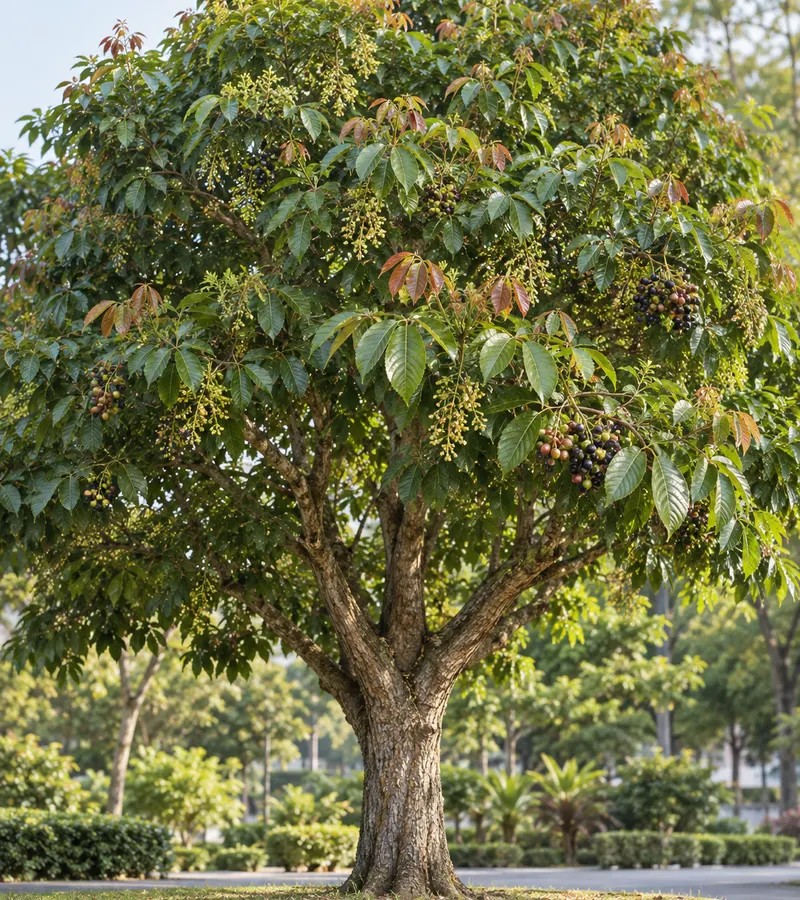
A familiar shade tree of Hanoi streets with three-leaflet leaves and a dense, rounded crown.
Care and placement
Grows in sun to part shade, tolerates many soils and tight urban soil; water regularly after planting; needs structural pruning for strong branches, and should not be planted close to pavements because of surface roots and fruit drop; propagated by seed or cuttings.
Draft mature dimensions
Maximum height (cm): 1200 cm · Maximum spread (cm): 900 cm
Things to consider
The sources do not state any toxicity for this tree, so it is not claimed safe or toxic; do not eat it or use it as medicine. The sap is milky; wear gloves and wash hands after pruning. The clearest city risks are branch breakage, surface roots that can lift pavements, and fruit that stains walks.
How to grow and care for it
Planting and pot
The tree grows about 9–15 m tall with a dense, round crown roughly 8–11 m wide, so it needs open ground. UF/IFAS says large surface roots can lift a pavement planted within about 1.5–1.8 m, so leave far more room than that; the sources give no distance for buildings, pipes or overhead lines, so a site survey is needed. The branches spread low, so leave room for the crown. Planting on a pavement or public land needs permission from the landowner or the tree authority.
Light
A light lover that takes full sun to part shade. UF/IFAS notes it also grows in confined urban soil space and has moderate tolerance of aerosol salt.
Watering
Newly planted trees need regular watering while larger trees need much less; UF/IFAS rates drought tolerance as moderate. Avoid long waterlogging since root rot can occur.
Feeding
The tree is easy and fast to grow and tolerates many soils, so it needs little extra feeding. Just mix well-rotted organic matter into the planting hole and feed lightly while young; the sources give no specific rates.
Pruning
Prune for structure from an early age: UF/IFAS says the tree is prone to breakage and needs pruning for strong structure, as it has several large low limbs near the ground. Keep one main trunk, space the main limbs evenly and use a trained arborist for large high branches.
Propagation
Propagated by seed or cuttings. Collect seed from a healthy parent after two fruiting seasons, sow about 0.5 cm deep in a bed and move seedlings at the 2–4 leaf stage; seed germinates in about a week according to a Vietnamese source. Male and female flowers are on separate trees, so only female trees bear fruit.
Pests and common problems
In the city: large surface roots lift pavements and make mowing near the trunk hard; big branches can break; female trees drop small fruit that litters and stains walks, and seeds readily sprout as unwanted seedlings. Severe scale (especially false oleander scale) with sooty mould and root rot are recorded problems, and insects also attack the wood. The sources say nothing on pollen allergy. In Vietnam it is a native tree, while in Florida it is rated invasive (Category I in central and south Florida) and its planting is discouraged.
For plentiful, healthy leaves
For a handsome, dense green crown: give enough sun, water regularly while young, prune for structure and check for scale regularly. The glossy three-leaflet leaves, bronze when young, give dense shade all year.