
Starfruit
Averrhoa carambola
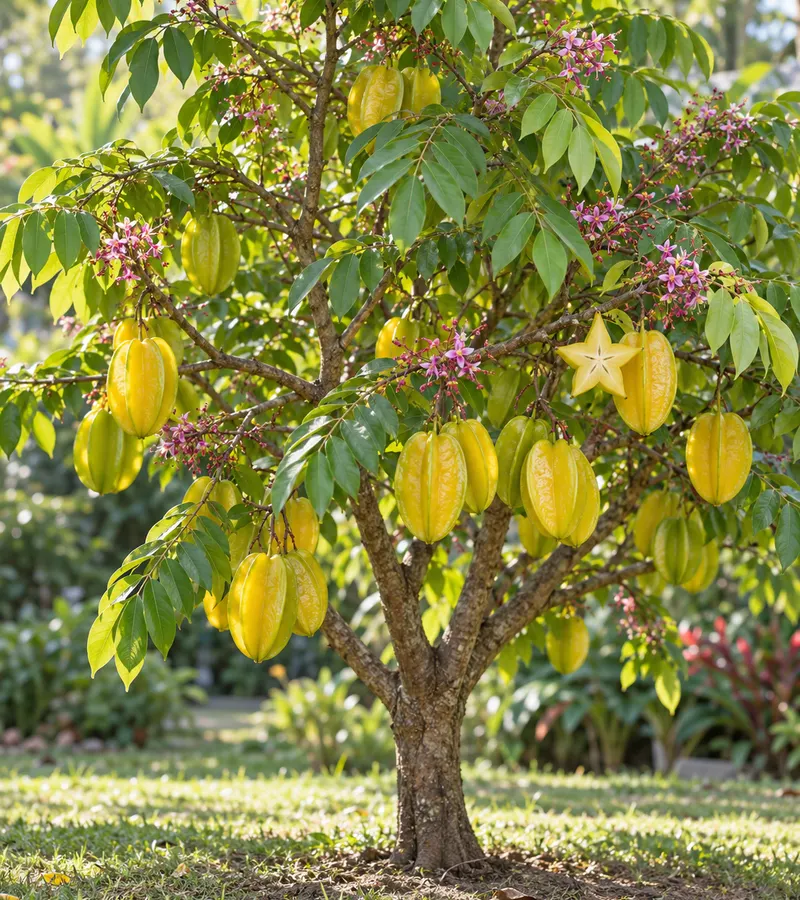
A medium, broad tree whose five-ribbed fruit slices into stars and which flowers nearly year-round.
Care and placement
Needs sun and well-drained soil, with no waterlogging and a pH from mildly acid to mildly alkaline; it tolerates drought but prefers moist soil (PFAF: 1,200–2,000 mm of rain a year preferred). It is frost tender: mature plants can be killed at −2 °C or lower and young growth is hurt at −1 °C. Wikipedia: it needs at least 1,800 mm of rain a year and can be grown up to 1,200 m.
Draft mature dimensions
Maximum height (cm): 800 cm · Maximum spread (cm): 800 cm
Things to consider
The fruit contains soluble oxalates and caramboxin, a neurotoxin: Wikipedia and PFAF both say it harms people with chronic kidney disease, kidney stones or on dialysis, with hiccups, vomiting, confusion, coma and sometimes death. Healthy people eating moderate amounts are usually fine, but anyone with kidney disease must not eat it. No toxicity rating exists for dogs, cats or young children, so it is not claimed safe.
How to grow and care for it
Planting and pot
Pick a sunny, well-drained spot with some shelter from wind. PFAF suggests spacing of about 6 × 6 m and says it can reach 8 m tall and 8 m wide, growing slowly, so it needs room. A grafted tree can fruit much sooner than a seedling (PFAF: 1–2 years grafted, 3–8 years from seed).
Light
It wants sun; PFAF's entries disagree, one preferring a little shade and another saying it cannot grow in shade, so choose plenty of sun and shade a young tree if the sun is fierce (our inference).
Watering
It prefers moist soil and tolerates drought but not waterlogging. Wikipedia says moderate irrigation helps through dry seasons and very heavy rain may reduce fruit set. Water young trees evenly; large trees mostly rely on rain, with extra in long dry spells (our inference).
Feeding
The sources give no feeding schedule. Add well-rotted organic matter at planting and feed young trees lightly to the label; PFAF says established trees need no special care (general practice for the rest; the sources do not say).
Pruning
PFAF: young fast-growing trees need pruning and thinning of excess fruit early on; established trees need no pruning or special care. Remove dead and crowded branches and keep a workable picking height; leave large limbs to someone qualified.
Propagation
PFAF: seed is viable only briefly and gives variable results, so budding or grafting onto 1-year-old seedling rootstock is most common; greenwood cuttings, layering and air layering are also used. Wikipedia: seeds lose viability within a few days of leaving the fruit. Buy grafted trees from a reputable nursery.
Pests and common problems
Wikipedia names the main pests as fruit flies, fruit moths, ants and birds. Clear fallen fruit regularly and bag fruit against flies if you wish (general practice; the sources do not say). Frost and waterlogging hurt it, and the coast does not suit it because it does not tolerate maritime exposure (PFAF).
For heavy fruiting
For more fruit: lots of sun, even moisture, thin young trees' fruit and choose a grafted tree. Wikipedia: it flowers all year and fruit is best eaten shortly after ripening, when yellow with a light green shade; fruit picked slightly green turns yellow but gains no sugar. People with kidney disease must not eat it.