
Soursop
Annona muricata
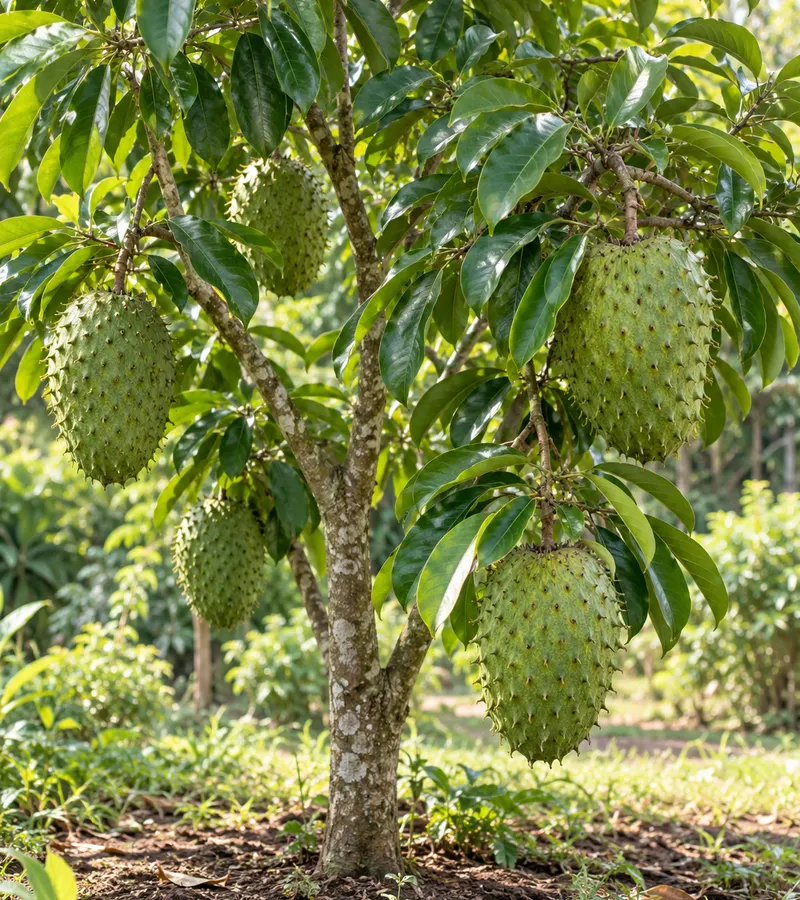
A small evergreen tree with large soft-spined fruit of a sweet-sour flavour that starts bearing in its second year.
Care and placement
Grows best in sun but tolerates part shade; PFAF prefers a moist but well-drained sandy loam with pH 5.5–6.5, and it tolerates poor soil and drought once established (though it sheds many leaves in prolonged drought). It is frost tender (USDA 10–12), preferring a mean annual temperature of 25–30 °C. Wikipedia: leaves and small branches are damaged below 5 °C and it can die below 3 °C (citation needed).
Draft mature dimensions
Maximum height (cm): 700 cm · Maximum spread (cm): 700 cm
Things to consider
PFAF says the seeds are toxic and the stems contain an irritant sap. Wikipedia says annonacin, a compound under preliminary neurotoxicity research, is found in the fruit, seeds and leaves, and in 2010 the French food safety agency could not confirm a link between eating the plant and cases of atypical Parkinson syndrome. So eat only moderate amounts of ripe flesh, discard the seeds, and do not drink leaf tea or use it as medicine. Keep children and pets from chewing seeds and leaves.
How to grow and care for it
Planting and pot
Choose a sunny spot with well-drained sandy soil, sheltered from cold. PFAF says it reaches about 7 m tall and wide and grows fast, so leave room. Seedlings usually come true and fruit from the second year (PFAF); a 5-year-old tree gives about 10–50 fruit.
Light
PFAF: grows best in a sunny position and tolerates part shade or none. Avoid cold spots: Wikipedia says leaves and small branches are damaged below 5 °C.
Watering
PFAF: it prefers moist soil but tolerates drought, and established plants are very drought tolerant though they shed many leaves in prolonged drought. Water young and fruiting trees evenly, and keep the soil draining, since it prefers well-drained ground (PFAF).
Feeding
The sources give no feeding schedule. PFAF says it tolerates nutritionally poor soil, so add well-rotted organic matter at planting and feed young trees lightly to the label (general practice; the sources do not say).
Pruning
The sources do not cover pruning. The tree is small (about 7–10 m), so a picking height is easy to keep; remove dead and crowded branches as needed. Wear gloves and wash your hands after cutting, since the stems contain an irritant sap (PFAF).
Propagation
PFAF: sow seed, usually true to type, in pots no deeper than 2 cm at about 21 °C; hard-coated seed may benefit from scarification; semi-ripe cuttings are also possible. The seeds are toxic, so wear gloves when handling them and keep them from children and pets.
Pests and common problems
PFAF lists seed borers, scale and mealy bugs. Prolonged drought makes the tree shed many leaves, and cold below 5 °C damages leaves and small branches (Wikipedia). Clear fallen and spoiled fruit regularly (general practice; the sources do not say).
For heavy fruiting
For fruit: enough sun, draining soil, even moisture and no cold. PFAF says fruiting starts in the second year; eat fully ripe fruit, only moderate amounts of flesh, and discard the seeds. Wikipedia: fruit is 10–35 cm long and typically about 4 kg.