
Devil tree
Alstonia scholaris
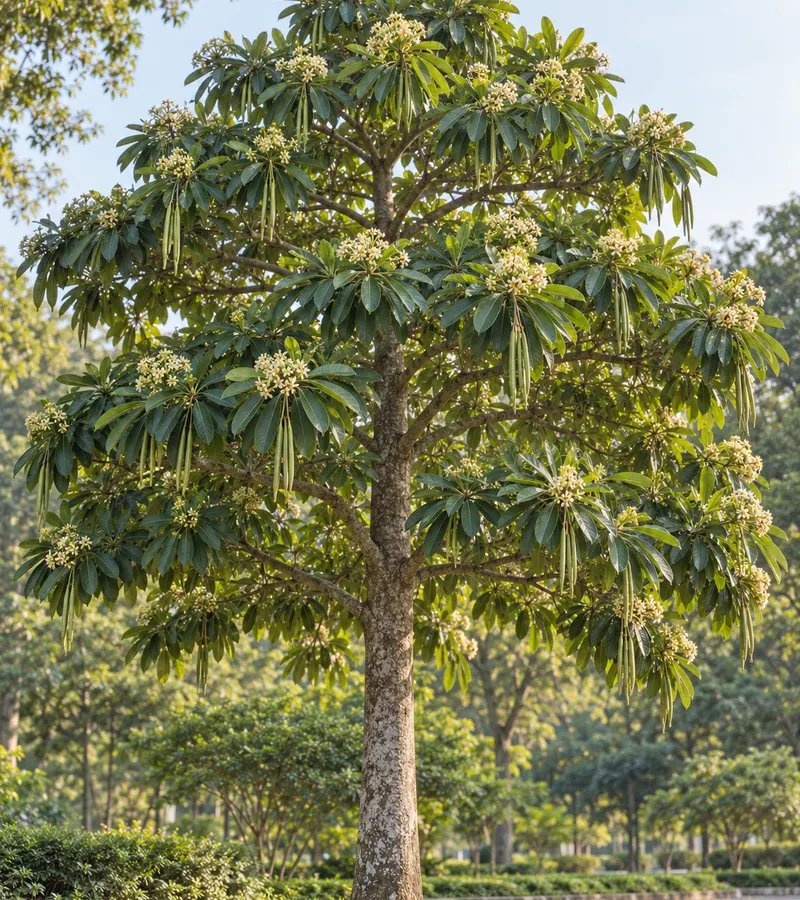
Leaves in whorls around the branches and small creamy flowers with a very strong scent, closely tied to the streets of Hanoi.
Care and placement
Needs full sun, fertile moist but well-drained loam and moderate watering; it grows fairly fast (plantation trees in Taiwan averaged 23.5 m at 18 years). The flower scent and pollen are very strong, so plant it spaced out and away from bedrooms and houses.
Draft mature dimensions
Maximum height (cm): 2000 cm · Maximum spread (cm): 1000 cm
Things to consider
All parts bleed white sap when injured and the sap can irritate skin, so wear gloves and eye protection when pruning. The scent and pollen are very strong in the flowering season and can cause nasal allergy or breathing discomfort in sensitive people. Extracts were toxic in rat studies; do not eat it or use it as medicine, and it has no pet rating.
How to grow and care for it
Planting and pot
Choose a sunny spot with loose well-drained loam. NParks recommends 12 m apart with a crown up to 10 m wide; a Hanoi expert advises medians at least 2 m wide, junctions or wide public spaces rather than pavements beside houses, and not planting too densely (many older rows are only 4–6 m apart, so the scent becomes overpowering). No source gives distances from pipes, foundations and overhead lines, so that needs a site survey; planting on a pavement or public land needs the authority's permission.
Light
Prefers full sun. Seedlings need an open site, and one source says trees flower only after marked dry spells. It grows from sea level to about 900 m and suits a mean annual temperature of 12–32 °C.
Watering
Moderate watering; the soil should be moist but well drained. Water young trees regularly until established; big trees usually get enough from rain where annual rainfall is about 1,000–3,800 mm.
Feeding
It likes fertile, moist loam; a base of well-rotted organic matter at planting is enough for a young tree. The sources give no feeding schedule for mature trees.
Pruning
Remove dead branches and any that touch buildings or wires, and leave this to a tree-care crew with safety gear. Where trees are dense, selective thinning or trimming off flower clusters, as Hanoi is doing, beats felling whole rows. Always wear gloves and eye protection since the white sap from cuts can irritate skin.
Propagation
Grown from seed sown in a sunny spot; fresh seed germinates at nearly 100% but the pods split open on the tree, so collecting is hard. A source describes cleft and inverted-T grafting for grafted plants.
Pests and common problems
In the flowering season the scent is very strong and pollen and fluffy seeds drift everywhere, which can affect the elderly, children and people with breathing problems; Vietnam has seen complaints and lawsuits over the smell. An expert says it seldom breaks or falls because of fibrous roots plus a taproot, but large city trees still need risk checks after storms. It loses leaves only briefly and irregularly, and white sap flows when branches break.
For more flowers
For fragrant flowers without a nuisance: enough sun, a dry season and wide spacing. One tree in a wide yard is pleasant, while too many make the scent overpowering; in Hanoi it flowers from about August to December, peaking in September and October.