
Chinese perfume plant
Aglaia odorata
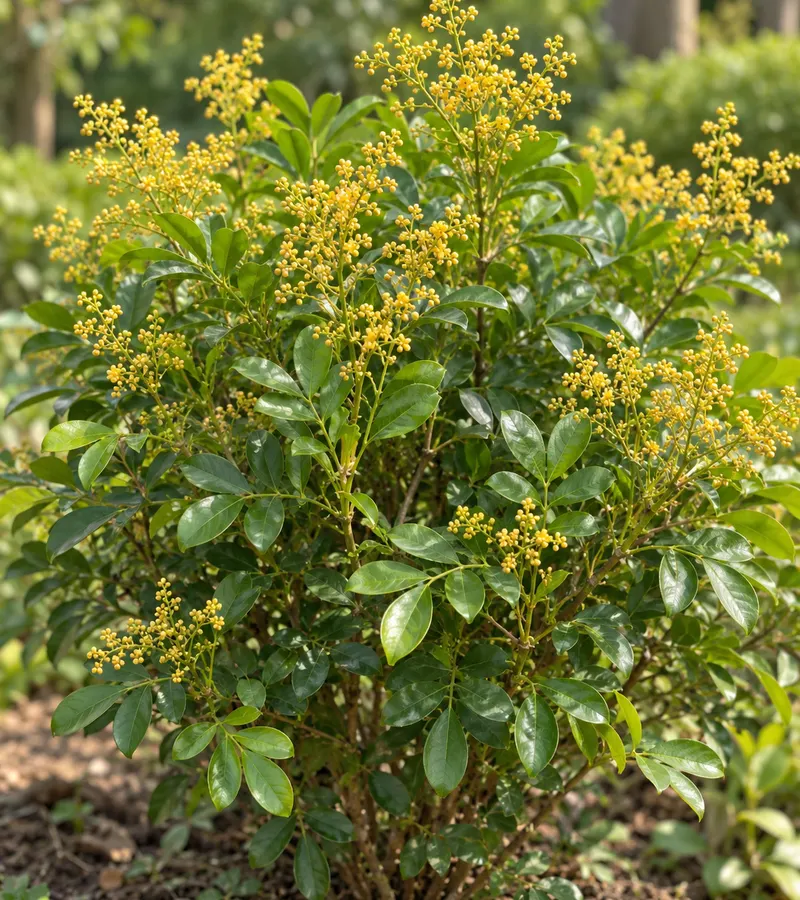
A small, many-branched shrub with tiny golden flowers scented like vanilla, strongest in the evening, that grows slowly and trims into a neat hedge.
Care and placement
An understorey shrub of sparse forests and thickets, often found on clay soils in the wild and at elevations up to 700 m; native to southern China, Cambodia, Thailand and Vietnam (Useful Tropical Plants). Wikipedia: a small, many-branched tree 2–5 m tall, grown outdoors in USDA zones 9–10. The sources do not state sun, water or soil needs, so choose a bright to morning-sun spot with well-drained soil (our inference from its open-forest habitat).
Draft mature dimensions
Maximum height (cm): 400 cm · Maximum spread (cm): 250 cm
Things to consider
Useful Tropical Plants lists no known hazards, but no official toxicity rating exists for children, dogs or cats, so it is not claimed safe. Wikipedia and that source say the flowers, leaves and roots are used in folk medicine and the dried flowers scent tea; do not eat it or use it as medicine unless you have identified the species correctly and asked someone qualified.
How to grow and care for it
Planting and pot
Choose a bright to morning-sun spot with free drainage (our inference from its open-forest habitat). It grows slowly (Useful Tropical Plants), so a large pot or low hedge suits a small yard; leave room for several metres of height (Wikipedia: 2–5 m; Useful Tropical Plants: up to 10 m). The species is dioecious, so both sexes are needed only if you want seed.
Light
The sources do not state light needs. It grows under sparse forest canopy so it tolerates light shade; Wikipedia says it is also sold as a houseplant under the name 'Chinese perfume plant'. Choose a bright to morning-sun spot and watch the leaves (our inference).
Watering
The sources do not state water needs. Water newly planted shrubs evenly and check the top soil before watering, never waterlogging it; an established plant usually tolerates a few dry days (general practice; the sources do not say).
Feeding
The sources give no feeding schedule. Add well-rotted organic matter at planting and feed lightly to the label while it grows; because it grows slowly it does not need heavy feeding (general practice; the sources do not say).
Pruning
Useful Tropical Plants: a good if slow-growing hedge plant; regular trimming gives a dense, neat hedge and it is used for topiary in Asia. Trim lightly after each flush of flowers to keep its shape (general practice; the sources do not say).
Propagation
Useful Tropical Plants: by seed and cuttings; the species is dioecious, so both male and female plants are needed for seed. Buy a cutting-grown plant from one that has flowered fragrantly to be sure of a scented one.
Pests and common problems
The sources I read do not name the main pests and diseases. Wikipedia only mentions research on compounds in the plant (rocaglaol and rocaglamide), and Useful Tropical Plants mentions insecticidal compounds. Inspect leaves and stems regularly and ask local extension advisers if pests or disease appear.
For more flowers
For plenty of scented flowers: choose a cutting from a good bloomer, a bright to morning-sun spot and a light trim after flowering. Wikipedia: small golden six-petalled flowers in racemes and red egg-shaped fruit; Useful Tropical Plants: flowers scented like vanilla with spicy undertones, strongest in the evening, and dried flowers keep their perfume almost indefinitely.