
Madagascar almond (umbrella tree)
Terminalia neotaliala
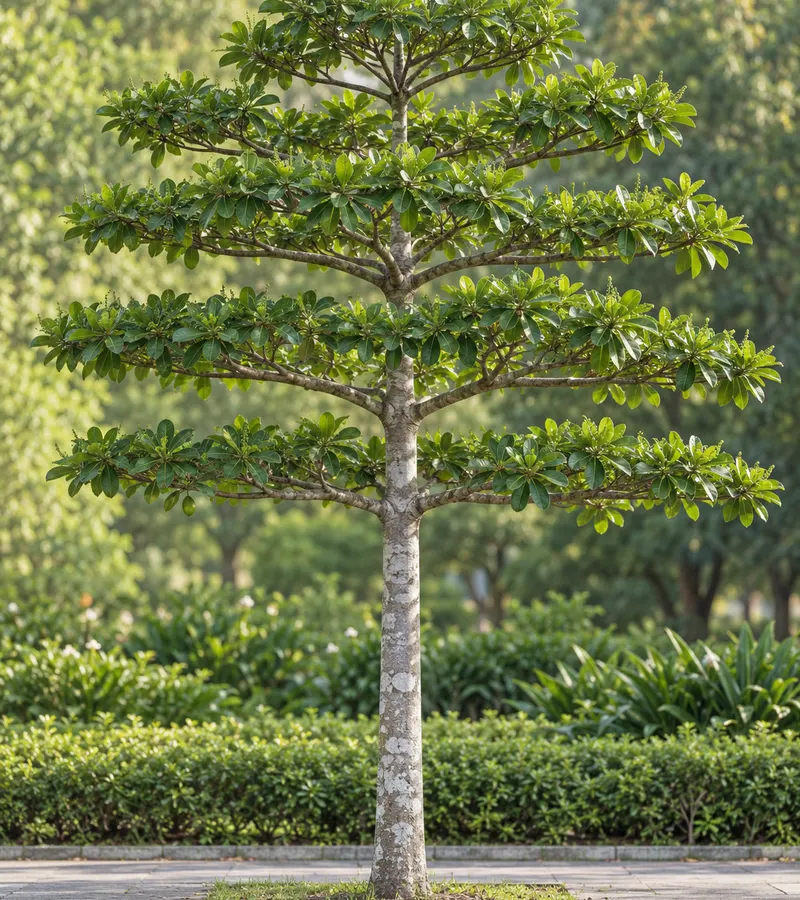
The Madagascar almond has a neat, layered umbrella crown with smaller leaves and fruit than the tropical almond (Terminalia catappa), and it is not the 'Bàng Singapore' (Ficus lyrata).
Care and placement
Needs full sun and loose well-drained soil, and tolerates drought once established; frost-sensitive. The crown is a neat layered umbrella with smaller leaves and fruit than the tropical almond; the older name Terminalia mantaly is still the one most nurseries and Vietnamese sources use.
Draft mature dimensions
Maximum height (cm): 1500 cm · Maximum spread (cm): 1000 cm
Things to consider
No source rates its toxicity for children or pets, so it is not claimed safe. A big tree has a crown 10–15 m wide, drops its leaves seasonally and needs pruning; bark and wood are used in folk medicine in its homeland, but do not use them yourself.
How to grow and care for it
Planting and pot
Choose a sunny spot with loose, well-drained soil and dig a hole wider than the root ball; add well-rotted organic matter at the bottom. In Singapore it reaches 10–20 m with a 10–15 m crown and suits roadsides and parks; no source gives a safe distance from buildings, pipes, pavements and overhead lines, so that needs a site survey. Planting on a pavement or public land needs the owner's or the authority's permission.
Light
Plant it in full sun. It is frost-sensitive (USDA 9–10), so it does not suit cold highlands; a source notes it rarely flowers at high altitude and is more often evergreen there.
Watering
The tree tolerates drought once established. A Vietnamese source advises daily watering for the first 1–2 months, then 2–3 times a week; the general level is moderate, watering when the topsoil is dry.
Feeding
Add well-rotted compost or a microbial fertiliser at planting, then organic feed or NPK about every 2–3 months per a Vietnamese source. On good soil it grows fast, so heavy feeding is not needed.
Pruning
Remove dead, diseased and misplaced branches to keep the tiers even. For tall street trees, leave the work to a tree-care crew with safety equipment, especially near overhead lines.
Propagation
It can be grown from seed or cuttings. For seed, remove the wing and soak in cold water for 24 hours before sowing; collect seed from trees in hot lowlands. Flowers and fruit are scarce in many places, so seed is not always available.
Pests and common problems
The tree drops its leaves in winter or the dry season and flushes again when it is warm and rainy, so a bare crown is not a cause for worry. A Vietnamese source says the taproot goes deep and surface roots are few, but the planting hole still needs to be wide enough; its small leaves and fruit make less litter than the tropical almond. It is easily confused with the tropical almond and with Bàng Singapore (Ficus lyrata, a houseplant).
For plentiful, healthy leaves
For a neat, even layered crown: enough sun, regular watering early on, and pruning only of dead or misplaced branches. Its tidy shape looks especially striking when planted in rows or groups.