
Tropical almond
Terminalia catappa
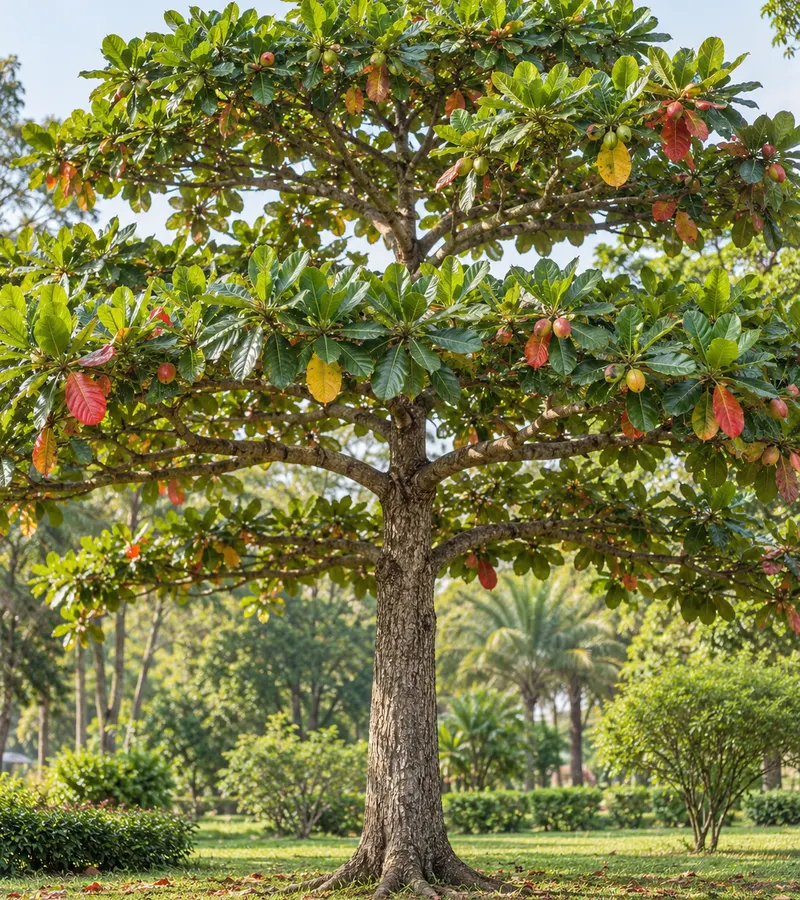
A tiered shade tree whose big leaves turn red before the dry-season fall, not to be confused with the small-leaved Madagascar almond or the 'Bàng Singapore' (Ficus lyrata).
Care and placement
Needs full sun and well-drained soil (poor sandy soil is fine); tolerates drought, wind and salt but has brittle branches and drops big leaves and fruit. Needs a wide site because the crown can spread 9–15 m.
Draft mature dimensions
Maximum height (cm): 1500 cm · Maximum spread (cm): 1200 cm
Things to consider
Branches are brittle and can break in storms, roots can surface, the tannin-rich fruit stains cars and pavement, and big leaves and fruit litter the ground. No source rates it for pet toxicity, so it is not claimed safe; keep children and pets from picking up and chewing the fruit.
How to grow and care for it
Planting and pot
Pick an open spot in full sun with well-drained soil. A mature tree is about 9–17 m tall with a 9–15 m spread and roots can surface, so do not plant close to houses, walls, narrow pavements or under overhead lines; the safe distance from buildings, pipes and wires needs a site survey because the sources give no figure. Planting on a pavement or public land needs the owner's or the authority's permission.
Light
Needs full sun; a Vietnamese source rates its shade tolerance as poor, so do not plant under larger trees. It belongs to warm zones (USDA 10B–11) and needs protection from freezing, so it suits warm lowlands only.
Watering
Once established it is very drought tolerant; water regularly only in the first months so the young tree roots in, then rely mostly on rain. The soil must drain, so avoid spots that stay waterlogged.
Feeding
The sources give no feeding schedule; the tree lives on poor sandy soil, so a base of well-rotted organic matter at planting and a light feed for young trees is enough. Mature trees usually need no extra feeding.
Pruning
Prune while the tree is young to build a strong branch structure, because the wood is brittle and breaks easily. Trim low drooping branches regularly so they do not touch vehicles and passers-by; leave this to tree-care crews once the tree is tall.
Propagation
Propagated by seed. The kernel is small and hard to extract from the fruit.
Pests and common problems
Big leaves drop heavily in the dry season (about March to May per a Vietnamese source) and large fruit fall through the fruiting season; the tannic fruit stains cars and pavement. Brittle branches can break in storms, surface roots can lift paving, and thrips and leaf spot are the usual pest and disease.
For plentiful, healthy leaves
For a handsome crown: give plenty of sun, build a strong frame while young and keep the horizontal tiers of branches. Before they fall, the leaves turn pink-red or yellow-brown, which is when the tree looks best.