
Tonkin creeper
Telosma cordata
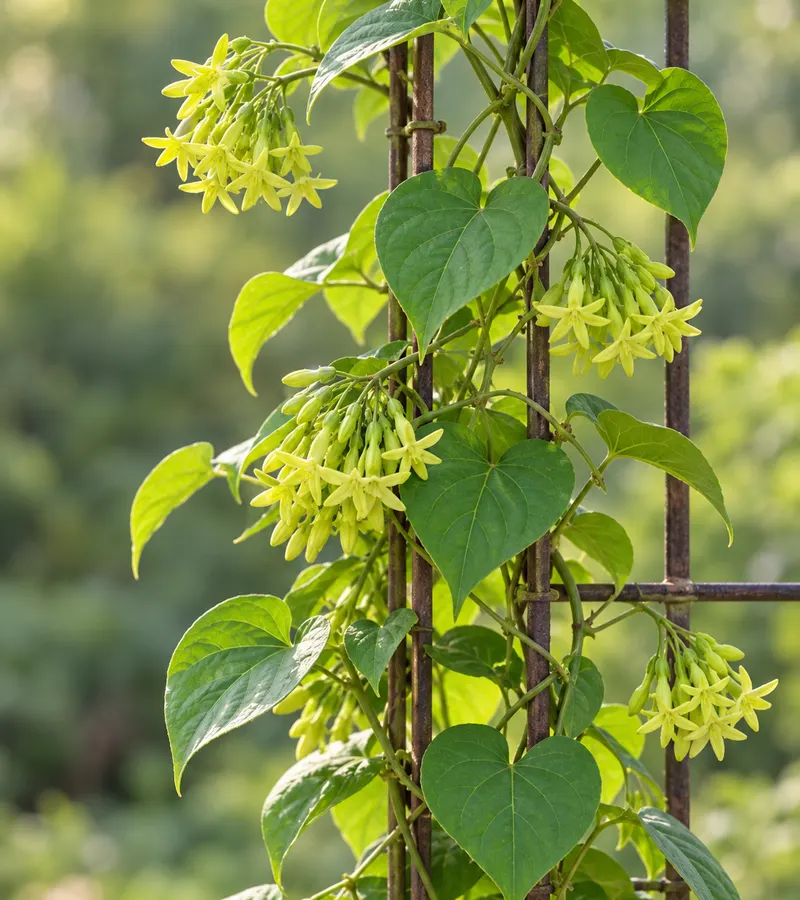
Lightly scented yellow-green flowers on a trellis, eaten stir-fried as a country dish.
Care and placement
Needs 4–6 hours of direct sun (or 6–8 hours of bright indirect light), loose well-drained soil and a sturdy trellis; no waterlogging; the fragrant flowers are edible (stir-fried or in soup).
Draft mature dimensions
Maximum height (cm): 500 cm · Maximum spread (cm): 300 cm
Things to consider
The flowers are eaten cooked (stir-fried or in soup; NParks Singapore); Wikipedia notes the vine is considered poisonous to pigs. Eat only cooked flowers of the correctly identified species, not leaves, stems or seeds, and do not self-medicate.
How to grow and care for it
Planting and pot
Plant in sun in loose, well-drained loamy soil; erect a sturdy trellis, mesh or arch since it climbs fast, up to 10 m. A large pot with a small trellis also works.
Light
Needs sun to flower: 4–6 hours of direct sun (or 6–8 hours of bright indirect light); it will not bloom in shade; reflected heat from concrete can scorch leaves.
Watering
Likes even moisture while growing (one source: about two deep waterings a week), less when cool; tolerates some drought but not waterlogging.
Feeding
Fairly undemanding and grows well with little feeding; a balanced fertilizer monthly (NParks) gives a fuller plant.
Pruning
Prune regularly for airflow and to keep it around 1.5 m for easy picking (NParks); remove old and tangled vines.
Propagation
Semi-woody cuttings about 30 cm with 3–5 nodes in winter or spring, kept shaded until new growth; seed also works (let pods dry on the plant, then split them). Thin stem tips can rot, so plant a few spare cuttings.
Pests and common problems
Prone to mealybugs and whiteflies, also aphids and spider mites; ants visit the nectar. Use insecticidal soap or neem and keep good airflow.
For a bigger harvest
For many flowers to pick: enough sun, a sturdy trellis, steady watering, light monthly feeding, and pruning to a pickable height with good airflow. Flowers open in the evening; pick freshly opened ones for cooking.