
Pink trumpet tree
Tabebuia rosea
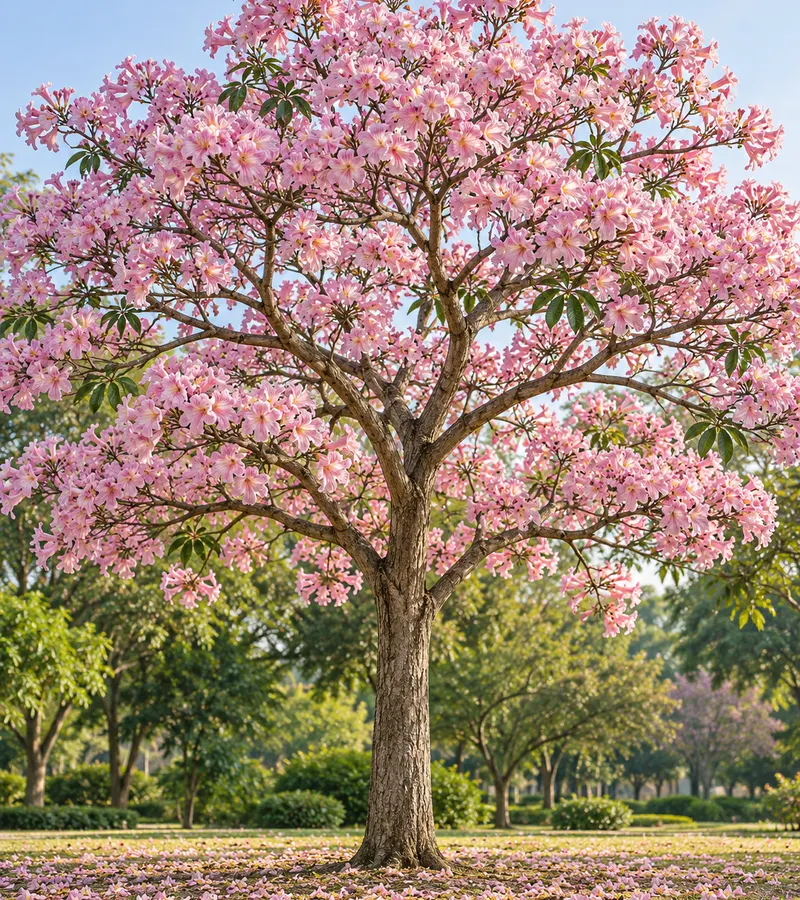
Pale pink trumpet flowers cover the nearly leafless branches; the branches are brittle, so it needs a roomy, sheltered spot.
Care and placement
Needs full sun, well-drained soil and regular watering while young; fairly drought-tolerant and tolerant of salt spray, but the branches break easily in strong wind, so give it a roomy, sheltered site.
Draft mature dimensions
Maximum height (cm): 1200 cm · Maximum spread (cm): 1000 cm
Things to consider
No source lists this tree as poisonous, but there is no safety rating for people or pets, so it is not claimed safe. Branches snap easily in storms, pods and winged seeds fall in numbers, and it can become weedy in some places; do not stand under the crown in strong gusts.
Sources to cross-check
Kew Plants of the World Online · Tabebuia roseaPlants For A Future · Tabebuia roseaWikipedia · Tabebuia roseaNParks Flora & Fauna Web · Tabebuia roseaArboriculture & Urban Forestry · Probability of damage to sidewalks and curbs by street trees in the tropicsCảnh quan · Kèn hồng (Tabebuia rosea)Eva · Cây kèn hồng: đặc điểm, ý nghĩa và cách trồngHow to grow and care for it
Planting and pot
Choose a sunny, well-drained, roomy and wind-sheltered spot: PFAF suggests 9-12 m between trees and Singapore's NParks lists 18 m. A street-tree study in Mérida, Mexico, put this species among those that crack pavement at small to moderate sizes, with higher risk nearer the kerb, so the safe distance from buildings, pipes, pavement and overhead lines needs a site survey because no source gives a figure. The planting hole can be mixed with about 0.5 kg of well-rotted manure. Planting on public land needs the owner's or authority's permission.
Light
Needs full sun; PFAF says it cannot grow in shade. It does best at about 22-30 °C and tolerates up to about 34 °C average daytime temperature, but it is frost-sensitive, so it is not for cold highland sites.
Watering
Water young trees daily in the early morning or cool evening, following a Vietnamese growing guide, keeping soil moist but not soggy. Established trees are fairly drought-tolerant and suit about 1,500-2,000 mm of rain a year; they need good drainage, and long waterlogging harms the roots.
Feeding
PFAF says it succeeds in most fertile soils at about pH 5.5-7. Mix well-rotted organic matter into the planting hole; a Vietnamese guide feeds diluted fertiliser weekly once young trees reach about 30 cm, while mature trees need only a light feed as the sources give no schedule.
Pruning
No source gives a pruning schedule. Because the branches are brittle, shape the tree while young to one main trunk with sturdy scaffold limbs and remove dead, broken and crossing branches; cut limbs that touch structures or wires early and use a qualified crew near power lines.
Propagation
Propagate by seed, cuttings or air layering. PFAF advises sowing seed as soon as it is ripe, with germination usually in 3-4 days, and Wikipedia reports nearly 100% germination. Seed-grown trees can flower after about 3 years.
Pests and common problems
The branches are brittle and break in strong wind or typhoons, so keep it out of exposed sites and away from walkways and car parks. It sheds all its leaves in flowering season, and flowers, pods 7-35 cm long and wind-blown winged seeds fall, so pavements and gutters need sweeping; PFAF warns it can sometimes be invasive. Roots may crack pavement when planted close to a kerb. A Vietnamese guide notes insects nesting in the trunk, treated by spraying the trunk or spreading lime round the base. No source mentions pollen or scent causing allergies.
For more flowers
For plentiful pink flowers: enough sun, good drainage, regular water while young, not too much nitrogen and a spot with little wind so branches survive. Flowers cover the leafless branches; timing varies by place, with Vietnamese sources giving roughly January to June.