
Satin pothos
Scindapsus pictus
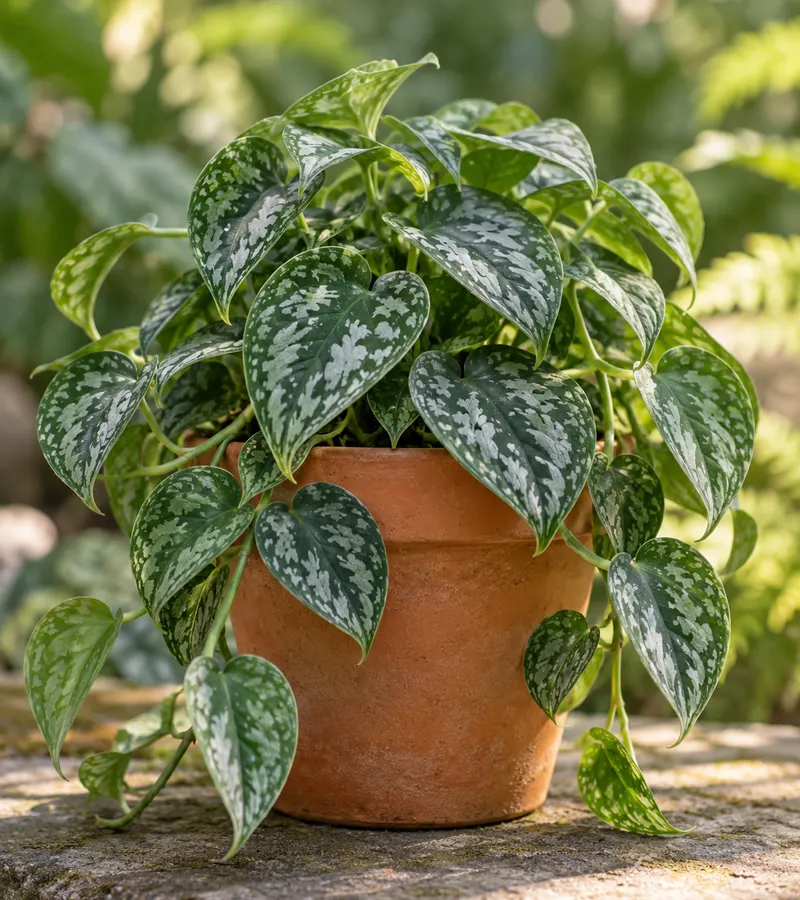
Deep green leaves splashed with silver drape gently over a shelf edge.
Care and placement
Prefers bright indirect light and 40–60% humidity and tolerates drought fairly well; let the top 3–4 cm dry before watering.
Draft mature dimensions
Maximum height (cm): 150 cm · Maximum spread (cm): 80 cm
Things to consider
Toxic to dogs, cats and horses through insoluble calcium oxalates: burning mouth, drooling, vomiting, difficulty swallowing (ASPCA). Keep pets and children from chewing leaves.
How to grow and care for it
Planting and pot
Plant in a draining pot with an airy aroid mix (bark, perlite, peat). Give a stake to climb or use a hanging pot or high shelf for trailing.
Light
Bright indirect light. It tolerates lower light but long-term loses its silver variegation and gets gaps between leaves. Harsh sun burns leaves.
Watering
Let the top 3–4 cm dry, then water until it drains and empty the saucer; less in cool months. Do not mist leaves (fungal and bacterial risk); use a pebble tray or humidifier if air is dry.
Feeding
A light feeder: balanced liquid fertilizer at half strength every 6–8 weeks in warm months; stop in cool months. Excess burns leaf tips.
Pruning
Cut long vines just above a node for a fuller plant; remove yellowed or damaged leaves.
Propagation
Cut just below a node with a leaf above it; root in water, sphagnum or moist mix at about 22–25 °C. Roots form in 3–6 weeks. A cutting without a node rots instead of rooting; when planting, bury the node 2–5 cm deep.
Pests and common problems
Spider mites in dry air (fine webs): raise humidity and rinse with a strong spray; use insecticidal soap or neem if severe. Aphids and scale can appear; fungus gnats when the surface stays wet; brown spots with yellow halos mean bacterial leaf spot.
For plentiful, healthy leaves
For dense, well-marked leaves: keep bright indirect light, steady humidity, light feeding on schedule and pinch tips for bushiness.