
Burma padauk
Pterocarpus macrocarpus
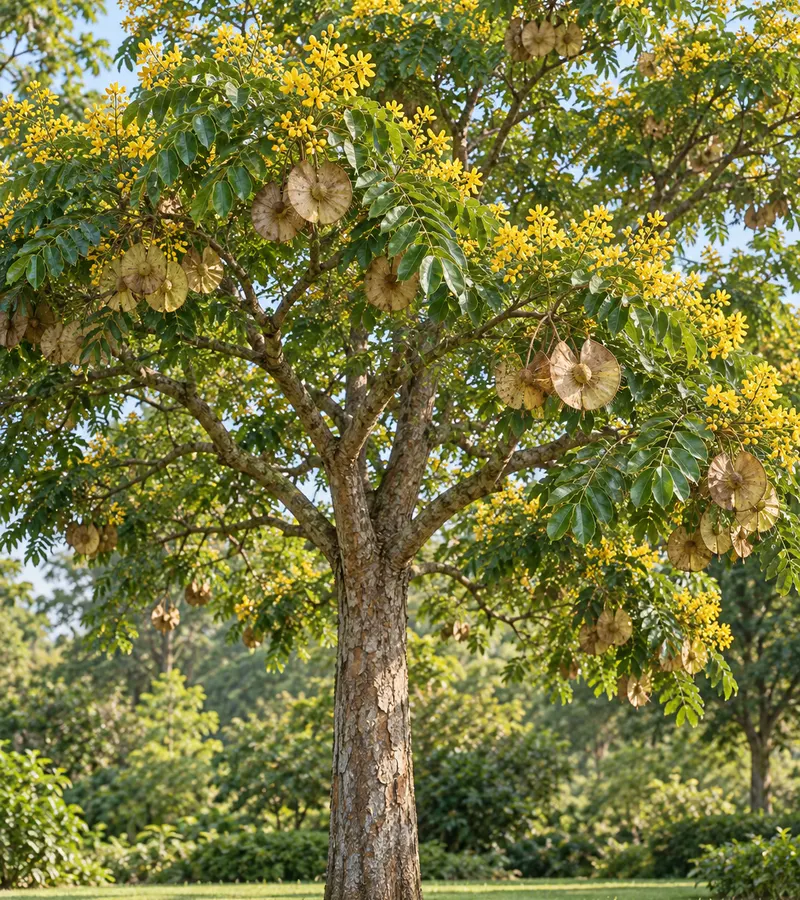
A large deciduous tree that sheds its leaves in the dry season, bearing fragrant yellow flower clusters and flat round winged pods.
Care and placement
Needs sun, deep well-drained soil and a lot of room; sheds its leaves in the dry season; frost tender; stake young trees and give nursery seedlings light shade; propagate from seed.
Draft mature dimensions
Maximum height (cm): 2000 cm · Maximum spread (cm): 1500 cm
Things to consider
The sources checked record no toxicity (Useful Tropical Plants lists no known hazards) but there is no official rating, so it is not claimed safe; do not eat it or use it as medicine, and keep children and pets from chewing it. The bark releases a red gum when cut that can stain clothes and hands (Wikipedia, Vietnamese Wikipedia). It is a very large tree, so falling limbs or a falling tree are real risks near roads and houses.
Sources to cross-check
Kew Plants of the World Online · Pterocarpus macrocarpusWikipedia (Vietnamese) · Giáng hươngWikipedia · Pterocarpus macrocarpusUseful Tropical Plants · Pterocarpus macrocarpusKỹ thuật trồng Giáng hươngCây giáng hương, loài cây được trồng nhiều tại Việt NamTổng quan về cây giáng hươngHow to grow and care for it
Planting and pot
Plant only where there is plenty of room: the sources give a height of 10–30 m and a trunk up to about 1.7 m (Vietnamese Wikipedia) with an umbrella-shaped crown (giongcaytrongdacsan.vn), but none measures canopy width or root depth. So the safe distance from buildings, buried pipes, pavements and overhead lines has to come from a site survey. Dig a hole 30–40 cm wider than the root ball and stake young trees against wind (hoadepviet.com); giongcaytrongdacsan.vn uses a 30 × 30 × 30 cm hole dug 15–20 days ahead and 6-month-old seedlings at least 50 cm tall. Planting on public land needs permission from the tree authority or the land owner. It is not frost tolerant, tolerates roughly 8–44 °C (Useful Tropical Plants) and grows wild in Vietnam at 100–800 m, so it suits warm lowlands better than cold highlands.
Light
It is a light-loving tree and grows best in a sunny position (Useful Tropical Plants; hoadepviet.com). In the nursery, seedlings get 50% shade for the first 3 months and 25% afterwards (giongcaytrongdacsan.vn), then move to full sun. The tree sheds its leaves in the dry season.
Watering
It grows in dry open forest with hot dry weather and tolerates drought well (caycanhsaigon.life), with a preferred rainfall of about 1,500–2,500 mm a year (Useful Tropical Plants). Water young trees regularly until established, then only top up in very long dry spells; do not let water stand, since it needs well-drained soil (giongcaytrongdacsan.vn).
Feeding
Useful Tropical Plants says the roots form nitrogen-fixing nodules and the tree grows on poor soil, so it needs little feeding. At planting, giongcaytrongdacsan.vn uses about 150 g of organic microbial fertiliser per hole; in the nursery it uses NPK 6:1:3 at 1–2% in the first 5 months. Afterwards, rotted organic matter around the edge of the canopy is enough when the tree looks weak.
Pruning
The bole is usually straight and unbranched for the first 7.5 m (Useful Tropical Plants). Just remove dry or pest-damaged branches when needed (caycanhsaigon.life) and stake young trees. The sources give no pruning guidance specific to street trees; leave pruning of large trees or trees near power lines to licensed crews.
Propagation
Propagate by seed: collect pods when they turn brown, dry them in the sun for 3–4 days and extract the seed (giongcaytrongdacsan.vn); seed can be sown untreated or soaked in warm water at 35–40 °C for 12–24 hours to speed germination, with germination around 64–70% (Useful Tropical Plants). Pot seedlings up when true leaves appear and plant out at about 1 year old and about 30 cm tall (Useful Tropical Plants). The tree also regenerates from shoots (Vietnamese Wikipedia). Open-grown trees flower after 5–10 years (Useful Tropical Plants).
Pests and common problems
The sources checked name no specific pests or diseases. In a city, the tree is very large and sheds its leaves in the dry season, so expect leaf litter; the flat round winged pods, 4.5–7 cm across, fall after ripening (Vietnamese Wikipedia). No source discusses surface roots lifting pavements, storm toppling, branch failure or allergenic pollen, so each site needs a survey before planting; the flowers are mildly fragrant (caycanhsaigon.life). The species is IUCN Endangered because of over-harvesting for timber (Vietnamese Wikipedia, Wikipedia), so buy only nursery-raised plants from legitimate growers and never take plants or seed from natural forest.
For more flowers
For more flowers: give full sun, deep well-drained soil and enough time, since open-grown trees usually flower after 5–10 years (Useful Tropical Plants). The fragrant yellow flowers open in clusters, typically around January to April (hoadepviet.com) or about April in Myanmar (Wikipedia), depending on the region.