
Yoshino cherry
Prunus × yedoensis
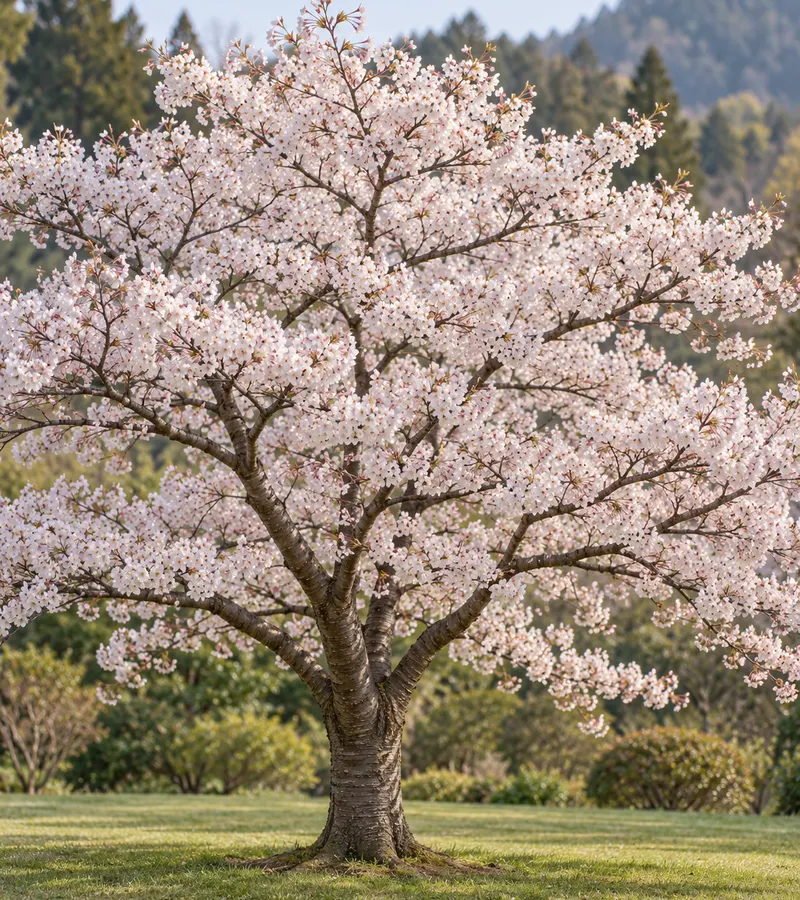
A cherry with pale pink-white flowers before its leaves; it needs a cold winter to flower well, so it suits cool highlands rather than Vietnam's hot lowlands.
Care and placement
Needs full sun and moist, well-drained soil, and dislikes both drought and waterlogging. It flowers well only after a sufficiently cold winter: a Vietnamese nursery says it suits highlands such as Sa Pa, Mộc Châu, Đà Lạt and Măng Đen and some northern provinces, while in the south it often flowers little or not at all. Leaves, stems and seeds are toxic to dogs, cats and horses.
Draft mature dimensions
Maximum height (cm): 1000 cm · Maximum spread (cm): 1000 cm
Things to consider
ASPCA lists the cherry genus (Prunus) as toxic to dogs, cats and horses: stems, leaves and seeds contain cyanide-forming compounds, and wilted leaves are especially dangerous; NC State also tags the plant as a problem for dogs, cats and horses. The sources do not rate it separately for children, so do not let children chew seeds, leaves or twigs and do not eat the fruit. The small black fruit drop and make a mess, and the red juice can stain clothing.
Sources to cross-check
Kew Plants of the World Online · Prunus × yedoensisNC State Extension Plant Toolbox · Prunus × yedoensisUtah State University Extension · Yoshino cherryASPCA · Cherry (Prunus spp.)Hoa Anh Đào Nhật Bản · Những loại hoa anh đào Nhật trồng hợp ở Việt NamHoa Anh Đào Nhật Bản · Hoa anh đào Yoshino SakuraBonsai Wonderland · Flowering cherry for warm climates (zone 8b)Wikipedia · Prunus %C3%97 yedoensisHow to grow and care for it
Planting and pot
Plant in full sun in loose, well-drained soil; USU says it tolerates poor drainage badly. A nursery in Hải Dương advises a hole 1–2 m wide and 50–70 cm deep, soil mixed 1:1 with organic matter, the root mound left 20–30 cm above ground, staked and mulched; this is commercial advice. The tree reaches about 9–12 m with a 6–15 m spread and is not suited under power lines; distances from buildings, paving and buried pipes need a site survey because the sources do not give them. Planting on public land needs permission from the owner or the tree-management authority.
Light
Needs full sun: USU says full sun prevents reduced flowering and the tree has low shade tolerance; NC State lists full sun to part shade. It prefers cool conditions, and one nursery gives an ideal temperature below 35 °C; in hot lowlands, strong sun does not make up for the missing cold season.
Watering
Keep the soil evenly moist but draining: USU says the tree likes moisture, is sensitive to drought and tolerates poor drainage badly. The nursery advises watering once or twice a day for the first 1–2 weeks, then keeping the soil moist in the dry season and avoiding standing water in the rainy season. A badly drained planting hole invites root rot and fungal disease.
Feeding
The scientific sources consulted give no feeding schedule. A Vietnamese nursery advises about 5–6 kg of organic fertiliser per tree every 1–2 months and one phosphate feed while the tree is leafless (December to February); this is commercial advice, so use less on small trees and follow the product label.
Pruning
The sources give no pruning schedule. The usual practice for a flowering tree is to remove only dead, broken or diseased wood and shape the crown while young, doing it after the flowers fade so next year's buds are not cut off. NC State records susceptibility to borers, scale, and fungal and viral disease, so keep cuts clean and clear diseased wood away.
Propagation
Yoshino cherry is a hybrid and NC State describes it as a grafted tree, so the surest route is a grafted nursery tree rather than seed, because seedlings are unlikely to match the parent. A grafted tree grows quickly but still needs a cold season to flower reliably.
Pests and common problems
Flowering depends on a cold season: temperate sources say Japanese cherries need many winter hours below about 7 °C to break dormancy, that in mild winters they bloom sparsely or not at all, and no source gives a chill figure for Yoshino itself. In Vietnam, one nursery says it grows in many northern provinces and highlands but flowers little or not at all around Ho Chi Minh City, Đồng Nai and Cần Thơ. NC State records viral and fungal disease, borers, scale, messy fruit and high maintenance; USU says it is not suited near streets or car parks because it is drought sensitive, while NC State calls it a good street tree; the nursery adds leaf-eating caterpillars, root galls and leaf spot in the rainy season. The sources say nothing about typhoon wind.
For more flowers
For plentiful flowers: plant where the winter is genuinely cold (in Vietnam mainly highlands or some northern provinces), give full sun, well-drained soil and even watering, and avoid both waterlogging and drought. The white to pale pink, lightly scented flowers open in clusters of 5–6 on the bare branches and last about 2–3 weeks; do not expect blossom in hot lowlands that never turn cold.