
Mast tree
Polyalthia longifolia
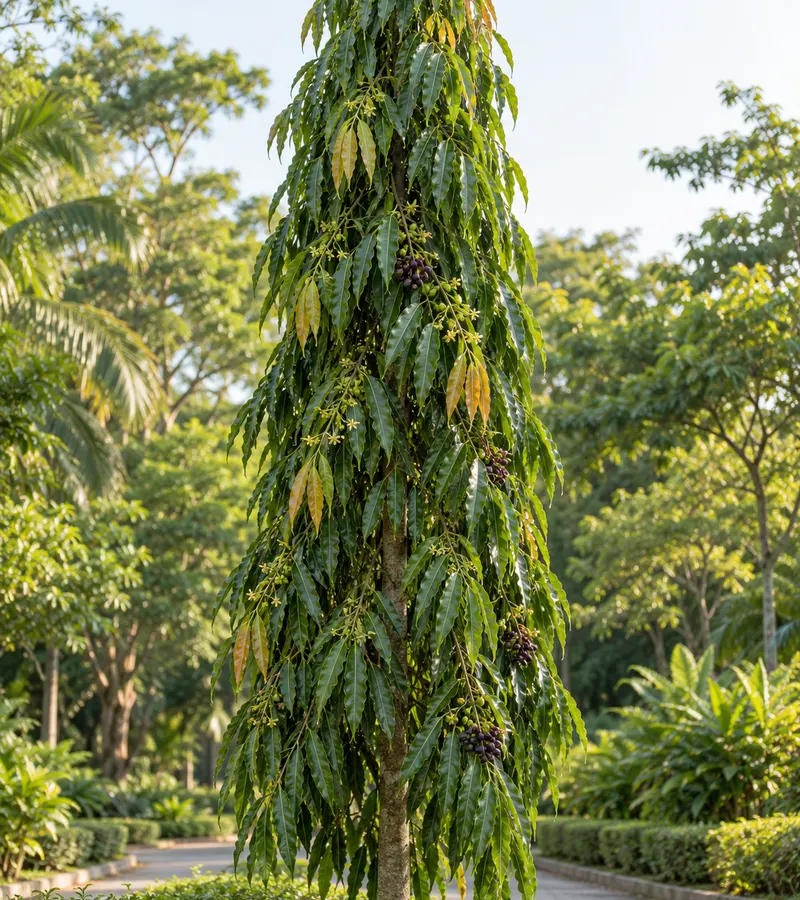
A narrow columnar tree with long drooping wavy-edged leaves, suited to rows in tight spaces such as medians and walkways.
Care and placement
Needs full sun, fertile well-drained soil and moderate watering, and is drought tolerant once established; usually 8–12 m tall with a narrow crown, frost-sensitive and poor at tolerating salt; propagated by seed, cuttings or air layering. Many sources now give the scientific name as Monoon longifolium.
Draft mature dimensions
Maximum height (cm): 1000 cm · Maximum spread (cm): 200 cm
Things to consider
The sources consulted give no toxicity or allergenic-pollen information, so the tree is not claimed safe; keep children and pets from chewing it. The fruits ripen in fleshy clusters that attract birds and fruit bats, so they and droppings may foul the ground below. No source rates the wind tolerance of the slender trunk, so check it after storms. Planting or pruning on public land needs the authority's permission.
Sources to cross-check
Kew Plants of the World Online · Polyalthia longifoliaNParks Flora & Fauna Web · Monoon longifolium (Polyalthia longifolia)Botanical garden profile (pslbg.org) · Mast tree 'Pendula'Top Tropicals · Polyalthia longifolia (telegraph pole tree)eFlora of India · Monoon longifoliumWikipedia · Monoon longifoliumChính phủ · Nghị định 64/2010/NĐ-CP về quản lý cây xanh đô thịHow to grow and care for it
Planting and pot
The tree is usually 8–12 m tall but narrow, so it fits tight spots such as medians and walkways; hedge or screen plantings are spaced 1.2–1.8 m apart, while the distances to buildings, pavements, pipes and overhead lines must come from a site survey (the decree requires the electricity safety corridor to be kept). Choose fertile, well-drained, slightly acidic to neutral soil; the sources consulted do not describe the roots. Planting on a pavement or public land needs the tree authority's permission.
Light
Two sources recommend full sun, and one says the tree also tolerates partial shade. For a row along a street, pick spots that get sun through most of the day rather than places shaded by tall buildings.
Watering
Water regularly until the tree is established, after which it is quite drought tolerant and needs only moderate watering. Use well-drained soil, and one source advises letting the topsoil dry slightly between waterings rather than keeping it constantly wet.
Feeding
The sources consulted give no specific fertiliser schedule. Mix well-rotted compost into the soil at planting and mulch to keep moisture steady; fertile soil is what the tree prefers.
Pruning
The narrow pyramid with drooping branches is natural, so little shaping is needed; remove only dead, damaged or diseased growth. The sources consulted give no specific pruning guidance. If the tree reaches 10 m or taller on public land, pruning needs a permit under the decree.
Propagation
Propagate by seed, stem cuttings or air layering. For seed, let the fruit become overripe and remove the pulp before storing it. The fruit turns from yellowish green to purple-black, and each holds one large light brown seed.
Pests and common problems
One source lists no pests or diseases of strong concern, but the tree is very sensitive to frost and poor at tolerating salt, so it suits neither frost-prone sites nor the seafront. In a city, the fleshy fruits in clusters of about 20, 2–2.5 cm across, attract birds and bats so fruit litter and droppings fall beneath the crown; the tree is tall for its width, so check it after storms. The sources consulted do not report a strong scent or allergenic pollen.
For plentiful, healthy leaves
For a neat pyramid of long, glossy, wavy-edged leaves: plant in full sun in fertile well-drained soil, water steadily at first and space rows evenly. The coppery or pale yellow new leaves turning dark green are the tree's highlight.